
Is It Safe to Eat Chicken Thighs Defrosted in the Microwave?
You can safely eat chicken thighs thawed in the microwave, but only if you follow strict steps to avoid uneven heating and bacterial growth.
Use the microwave’s defrost setting, remove any store packaging, rotate or flip the pieces during thawing, and cook the chicken immediately after it thaws.
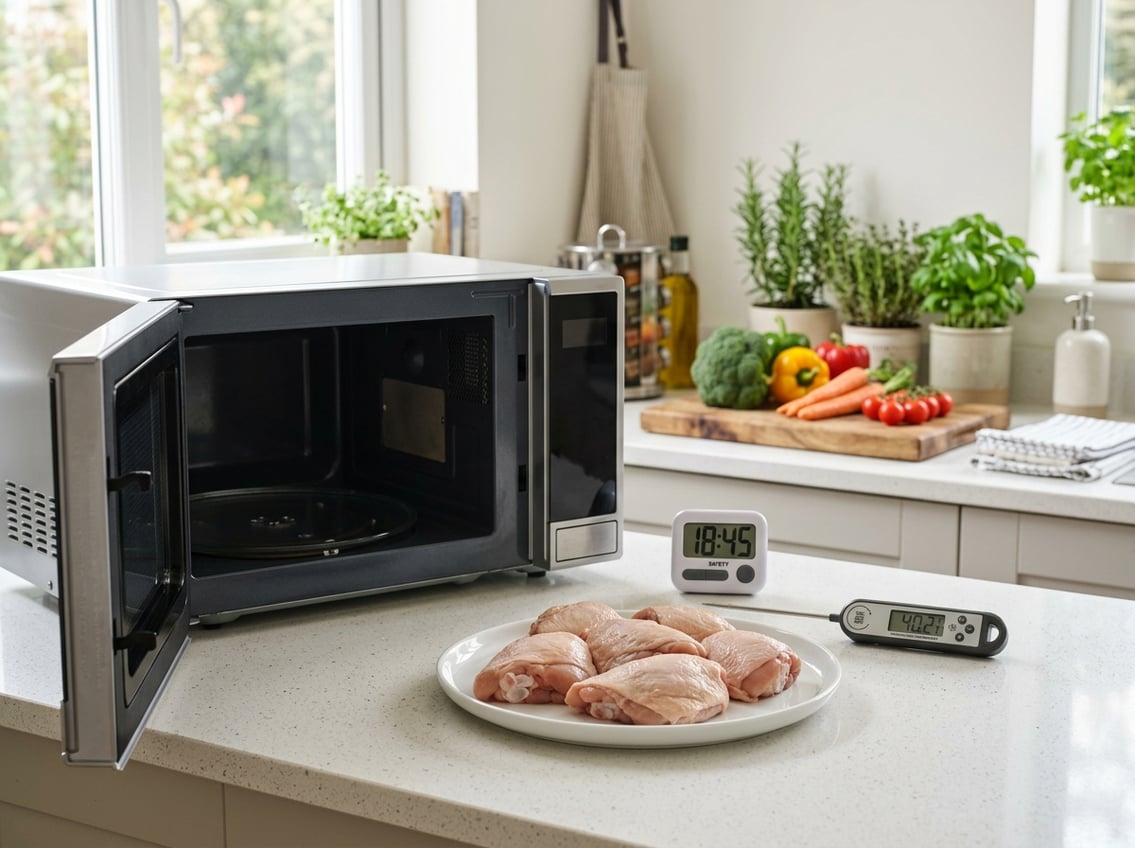
Microwave defrosting works quickly but requires careful setup and constant attention to prevent partial cooking and bacterial risk.
Use a flat, microwave-safe dish, set the correct power or defrost mode, and check and rotate the pieces often.
Microwave Defrosting Basics
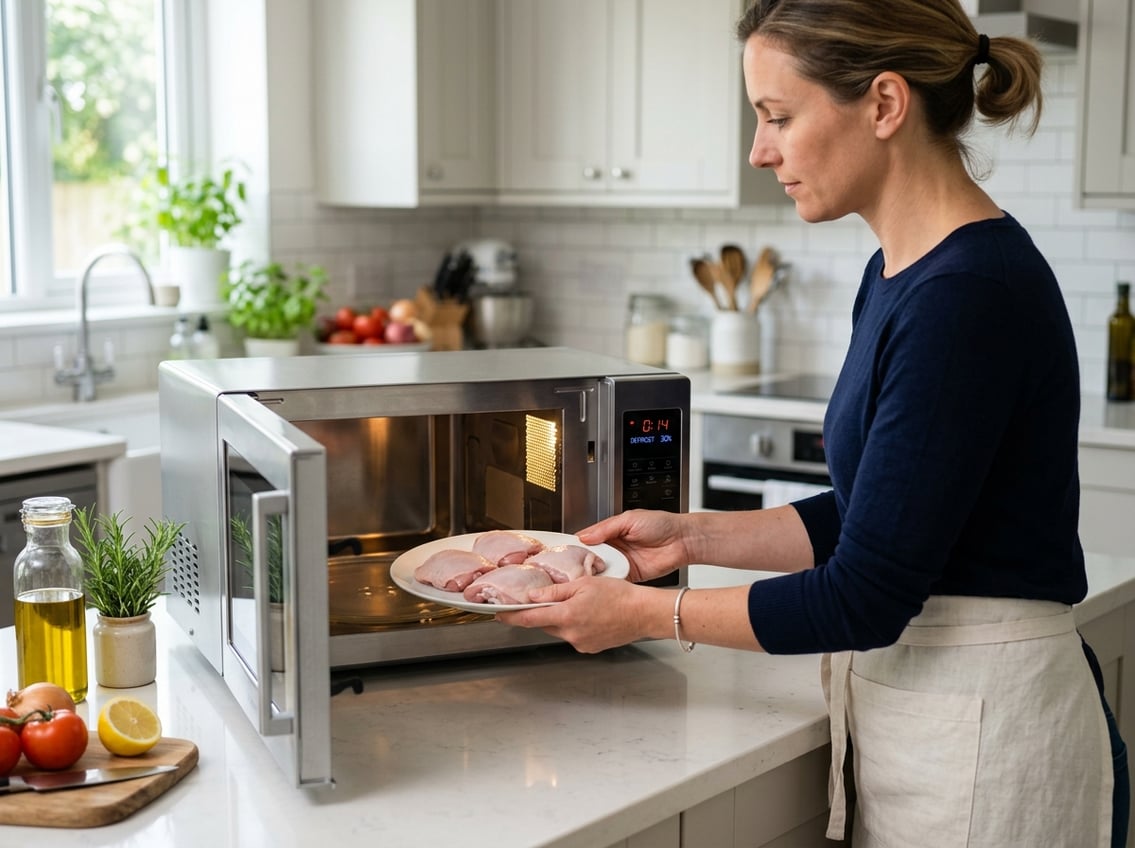
Microwaves heat food by agitating water molecules.
Frozen chicken thighs thaw where moisture absorbs energy first, so warm spots form around edges while thicker centers can stay frozen.
You need to monitor progress every 30–60 seconds for small pieces and every 1–2 minutes for larger thighs.
Stop when the meat is pliable but still cool to the touch in the center.
Cook the chicken immediately after microwaving to kill any bacteria that may have multiplied in warmer areas.
Microwave-Safe Dish and Setup
Use a shallow, microwave-safe glass or ceramic dish large enough to hold thighs in a single layer.
This prevents stacking, which causes uneven thawing.
Avoid plastic unless it’s labeled microwave-safe.
Remove thin retail packaging before microwaving.
Place a paper towel under the thighs to catch drips and reduce splatter.
Arrange thighs spaced apart with the thicker ends toward the center if your microwave has a turntable.
If your microwave lacks a turntable, pause and rotate the dish every 30–60 seconds to promote even thawing.
Defrost Setting and Power Level
Select the microwave’s defrost function or set power to about 30 percent.
Defrost settings cycle power to reduce cooking while delivering energy to thaw.
Refer to your microwave’s manual for specific timings.
Use time increments based on weight: roughly 2–5 minutes per pound as a starting point.
Check frequently.
If edges begin to warm or cook, pause and allow residual heat to even out, or finish thawing with cold water in a sealed bag.
Always cook defrosted chicken thighs immediately.
Do not refreeze raw meat thawed in the microwave.
Safety Guidelines for Defrosting Chicken Thighs in the Microwave
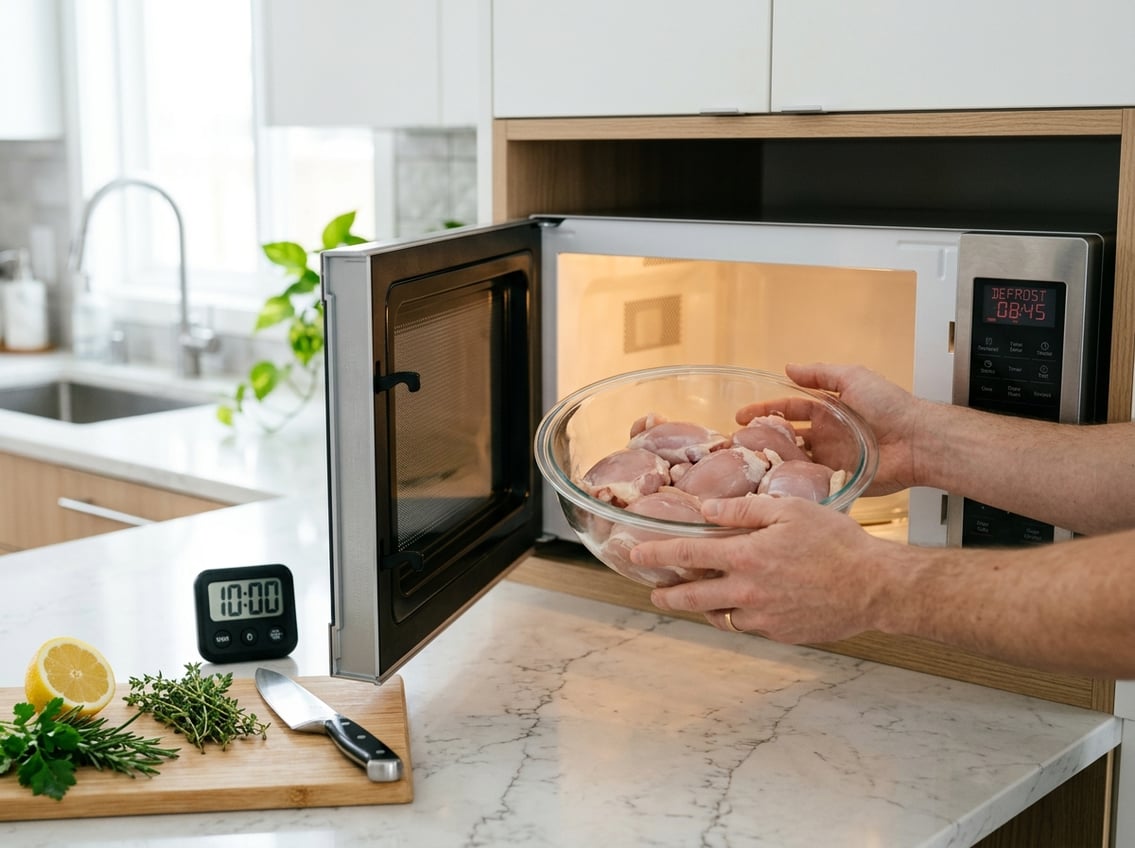
Follow specific steps, cook immediately after thawing, and manage microwave settings to avoid uneven thawing and bacterial growth.
Use a food thermometer and handle the thighs on clean surfaces to limit cross-contamination.
Steps to Defrost Chicken Safely
Remove packaging that is not microwave-safe and place the thighs on a microwave-safe plate or shallow dish.
Arrange thighs in a single layer and cover loosely with microwave-safe plastic wrap or a microwave-safe lid to retain moisture while allowing steam to escape.
Select your microwave’s defrost setting or set power to 30 to 50 percent and enter weight.
Pause every 1–2 minutes to rotate or flip pieces and separate any portions that are stuck together.
Monitor closely so edges don’t begin to cook.
After thawing, check internal temperature in the thickest part with a food thermometer.
Plan to cook immediately.
Clean surfaces and utensils that touched raw chicken to prevent cross-contamination.
Immediate Cooking After Thawing
Cook chicken thighs immediately after microwave thawing because parts can reach temperatures that favor bacterial growth.
Bacteria multiply quickly between 40°F and 140°F.
Leaving thawed chicken at room temperature increases risk.
Transfer thighs straight to the oven, stovetop, or grill.
Do not refreeze unless you cook them first.
If any portions started to cook during defrosting, continue cooking until the internal temperature reaches 165°F measured with a calibrated food thermometer.
If you cannot cook right away, refrigerate immediately and use within one day.
Avoid holding partially thawed or partially cooked chicken for later use.
Preventing Uneven Thawing
Uneven thawing can leave partially cooked edges and still-frozen centers.
To reduce this, spread pieces apart and use shorter defrost intervals with frequent checks and rotation.
Use lower power settings and check every 30–90 seconds to separate and reposition thighs.
If small frozen cores remain after most of the meat is pliable, let the thighs rest covered for 5–10 minutes.
Retained heat will finish gentle thawing more evenly.
If your microwave lacks a reliable defrost function or the thighs are large and bone-in, use cold-water thawing in a leak-proof bag as an alternative.
Risks Associated With Microwave Thawing
Microwave thawing saves time but introduces hazards: uneven thawing that creates warm pockets, partial cooking that allows bacteria to survive, and handling steps that can spread contamination.
Each risk requires concrete actions such as temperature checks, immediate cooking, and careful sanitation to keep chicken thighs safe.
Bacterial Growth Concerns
Microwaves often thaw edges faster than centers.
The outer layers can sit above 40°F while the core stays frozen.
Those warm outer areas enter the bacterial danger zone, where Salmonella and Campylobacter multiply quickly.
You increase risk whenever any part of the thigh stays in these temperatures for more than two hours total.
To prevent bacterial growth, keep thawed thighs refrigerated or cook them immediately.
If you must hold them briefly, keep them below 40°F.
Use a food thermometer to measure internal temperatures before cooking if you suspect uneven thawing.
Do not rely on touch or appearance.
Dangers of Partially Cooked Chicken
Microwave thawing can partially cook small spots while other areas remain frozen.
Partial cooking lets surface bacteria survive and multiply between thawing and final cooking.
If you later cook the thighs unevenly, some bacteria may not reach 165°F.
Always cook thighs immediately after microwave thawing.
If the microwave begins to cook any part, proceed directly to cooking and use a food thermometer to verify the thickest part reaches 165°F.
Do not reheat partially cooked meat later.
Once partial cooking occurs, treat the meat as ready-to-cook only and do not interrupt the process.
Handling Thawed Chicken Thighs
After microwave thawing, prevent cross-contamination.
Place thighs on a clean, microwave-safe dish before thawing and transfer them to a sanitized cutting board for seasoning or finishing.
Wash hands for at least 20 seconds after touching raw or thawed chicken.
Sanitize any surfaces and utensils that contacted the meat.
If you plan to store thighs briefly before cooking, refrigerate immediately in a shallow container to cool evenly and keep the internal temperature below 40°F.
If you note any warm spots, cook immediately rather than refreezing.
Thawed chicken should not be returned to the freezer unless it has been cooked first.
Use a food thermometer during cooking to confirm safety.
Recommended Alternatives to Microwave Defrosting
Use methods that keep chicken thighs at safe temperatures and avoid partial cooking.
Plan ahead for refrigerator thawing or use cold water thawing when you need faster results.
Both require immediate or timely cooking afterward.
Refrigerator Thawing
Move frozen chicken thighs from the freezer to the coldest part of your refrigerator, still in their original packaging or in a sealed container.
Allow roughly 24 hours per 1–2 pounds.
Small packages or individual thighs usually thaw within a day.
Keep the refrigerator at 40°F or below to prevent bacterial growth.
Place the thighs on a tray or plate to catch any drips and store them on the bottom shelf to avoid cross-contamination with ready-to-eat foods.
Thawed chicken thighs will stay safe for 1–2 days before cooking.
If you need to refreeze without cooking, you can do so only if the thighs remained continuously refrigerated while thawing.
Expect a small loss of texture but no food-safety risk when done correctly.
Cold Water Thawing
Seal the chicken thighs in a leak-proof plastic bag to prevent water contact and bacterial contamination.
Submerge the bag in a bowl or sink of cold tap water.
Change the water every 30 minutes so the surface stays cold.
Estimate about 30 minutes per pound.
One to two thighs often thaw in an hour or less.
Cook the chicken immediately after it’s thawed.
Do not refrigerate again unless you cook it first.
Use this method when you need faster thawing but still want to keep the meat below danger-zone temperatures.
Tips for the Best Texture and Flavor
Plan defrosting so the meat stays cold and cooks evenly.
Use these tools and timings to avoid partially cooked edges, soggy flesh, or dry results.
Defrosting Chicken Thighs for Optimal Quality
Defrost chicken thighs in a way that keeps temperature low and moisture controlled.
For best quality, defrost chicken in the refrigerator: place thighs on a tray, uncovered or loosely covered, on the lowest shelf and allow 12–24 hours depending on quantity and thickness.
For faster safe thawing, use cold water in a leak-proof bag, submerge, and change the water every 30 minutes until pliable.
If you must use a microwave, use the defrost setting and rotate or flip thighs every 30–60 seconds to prevent hot spots.
Stop microwaving when pieces are still slightly icy in the center.
Finish cooking immediately to protect texture and limit bacterial growth.
Avoiding Texture Loss
Excess moisture and uneven heating cause mushy or dry chicken.
Pat thighs dry with paper towels before seasoning or searing.
Dryness at the surface gives better browning and a crisp skin.
If thighs feel waterlogged after thawing in water, let them drain on a rack for 10–15 minutes or blot gently to remove surface water.
Avoid partially cooking in the microwave.
That creates rubbery proteins and uneven texture.
When baking or pan-searing, bring thighs to near-room temperature only for 15–20 minutes maximum.
Longer leaves you in the bacterial danger zone and can produce uneven cooking.
Using a Food Thermometer for Safety
Use an instant-read food thermometer to ensure safe, consistent doneness.
Insert the probe into the thickest part of the thigh without touching bone.
Cook until the internal temperature reaches 165°F.
Hold for a few seconds to confirm the reading.
If you finish cooking from a partially thawed state, monitor temperature closely since cook times vary.
After microwave thawing, always cook immediately and check temperature in multiple spots on larger pieces to make sure you avoided cold centers.
Common Mistakes to Avoid When Thawing Chicken
Thaw chicken in ways that minimize time in the 40–140°F danger zone and prevent cross-contamination.
Use a proper container, avoid leaving poultry at room temperature, and handle refreezing only after correct cooling or cooking.
Not Using a Microwave-Safe Dish
Always remove store packaging and place the chicken on a microwave-safe dish before defrosting.
Thin plastic, cardboard, or non-microwave-safe containers can melt, warp, or leach chemicals when heated.
A ceramic or glass dish catches drips and prevents juices from spilling onto the microwave turntable.
Elevate the chicken slightly on a rack or folded paper towel so air can circulate and the microwave’s defrost setting works more evenly.
Rotate or flip the pieces every few minutes if your microwave has no turntable.
After microwaving, transfer the chicken to a clean plate.
Do not reuse the dish that held raw juices without washing it in hot, soapy water.
Leaving Chicken at Room Temperature
Do not thaw chicken on the counter or leave it at room temperature to defrost.
The surface of the meat can enter the bacterial growth danger zone long before the center thaws.
Kitchen counters typically stay above 40°F, which allows bacteria to multiply rapidly.
If you need a quick method, use the microwave or a sealed bag submerged in cold water, changing the water every 30 minutes.
Always cook microwave-thawed chicken immediately because parts may already warm into the danger zone.
Keep raw chicken on the bottom shelf of the fridge while thawing there to avoid dripping onto other foods.
Refreezing Thawed Chicken Incorrectly
Do not refreeze chicken thawed in the microwave or in cold water unless you cook it first. Microwaving and cold-water thawing can expose meat to temperatures that let bacteria grow.
If you freeze the chicken again without cooking, you preserve that risk and reduce quality. Refreezing also causes moisture loss, making thighs dry and less tasty after cooking.
If you thawed chicken in the refrigerator and kept it below 40°F, you can refreeze it within 1–2 days. Expect some changes in texture and flavor.
For chicken thawed by microwave or cold water, cook it to 165°F throughout before refrigerating or freezing leftovers. Label and date any refrozen portions to help track storage time and food safety.


