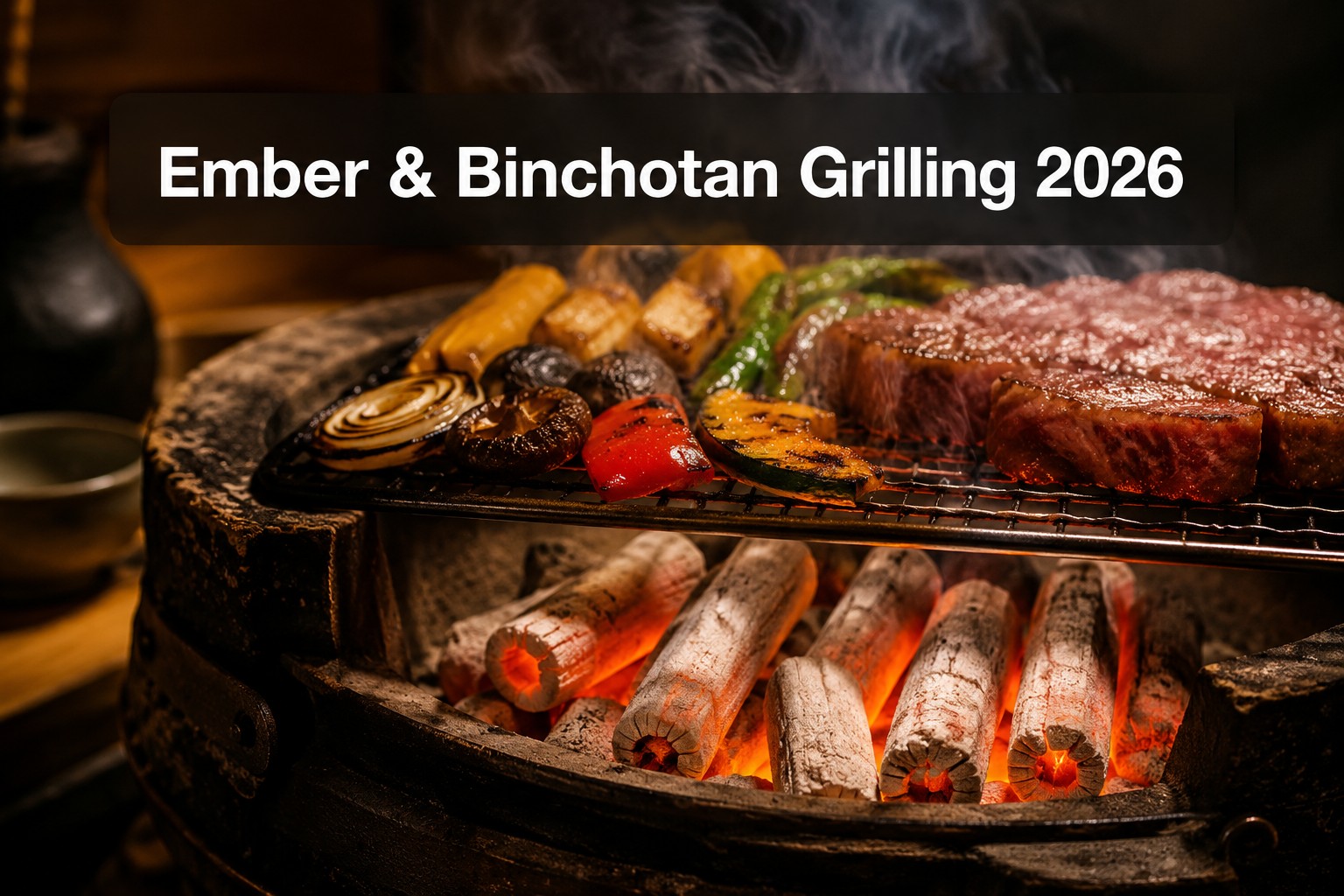
Ember and Binchotan Grilling: Home Techniques for 2026 Fire-Cooked Meats and Veggies
Last updated: July 12, 2026
Fire-cooked food has moved beyond basic charcoal grilling. Ember and Binchotan Grilling: Home Techniques for 2026 Fire-Cooked Meats and Veggies represents the next evolution in home cooking, where Japanese white charcoal and direct ember methods deliver restaurant-quality results with cleaner smoke and precise heat control. These techniques work in standard backyards and require no special equipment beyond the fuel itself.
Key Takeaways
- Binchotan charcoal burns hotter (up to 1,800°F) and cleaner than standard lump charcoal, producing minimal smoke and ash
- Ember grilling places food directly on hot coals for intense searing and smoky flavor, best for vegetables and quick-cooking cuts
- Binchotan costs $3-6 per pound versus $1-2 for lump charcoal but can be reused 3-4 times after extinguishing
- Lighting binchotan requires 30-40 minutes with a chimney starter or blowtorch; patience is essential
- Temperature control comes from adjusting coal density and distance, not airflow like standard grills
- Best meats for ember techniques include ribeye, short ribs, chicken thighs, and whole fish
- Common vegetable mistakes include under-charring delicate items and over-cooking dense vegetables
- Binchotan is not safe for indoor use without commercial ventilation due to carbon monoxide risk
What Is Binchotan Charcoal and How Is It Different from Regular Charcoal
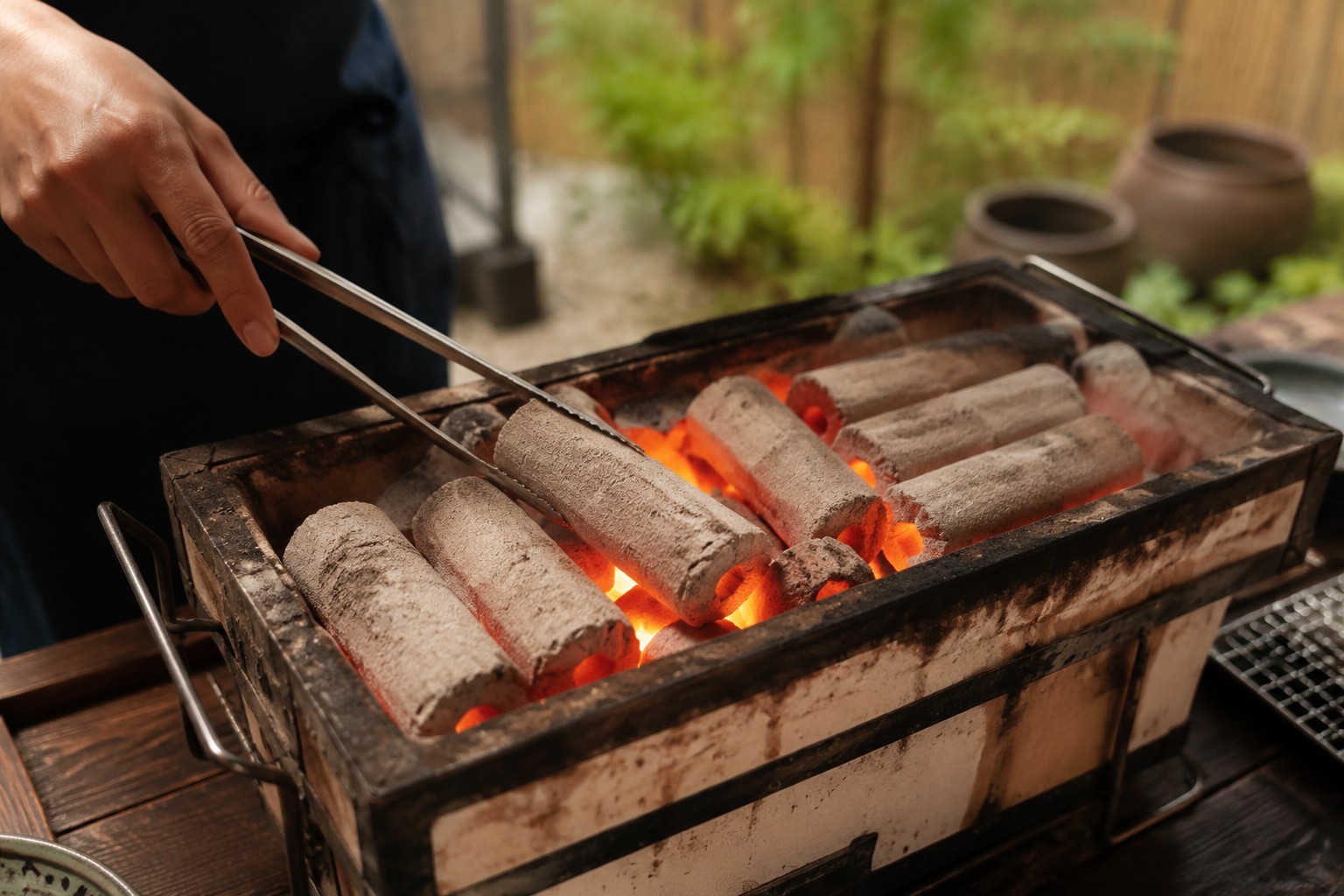
Binchotan is a premium Japanese white charcoal made from ubame oak, fired at extremely high temperatures (over 2,000°F) in low-oxygen kilns for weeks. This process creates a dense, almost metallic charcoal that burns significantly hotter and longer than standard briquettes or lump charcoal, with virtually no smoke or odor once lit.
Key differences from regular charcoal:
- Burn temperature: Binchotan reaches 1,500-1,800°F versus 800-1,200°F for standard lump charcoal
- Burn time: A single load lasts 3-5 hours compared to 45-90 minutes for regular charcoal
- Smoke production: Produces almost no visible smoke after ignition, unlike the heavy smoke from briquettes
- Ash content: Leaves less than 5% ash residue versus 15-20% for conventional charcoal
- Reusability: Can be extinguished and relit 3-4 times without significant performance loss
- Carbon content: 95%+ pure carbon versus 70-85% in standard charcoal
The high carbon purity means binchotan imparts minimal flavor to food, letting the natural taste of ingredients shine through. This makes it ideal for delicate fish, vegetables, and high-quality cuts where you want clean heat rather than heavy smoke. For comparison, mesquite or hickory lump charcoal adds distinct woody flavors that can overpower subtle ingredients.
Choose binchotan if you want precise temperature control, minimal cleanup, and pure ingredient expression. Choose standard lump charcoal if you prefer traditional smoky flavors and lower fuel costs for everyday grilling.
Ember Grilling vs Binchotan Grilling: Which One Should You Use at Home
Ember grilling and binchotan grilling are complementary techniques, not competing methods. Ember grilling refers to cooking food directly on or nestled into hot coals (any type), while binchotan grilling specifically uses Japanese white charcoal as the heat source, typically with food on grates above the coals.
Ember grilling works best for:
- Whole vegetables (onions, eggplant, peppers, sweet potatoes)
- Thick-cut steaks that benefit from aggressive crust development
- Whole fish wrapped in salt or leaves
- Flatbreads and tortillas for quick charring
Binchotan grilling excels at:
- Thin-sliced meats (yakiniku-style beef, pork belly)
- Delicate proteins (scallops, shrimp, white fish fillets)
- Vegetables requiring even, sustained heat without flare-ups
- Skewered items (yakitori, kebabs) needing consistent temperature
You can combine both approaches in a single session. Use binchotan as your primary fuel source for its clean, high heat, then push some pieces aside to create an ember zone for vegetables. This setup gives you a high-heat grilling area (over the binchotan) and an ultra-high-heat searing zone (directly on coals) in the same cooking space.
Common mistake: Trying to ember-grill delicate items like thin fish fillets or leafy greens directly on coals. These cook too quickly and stick to ash. Reserve ember cooking for sturdy ingredients with protective skins or high moisture content.
For home cooks starting with Ember and Binchotan Grilling: Home Techniques for 2026 Fire-Cooked Meats and Veggies, begin with binchotan on grates to master temperature control, then experiment with ember zones once you understand how your setup manages heat.
Where to Buy Binchotan Charcoal for Home Grilling in 2026
Binchotan charcoal availability has expanded significantly in 2026, though it remains more specialized than standard grilling fuels. You can find authentic binchotan through Japanese grocery stores, specialty cooking retailers, and online marketplaces.
Reliable sources for binchotan in 2026:
- Japanese markets (Mitsuwa, Nijiya, H Mart): Carry 2-5 lb bags of authentic Kishu binchotan, typically $25-40 per bag
- Amazon and specialty retailers: Multiple brands including Korin, Kameya, and Kuro Binchotan ship nationwide
- Restaurant supply stores: Some carry bulk options (10-20 lb cases) at better per-pound pricing
- Specialty grilling shops: Stores focusing on yakitori or Japanese cooking techniques stock various grades
What to look for when buying:
- Origin labeling: Authentic Kishu binchotan from Wakayama prefecture is premium; Vietnamese and Chinese white charcoal are acceptable budget alternatives
- Piece size: Longer pieces (6-8 inches) are easier to arrange and reuse than fragments
- Metallic ring: Tap two pieces together; genuine binchotan produces a clear, bell-like sound
- White coating: A light white ash on the surface indicates proper firing temperature
Price ranges in 2026:
- Premium Kishu binchotan: $5-7 per pound
- Vietnamese white charcoal: $3-4 per pound
- Chinese white charcoal: $2-3 per pound
- Standard lump charcoal (comparison): $1-2 per pound
For beginners exploring Ember and Binchotan Grilling: Home Techniques for 2026 Fire-Cooked Meats and Veggies, start with Vietnamese white charcoal to learn the techniques before investing in premium Kishu binchotan. The performance difference is noticeable but not dramatic for home use.
How Much Does Binchotan Charcoal Cost Compared to Lump Charcoal
Binchotan costs 2-4 times more per pound than standard lump charcoal, but its reusability and longer burn time narrow the practical cost gap. A typical grilling session uses 3-5 pounds of binchotan versus 5-8 pounds of lump charcoal, and you can reuse binchotan multiple times.
Cost breakdown per grilling session:
| Fuel Type | Cost per Pound | Amount per Session | Sessions per Load | Effective Cost |
|---|---|---|---|---|
| Premium binchotan | $6 | 4 lbs | 3-4 uses | $6-8 |
| Vietnamese white charcoal | $3.50 | 4 lbs | 3 uses | $4.50-5.50 |
| Premium lump charcoal | $2 | 6 lbs | 1 use | $12 |
| Standard briquettes | $0.80 | 8 lbs | 1 use | $6.40 |
Long-term value factors:
- Binchotan’s 3-5 hour burn time means one load handles multiple courses or extended cooking sessions
- Minimal ash production reduces cleanup time and grill maintenance
- Reusability makes the per-session cost competitive with premium lump charcoal
- Higher heat output means faster cooking and less fuel waste from extended preheating
When binchotan makes financial sense:
- You grill 2+ times per week and value time savings from reusability
- You cook delicate proteins where clean heat justifies premium fuel
- You want to reduce smoke for apartment balconies or close-quarters grilling
- You’re already buying premium lump charcoal ($2+ per pound)
Stick with standard charcoal if:
- You grill occasionally (monthly or less)
- You prefer heavy smoke flavor in your food
- Budget is the primary concern and you’re comfortable with longer prep and cleanup
For those mastering Ember and Binchotan Grilling: Home Techniques for 2026 Fire-Cooked Meats and Veggies, the investment pays off through better temperature control and ingredient expression, similar to how quality kitchen tools improve precision cooking.
Best Grill Setup for Binchotan Charcoal at Home
Binchotan works in any charcoal grill but performs best in setups that maximize airflow and allow close proximity between coals and food. Traditional Japanese konro grills are ideal but not required; a standard kettle grill or small hibachi-style setup works well with minor adjustments.
Optimal grill configurations for binchotan:
Konro-style setup (best for authenticity):
- Compact rectangular grill with adjustable grate height
- Allows 2-4 inch distance between coals and food
- Excellent airflow from bottom vents
- Typical size: 12×8 inches for 2-4 servings
Kettle grill adaptation (most accessible):
- Remove standard grate and use a smaller elevated grate or wire rack
- Arrange binchotan in a tight cluster in the center
- Use grate adjustments to get within 3-5 inches of coals
- Works for larger batches but less efficient with fuel
Portable hibachi (budget-friendly):
- Cast iron construction retains heat well
- Simple design with minimal parts
- Perfect for small-batch grilling and learning techniques
- Price range: $40-120 for quality models
Key setup requirements:
- Bottom ventilation: Binchotan needs consistent airflow; blocked vents cause uneven burning
- Grate distance: 2-5 inches from coals for most applications; closer for thin cuts, farther for thick items
- Fuel arrangement: Pack binchotan pieces tightly together; gaps reduce overall temperature
- Heat zones: Create a two-zone setup with dense coal packing on one side, sparse on the other
Common setup mistake: Using a standard grill with the grate at normal height (8-10 inches above coals). Binchotan’s radiant heat works best at close range; this distance wastes the fuel’s high-temperature advantage and extends cooking times unnecessarily.
Pro tip: Place a small metal tray or aluminum foil boat at the edge of your coal bed to catch drippings from fatty meats. This prevents flare-ups (rare with binchotan but possible) and makes cleanup easier.
For home cooks implementing Ember and Binchotan Grilling: Home Techniques for 2026 Fire-Cooked Meats and Veggies, start with whatever charcoal grill you own and focus on getting the grate closer to the coals before investing in specialized equipment.
How to Light Binchotan Charcoal Without a Chimney Starter
Binchotan’s density makes it challenging to ignite without sustained, intense heat. While a chimney starter is the most reliable method, you can light binchotan using a propane torch, electric starter, or even a gas stovetop burner with patience and proper technique.
Blowtorch method (fastest alternative):
- Place 3-4 binchotan pieces in your grill or on a fireproof surface
- Direct a propane torch flame at one piece for 3-5 minutes until it glows orange
- Once the first piece ignites, position it touching the others
- Continue torching adjacent pieces for 2-3 minutes each
- Total time: 15-20 minutes for a full load
Gas stovetop method (no special equipment):
- Turn a burner to high heat
- Place one binchotan piece directly on the grate
- Let it heat for 10-15 minutes, rotating every 3-4 minutes
- Once glowing, transfer to grill and add more pieces around it
- Repeat with 2-3 more pieces to build your coal bed
- Total time: 30-40 minutes
Electric charcoal starter method:
- Place the electric coil in your grill
- Stack 4-5 binchotan pieces directly on the coil
- Plug in and wait 15-20 minutes
- Once pieces glow, remove the starter and add remaining charcoal
- Total time: 25-30 minutes
Critical lighting tips:
- Never use lighter fluid on binchotan; it absorbs chemicals that taint food flavor
- Binchotan shows readiness by glowing orange-red, not by flames (it produces minimal flame)
- Once lit, pieces ignite adjacent charcoal through radiant heat; pack them tightly
- Patience is essential; rushing leads to partially lit charcoal that won’t reach proper temperature
What not to do:
- Don’t try to light binchotan with newspaper or kindling alone; it requires sustained high heat
- Don’t assume it’s ready when you see white ash; binchotan needs to glow internally
- Don’t spread pieces out while lighting; keep them touching for heat transfer
For those practicing Ember and Binchotan Grilling: Home Techniques for 2026 Fire-Cooked Meats and Veggies, investing in a chimney starter ($20-30) eliminates frustration and ensures consistent results, but these alternative methods work when needed.
Why Does My Binchotan Charcoal Take So Long to Ignite
Binchotan’s 30-40 minute ignition time is normal and results from its ultra-dense structure and high carbon purity. The same properties that make it burn hot and long also make it resistant to initial ignition, requiring sustained heat input that standard charcoal doesn’t need.
Scientific reasons for slow ignition:
- Density: Binchotan is 2-3 times denser than lump charcoal, requiring more energy to reach combustion temperature
- Low volatile content: Standard charcoal contains oils and resins that ignite quickly; binchotan’s purity eliminates these easy-burning compounds
- High ignition point: Pure carbon requires temperatures above 1,200°F to sustain combustion versus 600-800°F for regular charcoal
- Minimal surface area: Smooth, dense surface provides fewer ignition points compared to porous lump charcoal
Factors that slow ignition further:
- Humidity: Binchotan absorbs moisture from air; damp pieces can take 50%+ longer to light
- Piece size: Larger diameter pieces (2+ inches) take longer than thinner pieces
- Insufficient heat source: Small flames or low-BTU torches can’t deliver enough energy
- Poor airflow: Stacking pieces too loosely prevents heat concentration
How to speed up the process:
- Store binchotan in a dry location; moisture is the biggest ignition delay factor
- Start with 3-4 pieces instead of a full load; add more once the first batch glows
- Use a high-BTU propane torch (15,000+ BTU) rather than a small kitchen torch
- Pre-heat pieces in a 400°F oven for 10 minutes before torching (unconventional but effective)
When to worry: If binchotan takes more than 60 minutes to ignite with proper technique, it may be low-quality charcoal with impurities or excessive moisture. Authentic binchotan should glow orange within 30-40 minutes using a chimney starter or torch.
Patience pays off: Once lit, binchotan maintains temperature for 3-5 hours without refueling, making the initial time investment worthwhile for extended cooking sessions typical in Ember and Binchotan Grilling: Home Techniques for 2026 Fire-Cooked Meats and Veggies.
Can I Reuse Binchotan Charcoal After Grilling
Yes, binchotan charcoal can be reused 3-4 times if properly extinguished and stored. This reusability is one of binchotan’s key advantages over standard charcoal, which typically crumbles after one use. Proper extinguishing technique preserves the charcoal’s structure and performance.
How to extinguish and save binchotan:
- Remove from grill: Use metal tongs to transfer glowing pieces to a fireproof metal container
- Submerge in water: Place pieces in a bucket of water; they’ll hiss and steam for 30-60 seconds
- Dry thoroughly: Let pieces air-dry for 24-48 hours in a well-ventilated area
- Store properly: Keep dried binchotan in a sealed container or bag to prevent moisture absorption
- Inspect before reuse: Discard pieces that have crumbled or show significant size reduction
Alternative extinguishing method (no water):
- Transfer pieces to a metal container with a tight-fitting lid
- Seal immediately to cut off oxygen supply
- Let cool completely (4-6 hours) before opening
- This method preserves more of the charcoal’s mass but requires patience
Performance across multiple uses:
- First use: Full heat output and longest burn time
- Second use: 90-95% of original performance
- Third use: 80-85% of original performance
- Fourth use: 70-75% of original performance; best for low-heat applications
Signs binchotan is spent:
- Pieces are less than half their original size
- Charcoal crumbles easily when handled
- Takes significantly longer to reach temperature
- Burns out in less than 2 hours
Storage tips for reused binchotan:
- Keep separate from new pieces to track usage
- Store in a dry location; moisture ruins reusability
- Use older pieces for shorter cooking sessions or as supplemental heat
Cost benefit: Reusing binchotan 3 times reduces effective cost from $6 per session to $2 per session, making it competitive with premium lump charcoal while maintaining superior performance.
For home cooks maximizing value in Ember and Binchotan Grilling: Home Techniques for 2026 Fire-Cooked Meats and Veggies, proper reuse technique makes premium fuel affordable for regular grilling, similar to how smart ingredient choices stretch food budgets.
Is Binchotan Grilling Worth It for Beginners or Too Advanced
Binchotan grilling is accessible to beginners but requires patience with the fuel’s unique characteristics. The technique itself is simpler than standard grilling because binchotan’s stable heat eliminates flare-ups and temperature fluctuations, but the longer ignition time and higher fuel cost create a steeper learning curve.
Beginner-friendly aspects:
- Stable temperature: Once lit, binchotan maintains consistent heat without constant adjustment
- No flare-ups: Minimal smoke and ash mean less babysitting and fewer burnt spots
- Clear visual cues: Glowing coals provide obvious temperature indicators
- Forgiving timing: Long burn time gives you flexibility if food takes longer than expected
Challenging aspects for newcomers:
- Ignition patience: 30-40 minute lighting process can frustrate those used to quick-start charcoal
- Fuel cost: Higher price per session makes mistakes more expensive during the learning phase
- Distance judgment: Finding the right grate height requires trial and error
- Minimal smoke flavor: If you expect traditional BBQ smoke taste, binchotan will disappoint
Ideal beginner approach:
- Start with Vietnamese white charcoal ($3-4/lb) instead of premium Kishu binchotan
- Practice with forgiving foods: chicken thighs, pork chops, sturdy vegetables
- Master temperature control before attempting delicate items like fish or thin-sliced beef
- Use a two-zone setup so you have a safety zone for items cooking too fast
Skip binchotan if you:
- Grill less than once per month (fuel cost doesn’t justify occasional use)
- Prefer heavy smoke flavor in your food
- Want quick 15-minute grill sessions
- Haven’t mastered basic charcoal grilling temperature control
Choose binchotan if you:
- Enjoy the process and ritual of fire cooking
- Cook delicate proteins where clean heat matters
- Grill frequently enough to develop technique
- Value ingredient-forward flavors over smoke
For beginners exploring Ember and Binchotan Grilling: Home Techniques for 2026 Fire-Cooked Meats and Veggies, the technique is learnable but requires commitment to the process. Start with one or two practice sessions using budget white charcoal before investing in premium fuel and specialized equipment.
Common Mistakes When Grilling Vegetables Over Ember Heat
Ember grilling vegetables requires different technique than cooking them on grates because direct coal contact creates extreme heat that can char exteriors before interiors cook through. The most common mistakes involve choosing the wrong vegetables, inadequate preparation, and poor heat management.
Mistake 1: Grilling delicate vegetables directly on embers
- The problem: Thin items like zucchini slices, tomatoes, or leafy greens burn instantly on coals
- The fix: Reserve ember grilling for sturdy vegetables with protective skins (eggplant, peppers, onions, sweet potatoes)
- Rule: If a vegetable is less than 1 inch thick, cook it on grates above coals, not directly on them
Mistake 2: Not removing loose ash before placing vegetables
- The problem: Ash sticks to moist vegetable surfaces, creating bitter, gritty coating
- The fix: Blow or brush ash off the ember zone before cooking; create a clean coal surface
- Pro tip: Use a small handheld fan or bellows to clear ash without disturbing coal arrangement
Mistake 3: Under-charring vegetables that need it
- The problem: Pulling vegetables too early leaves them raw inside with minimal char flavor
- The fix: Let skins blacken completely; the char protects interior and adds flavor
- Examples: Eggplant, peppers, and onions should have fully blackened, blistered skins before removal
Mistake 4: Over-charring high-sugar vegetables
- The problem: Sweet potatoes, carrots, and beets burn before cooking through due to sugar content
- The fix: Wrap in foil or nestle in cooler ember zones; rotate frequently
- Timing: These vegetables need 20-40 minutes depending on size
Mistake 5: Not seasoning until after cooking
- The problem: Salt and oil applied after cooking don’t penetrate charred skin
- The fix: Brush vegetables with oil and season before placing on embers
- Exception: Delicate herbs burn; add these after cooking
Mistake 6: Crowding the ember zone
- The problem: Too many vegetables create steam and prevent proper charring
- The fix: Leave 1-2 inches between items; cook in batches if needed
- Heat management: Crowding also lowers coal temperature, extending cook times
Vegetables that excel with ember grilling:
- Whole onions (30-40 minutes)
- Bell peppers and poblanos (15-20 minutes)
- Japanese eggplant (20-25 minutes)
- Sweet potatoes (30-45 minutes)
- Whole garlic heads wrapped in foil (25-30 minutes)
- Corn in husks (15-20 minutes)
Vegetables to keep on grates:
- Asparagus
- Zucchini and summer squash
- Mushrooms
- Cherry tomatoes
- Leafy greens
For those mastering Ember and Binchotan Grilling: Home Techniques for 2026 Fire-Cooked Meats and Veggies, vegetable technique requires as much attention as meat preparation, and understanding these common pitfalls prevents wasted ingredients and disappointing results.
How to Control Temperature When Cooking with Binchotan
Temperature control with binchotan differs from standard charcoal grilling because binchotan maintains consistent heat output once lit. Instead of adjusting airflow vents, you control temperature by changing coal density, grate distance, and cooking zones.
Primary temperature control methods:
Coal density adjustment (most effective):
- High heat (600-800°F): Pack binchotan pieces tightly together with no gaps
- Medium heat (400-600°F): Space pieces 1/2 inch apart
- Low heat (300-400°F): Space pieces 1-2 inches apart or use fewer pieces
- Principle: Binchotan radiates heat; tighter packing creates more intense radiant energy
Grate distance (second most important):
- Searing zone: 2-3 inches from coals for steaks, chops, quick-cooking items
- Standard grilling: 4-5 inches for chicken, fish, vegetables
- Gentle cooking: 6-8 inches for thick cuts, delicate items
- Adjustment: Use adjustable grates or stack bricks/metal spacers to change height
Two-zone setup (essential for versatility):
- Hot zone: Dense coal packing on one side
- Cool zone: Sparse coals or no coals on the other side
- Usage: Sear on hot side, finish on cool side; move items as needed
- Benefit: Eliminates need for precise timing; food can rest in cool zone
Airflow considerations (minor with binchotan):
- Unlike standard charcoal, binchotan doesn’t respond dramatically to vent adjustments
- Keep bottom vents fully open for consistent performance
- Top vents (if present) have minimal effect; binchotan burns steadily regardless
- Only close vents when extinguishing coals
Temperature indicators without a thermometer:
- Hand test: Hold hand 4 inches above coals
- 2-3 seconds before pulling away = high heat
- 4-5 seconds = medium heat
- 6-8 seconds = low heat
- Visual cues: Bright orange glow = peak temperature; dull red = cooling down
- Sizzle test: Drop of water should evaporate instantly on high heat, sizzle and dance on medium
Common temperature control mistakes:
- Trying to lower temperature by closing vents (ineffective with binchotan)
- Not creating a cool zone for items that cook too fast
- Placing grate too far from coals, wasting binchotan’s high-heat advantage
- Adding new charcoal mid-session without preheating it first
Pro technique for extended sessions:
- Keep a small chimney of lit binchotan on the side
- Add preheated pieces to maintain temperature during long cooks
- This prevents temperature drops from adding cold charcoal
For home cooks implementing Ember and Binchotan Grilling: Home Techniques for 2026 Fire-Cooked Meats and Veggies, mastering these temperature control methods transforms binchotan from an expensive fuel into a precision cooking tool, similar to how proper technique elevates simple ingredients.
Alternatives to Binchotan Charcoal for High Heat Grilling
Several charcoal types deliver high heat suitable for fire-cooking techniques without binchotan’s premium price. While none match binchotan’s exact performance profile, these alternatives work well for home cooks developing their skills or seeking more affordable options.
Premium lump charcoal (best all-around alternative):
- Heat output: 1,000-1,400°F (lower than binchotan but adequate)
- Burn time: 60-90 minutes per load
- Cost: $1.50-2.50 per pound
- Best for: General high-heat grilling, steaks, burgers, vegetables
- Drawback: More smoke and ash than binchotan; not reusable
Vietnamese or Chinese white charcoal (closest to binchotan):
- Heat output: 1,400-1,600°F
- Burn time: 2-4 hours
- Cost: $2.50-4 per pound
- Best for: Learning binchotan techniques at lower cost
- Drawback: Slightly more ash and less consistent quality than Japanese binchotan
Hardwood lump charcoal (flavor-forward option):
- Heat output: 900-1,200°F
- Burn time: 45-75 minutes
- Cost: $1-2 per pound
- Best for: Foods that benefit from wood smoke (ribs, brisket, pork)
- Drawback: Heavy smoke can overpower delicate ingredients
Coconut shell charcoal (eco-friendly choice):
- Heat output: 1,100-1,300°F
- Burn time: 90-120 minutes
- Cost: $1.50-2 per pound
- Best for: Sustainable grilling, medium-high heat applications
- Drawback: Smaller pieces require more frequent arrangement
Comparison for home use:
| Fuel Type | Max Temp | Burn Time | Reusable | Best Use Case |
|---|---|---|---|---|
| Binchotan | 1,500-1,800°F | 3-5 hours | Yes (3-4x) | Delicate proteins, clean heat |
| Vietnamese white | 1,400-1,600°F | 2-4 hours | Yes (2-3x) | Learning binchotan technique |
| Premium lump | 1,000-1,400°F | 60-90 min | No | Everyday high-heat grilling |
| Hardwood lump | 900-1,200°F | 45-75 min | No | Smoke-forward BBQ |
When to choose alternatives:
- You’re practicing ember techniques before investing in premium fuel
- Budget is a primary concern for regular grilling
- You prefer traditional smoke flavor in your food
- You grill occasionally and don’t need reusability
When binchotan is worth the premium:
- You cook delicate fish, scallops, or thin-sliced meats regularly
- Clean, ingredient-forward flavor is your priority
- You grill 2+ times weekly and benefit from reusability
- You want minimal smoke for apartment or close-quarters grilling
For those exploring Ember and Binchotan Grilling: Home Techniques for 2026 Fire-Cooked Meats and Veggies, starting with Vietnamese white charcoal or premium lump charcoal builds skills without the financial commitment, then upgrading to Japanese binchotan once technique is solid.
What Meats Work Best for Ember Grilling Techniques
Ember grilling works best with meats that have protective fat caps, high marbling, or can withstand aggressive heat without drying out. The intense, direct heat from coals creates exceptional crust development but can overcook lean cuts quickly.
Ideal cuts for ember grilling:
Beef:
- Ribeye steaks (1.5-2 inches thick): Marbling protects against drying; develops incredible crust
- Short ribs (flanken-cut): Thin slices cook in 2-3 minutes per side with dramatic char
- Skirt steak: Quick-cooking, benefits from high heat and smoky flavor
- Beef tongue (pre-cooked): Traditional yakitori item; rich flavor stands up to char
Pork:
- Pork belly slices (1/4-1/2 inch): Fat renders beautifully over embers
- Pork chops (bone-in, 1 inch thick): Bone protects meat from overcooking
- Spare ribs (pre-cooked): Finish over embers for crispy exterior
- Pork jowl: High fat content makes it nearly impossible to overcook
Poultry:
- Chicken thighs (bone-in, skin-on): Fat and skin protect meat; crispy results
- Chicken wings: Small size and high skin-to-meat ratio work perfectly
- Duck breast: Thick fat cap renders over high heat
- Quail (spatchcocked): Small birds cook quickly and evenly
Seafood:
- Whole fish (wrapped in salt or leaves): Protection prevents sticking and drying
- Mackerel and sardines: Oily fish handle high heat well
- Squid and octopus (pre-cooked): Quick char adds texture
- Thick fish steaks (swordfish, tuna): Meaty texture withstands ember heat
Meats to avoid for ember grilling:
- Lean chicken breast (dries out too quickly)
- Pork tenderloin (no protective fat)
- Thin fish fillets (stick to coals and fall apart)
- Ground meat patties (crumble and fall through coals)
Preparation tips for ember-grilled meats:
- Pat dry thoroughly: Moisture causes sticking and prevents crust formation
- Oil lightly: Brush meat with high-smoke-point oil (avocado, grapeseed)
- Season generously: Salt draws moisture to surface, creating better crust
- Room temperature: Cold meat from fridge cooks unevenly over high heat
- Minimal handling: Flip once or twice maximum; constant flipping prevents crust development
Timing guidelines:
- Thin cuts (1/2 inch): 1-2 minutes per side
- Medium cuts (1 inch): 3-4 minutes per side
- Thick cuts (2 inches): 5-7 minutes per side, then move to cooler zone to finish
Common mistake: Attempting to cook thick steaks entirely over embers. Instead, sear both sides over embers (2-3 minutes each), then move to grates above coals to finish cooking to desired doneness.
For those mastering Ember and Binchotan Grilling: Home Techniques for 2026 Fire-Cooked Meats and Veggies, choosing the right cuts makes the difference between spectacular results and disappointing failures, similar to how proper protein selection improves any cooking method.
Is Binchotan Grilling Safe for Indoor Use or Apartment Balconies
Binchotan grilling is not safe for indoor use without commercial-grade ventilation due to carbon monoxide production. While binchotan burns cleaner than standard charcoal with minimal visible smoke, it still produces dangerous levels of CO that can accumulate in enclosed spaces. Apartment balcony use depends on building regulations and balcony design.
Indoor safety facts:
- All charcoal produces carbon monoxide, including binchotan, regardless of how clean it burns
- Carbon monoxide is colorless, odorless, and deadly in enclosed spaces
- Residential kitchen exhaust fans do not provide adequate ventilation for charcoal combustion
- Even with windows open, indoor charcoal use can create dangerous CO levels
- Never use binchotan or any charcoal indoors unless you have a commercial ventilation system designed for live-fire cooking
Apartment balcony considerations:
Check before grilling:
- Review your lease agreement; many prohibit all open-flame cooking
- Check local fire codes; some cities ban charcoal grills on balconies
- Verify building insurance requirements; violations can void coverage
- Consider neighbors; smoke (even minimal) can enter adjacent units
Balcony design factors:
- Open-air balconies (no roof, three sides open): Generally safer if regulations allow
- Covered balconies: Smoke and CO can accumulate; higher risk
- Enclosed balconies (screened or windowed): Treat as indoor space; do not use charcoal
- Balcony size: Minimum 80-100 square feet recommended for safe clearance
Safer alternatives for restricted spaces:
- Electric grills: No combustion, no CO risk, usually allowed by building codes
- Infrared grills: High heat without charcoal; check building regulations
- Portable gas grills: Often permitted where charcoal is banned (verify first)
- Indoor grill pans: No open flame; works on stovetop
If balcony grilling is permitted:
- Position grill at least 10 feet from building walls and overhangs
- Keep a fire extinguisher rated for grease fires nearby
- Never leave lit charcoal unattended
- Fully extinguish coals before going inside
- Use a grill mat to protect balcony flooring from heat damage
- Notify neighbors before grilling to allow them to close windows if desired
Carbon monoxide symptoms (seek fresh air immediately if experienced):
- Headache
- Dizziness
- Nausea
- Confusion
- Shortness of breath
Legal and insurance implications:
- Violating building fire codes can result in fines or lease termination
- Fires caused by prohibited grilling may not be covered by renter’s or homeowner’s insurance
- Injuries to others from prohibited grilling create liability exposure
For those interested in Ember and Binchotan Grilling: Home Techniques for 2026 Fire-Cooked Meats and Veggies in apartment settings, outdoor spaces like parks with designated grilling areas or community grills provide safer alternatives than balconies. When in doubt, choose electric or gas options that deliver similar results without combustion risks.
Frequently Asked Questions
How long does binchotan charcoal burn compared to regular charcoal? Binchotan burns 3-5 hours per load versus 45-90 minutes for standard lump charcoal. The dense structure and high carbon content create sustained heat output that eliminates the need for refueling during typical grilling sessions.
Can you mix binchotan with regular charcoal to save money? Yes, mixing works well for learning techniques. Use binchotan in the center hot zone for primary cooking and surround it with lump charcoal for extended heat. This reduces cost while maintaining high-temperature capability where it matters most.
What’s the white coating on binchotan charcoal? The white coating is calcium carbonate ash that forms during the high-temperature firing process. It indicates proper production technique and doesn’t affect performance. The coating disappears once the charcoal is lit and reaches cooking temperature.
Do I need special tools for binchotan grilling? No specialized tools are required beyond standard grilling equipment. Long metal tongs, a chimney starter or torch, and a grill with adjustable grate height are sufficient. Traditional konro grills are nice but not necessary for home use.
How do I know when binchotan is ready for cooking? Binchotan is ready when pieces glow orange-red throughout and any white ash has burned off. Unlike standard charcoal, binchotan produces minimal flame; the glow indicates proper temperature. This typically occurs 30-40 minutes after ignition.
Can binchotan charcoal be used in a regular Weber kettle grill? Yes, binchotan works in any charcoal grill. For best results in a kettle grill, lower the cooking grate closer to the coals (3-5 inches) or use a smaller elevated grate. The standard 8-10 inch distance wastes binchotan’s high-heat advantage.
Why does my food stick to the grill when using binchotan? Sticking usually results from inadequate preheating, insufficient oil on food, or moving food too soon. Let the grate heat for 5-10 minutes after adding food, brush items with oil before grilling, and wait until a crust forms before flipping.
Is the smoke from binchotan harmful? All charcoal combustion produces carbon monoxide and should only be used outdoors with adequate ventilation. Binchotan produces less visible smoke than standard charcoal but still generates CO. Never use any charcoal indoors without commercial ventilation systems.
How much binchotan do I need for a typical grilling session? Plan for 3-5 pounds of binchotan for a 2-4 person meal with 60-90 minutes of active cooking. This provides enough heat for multiple courses or extended cooking sessions without refueling.
Can I use binchotan for low-and-slow BBQ cooking? Binchotan works for low-and-slow cooking but is not cost-effective for this purpose. Its high heat output and premium price make it better suited for high-heat grilling. Use standard lump charcoal or hardwood for extended smoking sessions.
What’s the difference between white charcoal and black charcoal? White charcoal (binchotan) is fired at higher temperatures (2,000°F+) in low-oxygen kilns, creating denser, hotter-burning fuel. Black charcoal is fired at lower temperatures (1,200-1,500°F), resulting in softer, faster-burning charcoal with more smoke.
How do I dispose of used binchotan ash? Let ash cool completely (24+ hours), then dispose in regular trash. Binchotan produces minimal ash (less than 5% of original weight), making cleanup easier than standard charcoal. Ash can also be added to compost in small amounts as a soil amendment.
Conclusion
Ember and Binchotan Grilling: Home Techniques for 2026 Fire-Cooked Meats and Veggies represents a shift toward ingredient-focused fire cooking that prioritizes clean heat and precise temperature control over heavy smoke. While binchotan charcoal requires patience to light and costs more than standard fuel, its reusability, extended burn time, and superior heat output make it a valuable tool for home cooks serious about grilling technique.
Success with these methods comes from understanding the fundamentals: binchotan’s dense structure demands sustained ignition heat but rewards you with 3-5 hours of stable cooking temperature. Ember grilling works best with sturdy vegetables and well-marbled meats that can withstand direct coal contact. Temperature control relies on coal density and grate distance rather than airflow adjustments.
Start your fire-cooking journey with these steps:
- Begin with Vietnamese white charcoal ($3-4/lb) to learn techniques before investing in premium Kishu binchotan
- Master lighting technique using a chimney starter or propane torch; patience during the 30-40 minute ignition pays off
- Practice on forgiving ingredients like chicken thighs, pork chops, and whole vegetables before attempting delicate fish
- Create two-zone setups with dense coal packing for high heat and sparse coals for finishing
- Reuse your binchotan by extinguishing properly and storing dry; this makes premium fuel affordable
- Respect safety guidelines by grilling only in well-ventilated outdoor spaces, never indoors or on enclosed balconies
The investment in technique and fuel quality transforms everyday ingredients into restaurant-worthy results. Whether you’re searing perfectly cooked chicken over glowing coals or charring vegetables to smoky perfection, binchotan and ember methods give you the tools to achieve dramatic, flavor-forward results that showcase ingredients at their best.
SEO Meta Title: Ember & Binchotan Grilling: 2026 Home Techniques Guide


