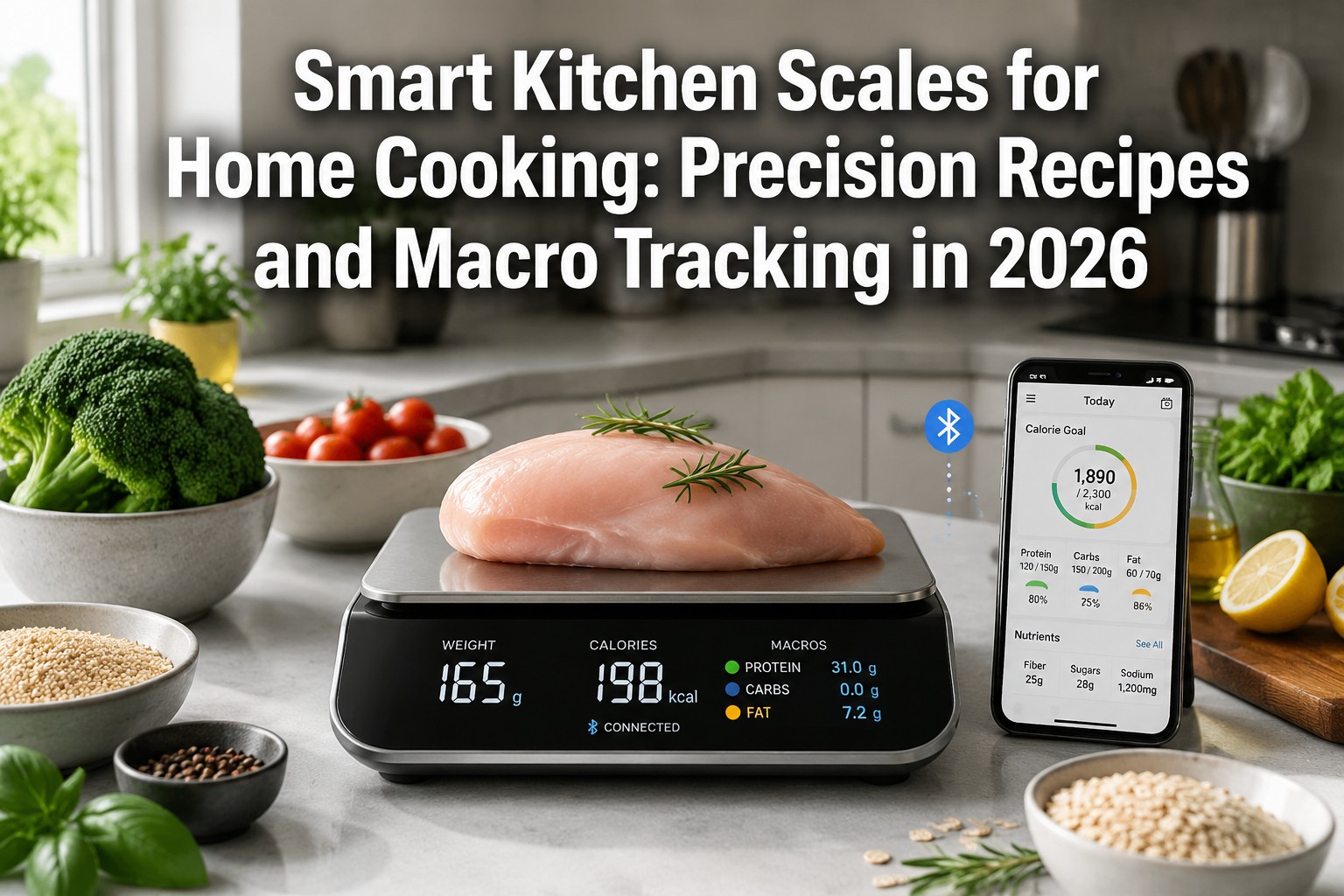
Smart Kitchen Scales for Home Cooking: Precision Recipes and Macro Tracking in 2026
Last updated: May 6, 2026
Quick Answer
Smart kitchen scales in 2026 combine precise ingredient measurement (accurate to 1 gram) with AI-powered nutritional tracking, allowing home cooks to weigh food, automatically calculate macros, and scale recipes through connected apps. These devices are essential for anyone tracking protein intake, following specific diets, or seeking consistent cooking results, with models ranging from $15 budget options to $150 AI-integrated systems.
Key Takeaways
- Modern smart scales measure to 1-gram precision and display weights in multiple units (grams, ounces, pounds, milliliters) for versatile cooking and macro tracking
- AI-powered models sync with smartphone apps to automatically calculate calories, protein, carbs, and fats as you weigh ingredients
- Budget options start at $15-25 (like Amazon Basics Digital Kitchen Scale) while premium AI-enabled scales cost $80-150
- Top performers in 2026 include Nicewell Food Scale (best overall), Etekcity (most durable), and OXO Good Grips (best for large batches up to 11 pounds)
- Macro tracking accuracy is critical for fitness goals—scales designed for nutrition professionals offer the precision needed for high-protein meal prep
- Portable models now exist for travelers and on-the-go macro tracking, with compact folding designs
- Recipe scaling features let you automatically adjust ingredient quantities when cooking for different serving sizes
What Are Smart Kitchen Scales and How Do They Work in 2026?
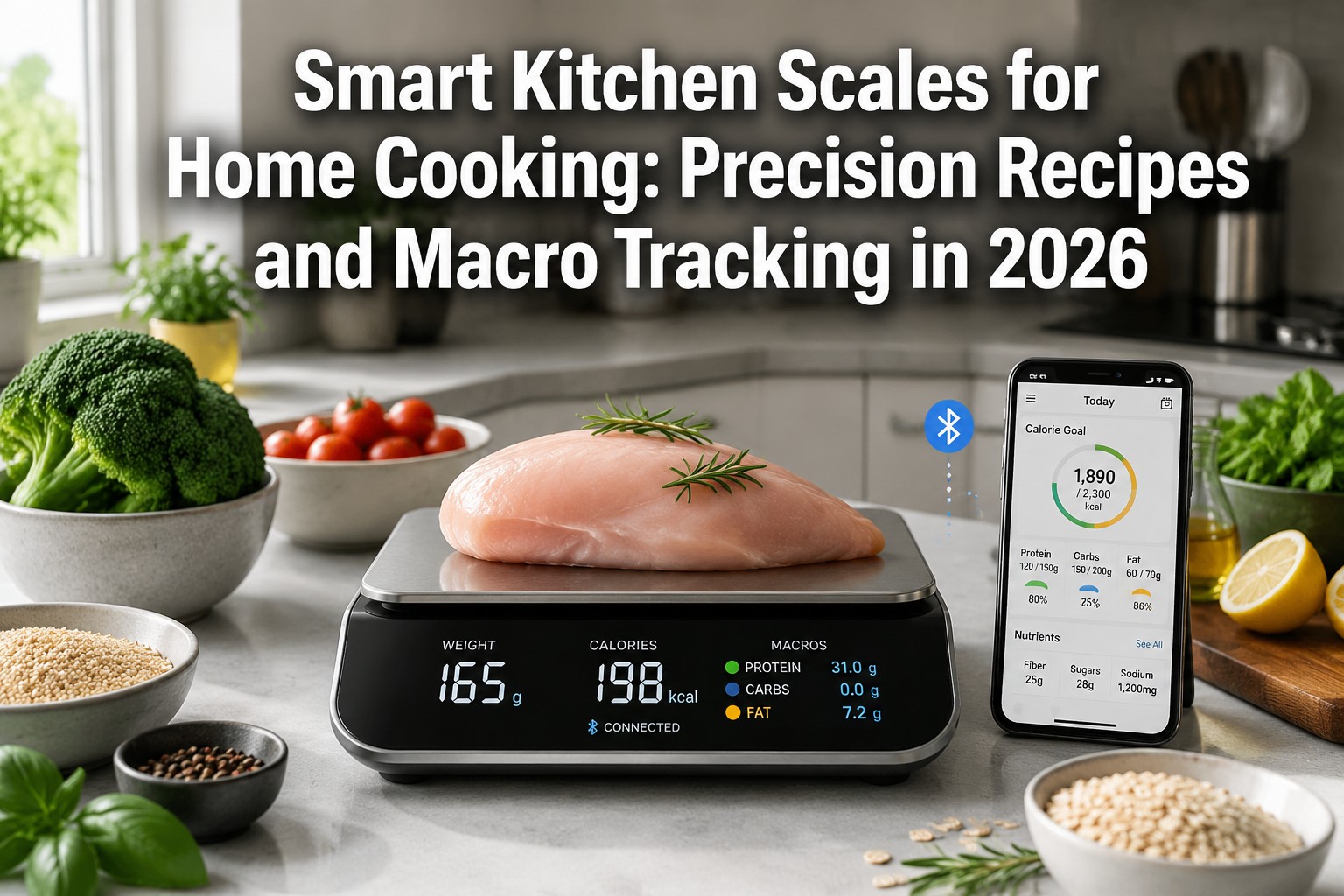
Smart kitchen scales are digital weighing devices that measure food ingredients with precision (typically to 1 gram) and connect to smartphone apps or built-in displays to provide real-time nutritional information. When you place food on the platform, the scale weighs it and either displays the weight alone (basic models) or calculates macronutrients automatically by identifying the food type through app integration (AI-powered models).
The technology works through strain gauge sensors that detect weight changes and convert them to digital readings. Premium 2026 models add Bluetooth or Wi-Fi connectivity, allowing the scale to communicate with nutrition databases containing thousands of foods. You simply select the food type in the app, and the system calculates protein, carbohydrates, fats, and calories based on the exact weight.
Key features in 2026 models:
- Multi-unit display: Grams, kilograms, pounds, ounces, fluid ounces, and milliliters [1]
- Tare function: Reset to zero with containers on the platform to weigh only the food
- Auto-shutoff: Preserves battery life when not in use
- Backlit displays: Easy reading in various lighting conditions
- App integration: Syncs with MyFitnessPal, Lose It!, and proprietary nutrition apps
Choose a smart scale if you’re tracking macros for fitness goals, following precise recipes (like baking or espresso preparation), or meal prepping for the week. Skip it if you only cook casually without nutritional goals and don’t mind approximate measurements.
Why Do Home Cooks Need Precision Weighing for Recipes and Macro Tracking?
Precision weighing eliminates guesswork in both cooking and nutrition tracking, ensuring consistent results and accurate macro calculations. Volume measurements (cups, tablespoons) vary significantly based on how ingredients are packed, but weight measurements remain constant—100 grams of chicken breast is always 100 grams, regardless of how it’s arranged.
For macro tracking specifically, accuracy matters because small measurement errors compound throughout the day. If you underestimate protein portions by just 20 grams per meal across three meals, you’ve missed 60 grams of protein (about 240 calories)—enough to derail cutting or bulking goals. When tracking whole chicken breast macros, precision becomes even more important since protein content varies by exact weight.
Precision benefits for cooking:
- Baking consistency: Flour measured by weight produces identical results every time
- Recipe scaling: Easily double or halve recipes with accurate proportions
- Portion control: Serve exact serving sizes for consistent meal planning
- International recipes: Convert between metric and imperial measurements instantly
Precision benefits for macro tracking:
- Accurate protein intake: Essential for muscle building and preservation during weight loss
- Carb cycling: Track exact carbohydrate amounts for performance nutrition
- Fat monitoring: Measure calorie-dense fats precisely to avoid overshooting calorie targets
- Progress tracking: Identify what’s working by eliminating measurement variables
Common mistake: Relying on “eyeballing” portions or using measuring cups for solid foods. A “cup” of cooked chicken can range from 120-180 grams depending on how it’s cut and packed, creating a 60-gram protein variance.
What Are the Best Smart Kitchen Scales for Home Cooking in 2026?
The best smart kitchen scales for home cooking in 2026 balance accuracy, durability, and features at various price points. The Nicewell Food Scale leads as the top overall performer, offering precision suitable for both macro tracking and specialty applications like espresso preparation and protein pancake mixing [1].
Top Picks by Category
Best Overall: Nicewell Food Scale
- Precision to 1 gram for accurate macro tracking
- Versatile for everyday cooking and specialty applications
- Reliable performance across multiple use cases [1]
Best Budget: Amazon Basics Digital Kitchen Scale
- Cost-effective precision weighing under $25
- Essential features without premium pricing
- Ideal for beginners starting macro tracking [1]
Most Durable: Etekcity Food Scale
- Consistently appears in top 10 lists for reliability
- Built to withstand daily meal prep use
- Long-term value through extended lifespan [1][2]
Best for Travel: Brynnl Compact Folding Digital Kitchen Scale
- Portable design for on-the-go macro tracking
- Folds for easy packing in luggage or gym bags
- Maintains accuracy despite compact size [1]
Best for Large Batches: OXO Good Grips 5KG Stainless Steel Scale
- 11-pound (5 kilogram) capacity for bulk cooking
- Stainless steel platform for easy cleaning
- Pull-out display for visibility with large containers [1]
Decision rule: Choose budget models ($15-25) if you’re new to macro tracking and want to test the habit. Invest in mid-range options ($40-70) like Nicewell or Etekcity if you’re committed to consistent meal prep. Consider premium models ($80-150) only if you need AI-powered automatic nutritional calculations or specialized features.
How Do Smart Scales Track Macros Automatically?
Smart scales track macros automatically by combining precise weight measurements with extensive food databases accessed through connected smartphone apps. When you place food on the scale, you select the food type from the app’s database (or scan a barcode for packaged foods), and the system calculates protein, carbohydrates, fats, fiber, and calories based on the exact weight measured.
The process works in three steps:
- Weigh the food: Place the ingredient on the scale platform
- Identify the food: Select from the app’s database or scan the product barcode
- View nutritional breakdown: The app displays macros and calories instantly
Advanced features in 2026 AI-powered models:
- Visual food recognition: Point your phone camera at the food, and AI identifies it automatically
- Recipe building: Add multiple ingredients sequentially, and the app totals all macros
- Meal saving: Store frequently eaten meals for one-tap logging
- Goal tracking: Monitor daily protein, carb, and fat targets with progress bars
- Historical data: Review past meals and identify eating patterns
For high-protein meal prep, this automation saves significant time. Instead of manually logging each ingredient in chicken breast recipes, you weigh once and get complete nutritional information instantly.
Edge case: Homemade mixed dishes (casseroles, stir-fries) require weighing each ingredient separately before combining, then dividing the total by servings. Smart scales can’t analyze mixed foods after cooking, so track components individually.
What Features Should You Look for in a Smart Kitchen Scale?
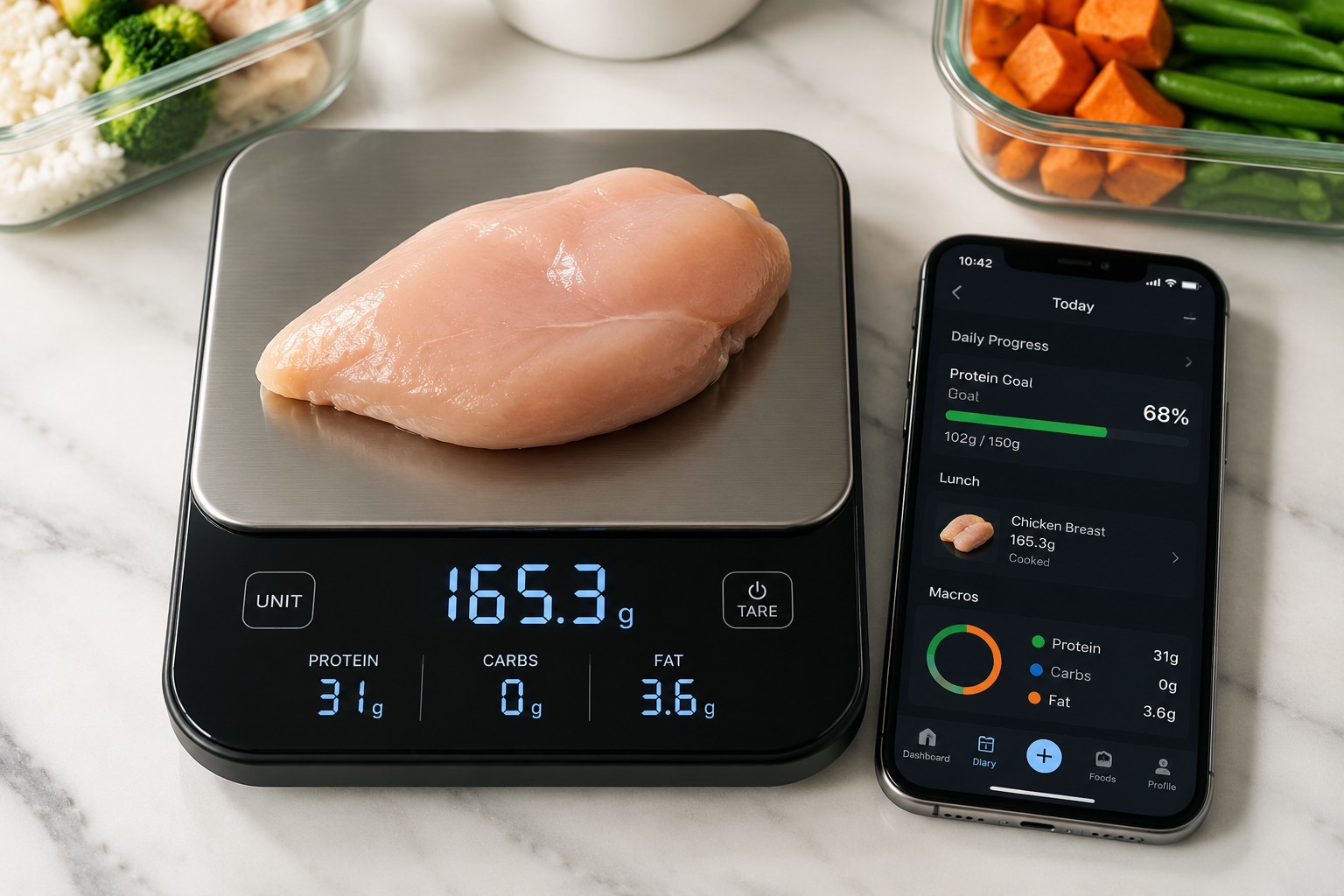
Essential features for a smart kitchen scale include 1-gram precision, tare function, multi-unit display, and sufficient weight capacity for your typical cooking needs. These core capabilities ensure accurate measurements for both cooking and macro tracking without unnecessary complexity.
Must-Have Features
Precision and Accuracy
- Minimum 1-gram increments for macro tracking
- Consistent readings across the platform surface
- Quick stabilization (readings appear within 2-3 seconds)
Capacity
- 5kg (11 pounds) minimum for general cooking
- 3kg sufficient for individual meal prep
- 10kg+ needed for bulk batch cooking
Display and Interface
- Backlit LCD or LED for visibility in any lighting
- Large numbers readable from standing position
- Unit conversion button easily accessible
Power and Durability
- Replaceable batteries (AAA or AA) or USB rechargeable
- Auto-shutoff after 2-3 minutes of inactivity
- Water-resistant or sealed buttons for easy cleaning
Nice-to-Have Features
App Connectivity
- Bluetooth sync with nutrition tracking apps
- Recipe scaling and conversion tools
- Cloud storage for meal history
Physical Design
- Removable platform for dishwasher cleaning
- Compact storage or wall-mounting options
- Non-slip feet for stability
Additional Functions
- Timer for cooking coordination
- Temperature reading for food safety
- Multiple user profiles for household sharing
Choose scales with app connectivity if you’re serious about macro tracking and want automated logging. Stick with basic digital scales if you primarily need accurate measurements for cooking chicken breast and other recipes without nutritional tracking.
Common mistake: Buying scales with 5-gram increments thinking they’re sufficient. For macro tracking, 5-gram precision creates too much variance—a 5-gram error on a 150-gram chicken breast means 1-2 grams of protein miscalculation per meal, adding up significantly over time.
How Much Do Smart Kitchen Scales Cost in 2026?
Smart kitchen scales in 2026 range from $15 for basic digital models to $150 for AI-powered systems with advanced nutritional tracking. The majority of reliable options for home cooking and macro tracking fall in the $25-70 range, offering the precision and features most users need without premium pricing.
Price Tiers and What You Get
Budget Tier ($15-25)
- Basic digital weighing with 1-gram precision
- Manual unit conversion
- Simple LCD display
- Example: Amazon Basics Digital Kitchen Scale [1]
- Best for: Testing macro tracking before committing to the habit
Mid-Range ($30-70)
- Enhanced durability and build quality
- Larger weight capacity (5kg+)
- Better displays with backlighting
- Longer battery life
- Examples: Nicewell Food Scale, Etekcity Food Scale [1][2]
- Best for: Committed meal preppers and home cooks
Premium ($80-150)
- Bluetooth/Wi-Fi app connectivity
- Automatic nutritional calculations
- AI food recognition
- Recipe scaling features
- Cloud sync and meal history
- Best for: Serious fitness enthusiasts and nutrition professionals
Value consideration: The jump from budget to mid-range ($15 to $40) provides significant durability and usability improvements. The jump from mid-range to premium ($40 to $100+) primarily adds convenience through automation—the measurement accuracy remains similar.
For most home cooks tracking macros, a $30-50 scale offers the best balance of precision, durability, and features. Invest more only if automatic nutritional logging saves you significant time daily.
How Do You Use a Smart Kitchen Scale for Meal Prep and Macro Tracking?
Using a smart kitchen scale for meal prep involves weighing each ingredient as you prepare it, recording the macros, and dividing the total by servings to determine per-portion nutrition. The process becomes faster with practice and can be streamlined significantly with app-connected scales.
Step-by-Step Process
1. Set up your workspace
- Place scale on flat, stable surface
- Have meal prep containers ready
- Open your tracking app (if using connected scale)
2. Prepare ingredients individually
- Place empty container on scale and press tare to zero
- Add first ingredient until reaching desired weight
- Record weight and food type in app or notebook
- Remove ingredient to prep area
3. Track as you cook
- Weigh proteins raw for most accurate macro data
- Account for cooking oils and seasonings (they add calories)
- For chicken breast recipes, weigh before cooking since moisture loss during cooking concentrates macros
4. Calculate per-serving macros
- Add all ingredient macros together for total recipe nutrition
- Divide by number of servings
- Label meal prep containers with per-serving macros
5. Weigh finished portions (optional)
- Tare scale with empty container
- Add food until reaching calculated serving weight
- Ensures consistent portions throughout the week
Time-Saving Tips
- Batch similar foods: Weigh all proteins together, then all carbs, then all fats
- Use tare between ingredients: Keep the same bowl on the scale, taring between each addition
- Create meal templates: Save frequently eaten combinations in your app
- Prep proteins in bulk: Weigh and cook large batches, then divide into portions
Common mistake: Weighing cooked proteins and using raw nutrition data (or vice versa). Chicken breast loses about 25% of its weight during cooking due to moisture loss, but the protein content remains the same. Always match your weighing method (raw or cooked) to the corresponding nutrition data. Check chicken breast cooking guides for proper preparation methods.
Edge case: When cooking recipes with significant liquid reduction (soups, sauces), weigh the finished product and divide by servings rather than calculating from raw ingredients, as evaporation concentrates nutrients unpredictably.
What Are Common Mistakes When Using Kitchen Scales for Macro Tracking?
The most common mistake when using kitchen scales for macro tracking is inconsistency between weighing methods and nutrition data sources—specifically, weighing cooked food but using raw nutrition values, or vice versa. This creates significant macro miscalculations because cooking changes food weight through moisture loss or absorption.
Critical Errors to Avoid
Weighing Method Mismatches
- The problem: Using raw chicken nutrition data for cooked chicken weight
- The impact: Overestimating protein by 20-30% due to cooking moisture loss
- The fix: Always match weighing timing to your nutrition data source (if data says “raw,” weigh raw)
Forgetting Cooking Fats
- The problem: Not weighing oils, butter, or cooking sprays
- The impact: Missing 100-400 calories per meal from “invisible” fats
- The fix: Weigh the pan before and after adding oil, or measure oil directly on scale
Ignoring Tare Function
- The problem: Including container weight in food measurements
- The impact: Overestimating portions and macros
- The fix: Always place empty container on scale, press tare, then add food
Using Volume for Solids
- The problem: Measuring chicken, rice, or vegetables in cups instead of grams
- The impact: 20-40% variance in portions depending on how food is packed
- The fix: Weigh all solid foods; reserve volume measurements for liquids only
Not Calibrating Regularly
- The problem: Scale accuracy drifts over time without calibration
- The impact: Systematic under- or over-measurement of all foods
- The fix: Test with known weights (coins, calibration weights) monthly
Accuracy Best Practices
- Weigh on stable surfaces: Uneven counters affect readings
- Let scale stabilize: Wait 2-3 seconds for reading to settle before recording
- Replace batteries proactively: Low batteries cause inaccurate measurements
- Clean platform regularly: Food residue can interfere with sensors
- Weigh in grams: More precise than ounces for macro tracking
Decision rule: If your weight loss or muscle gain stalls despite “perfect” macro tracking, audit your weighing method. Inconsistent weighing is often the hidden variable preventing progress.
How Do Smart Scales Compare to Traditional Measuring Methods?
Smart scales provide significantly greater accuracy and consistency than traditional volume-based measuring methods (cups, tablespoons, spoons), especially for solid foods and macro tracking. While measuring cups work adequately for liquids, they introduce 20-40% variance for solid ingredients depending on how the food is packed, cut, or settled.
Accuracy Comparison
| Method | Accuracy for Solids | Accuracy for Liquids | Best Use Case |
|---|---|---|---|
| Smart Scale (grams) | ±1g (>99% accurate) | ±1g | Macro tracking, baking, meal prep |
| Digital Scale (basic) | ±1-5g (95-99% accurate) | ±1-5g | General cooking, portion control |
| Measuring Cups | ±20-40% variance | ±5-10% variance | Casual cooking, liquids only |
| Measuring Spoons | ±15-30% variance | ±10-15% variance | Small quantities, seasonings |
| Eyeballing | ±50-100% variance | ±50-100% variance | Experienced cooks, non-critical recipes |
Practical Differences
For Macro Tracking
- Scales: 150g chicken breast = exactly 31g protein (assuming 20.6g protein per 100g raw)
- Cups: “1 cup” chicken = anywhere from 120-180g = 25-37g protein (48% variance)
- Impact: Cups make accurate macro tracking nearly impossible
For Baking
- Scales: 120g flour produces identical results every time
- Cups: “1 cup” flour ranges from 100-140g depending on scooping method and settling
- Impact: Cups cause inconsistent texture, rise, and moisture in baked goods
For Recipe Scaling
- Scales: Multiply all weights by 1.5 to scale recipe up 50%
- Cups: Converting “1⅓ cups” to 2 cups requires calculation and introduces rounding errors
- Impact: Scales make scaling effortless and precise
When volume measurements work: Liquids (water, milk, oil) measured in cups or milliliters are sufficiently accurate for most cooking. Spices and seasonings in small quantities (1 teaspoon salt) don’t significantly impact macros.
Choose scales over cups if you’re tracking macros, baking regularly, meal prepping, or following recipes from countries using metric measurements. Stick with volume measurements only for casual cooking without nutritional goals.
What’s the Future of Smart Kitchen Scales Beyond 2026?
The future of smart kitchen scales beyond 2026 points toward deeper AI integration, with visual food recognition becoming standard, real-time nutritional coaching through voice assistants, and seamless integration with smart appliances for fully automated cooking. Emerging technologies suggest scales will evolve from passive measurement tools to active cooking assistants that guide recipe execution and nutritional optimization.
Emerging Trends
AI and Machine Learning
- Visual recognition: Point camera at food, AI identifies it without manual selection
- Portion learning: System learns your typical portions and suggests adjustments
- Nutritional optimization: AI recommends ingredient swaps to hit macro targets
- Predictive tracking: Anticipates meals based on eating patterns and suggests prep
Smart Home Integration
- Connected appliances: Scale communicates with oven, air fryer, and slow cooker
- Automated cooking: Scale measures ingredients, appliance adjusts time/temperature automatically
- Voice control: Alexa/Google Assistant integration for hands-free operation
- Recipe sourcing: Scale suggests recipes based on ingredients you weigh
Health and Wellness Features
- Micronutrient tracking: Beyond macros to vitamins, minerals, and fiber
- Allergen detection: Warns about ingredients conflicting with dietary restrictions
- Blood sugar prediction: Estimates glycemic impact for diabetic users
- Personalized nutrition: Adjusts recommendations based on biometric data from wearables
Sustainability Features
- Food waste tracking: Monitors discarded food and suggests portion adjustments
- Carbon footprint: Calculates environmental impact of ingredient choices
- Local sourcing: Recommends local alternatives to reduce food miles
Practical timeline: Visual recognition and voice control are already appearing in premium 2026 models and will become standard by 2028. Full smart home integration and personalized nutrition coaching will likely reach mainstream adoption by 2030-2032 as AI capabilities mature and costs decrease.
For home cooks focused on macro tracking and precision cooking, current 2026 models already provide the essential features needed. Future upgrades will primarily add convenience and coaching rather than fundamental measurement improvements.
Frequently Asked Questions
Do I need a smart scale if I’m not tracking macros?
No, you don’t need a smart scale specifically for macro tracking if you’re not monitoring nutritional intake. However, a basic digital kitchen scale (even without smart features) still improves cooking consistency, especially for baking, recipe scaling, and portion control. Choose a simple $15-25 digital scale for cooking accuracy without the macro tracking features.
How accurate are smart kitchen scales for protein tracking?
Smart kitchen scales are accurate to ±1 gram for weight measurement, which translates to roughly ±0.2g protein accuracy for chicken breast (at 20.6g protein per 100g). The nutritional database accuracy matters more than scale precision—generic “chicken breast” entries can vary by 10-15% from actual values. For best accuracy, use USDA-verified entries and weigh raw.
Can I use a smart scale for liquids and dry ingredients?
Yes, smart scales measure both liquids and dry ingredients accurately when using the appropriate unit. For liquids, switch to milliliters or fluid ounces; for dry ingredients, use grams or ounces. The tare function lets you measure multiple ingredients in the same bowl by zeroing between additions, making recipe preparation efficient.
How long do smart kitchen scale batteries last?
Most smart kitchen scales using AAA or AA batteries last 6-12 months with daily use, depending on auto-shutoff settings and display type. Backlit displays drain batteries faster than basic LCD screens. USB-rechargeable models typically need charging every 2-3 months. Replace batteries proactively when readings become inconsistent, as low power affects accuracy.
Do smart scales work with MyFitnessPal and other tracking apps?
Many 2026 smart scales sync directly with MyFitnessPal, Lose It!, Cronometer, and other popular nutrition apps via Bluetooth. Check compatibility before purchasing if you have a preferred app. Basic digital scales without connectivity require manual entry into tracking apps, which takes 30-60 seconds per ingredient but still provides accurate data.
Should I weigh food before or after cooking?
Weigh food raw (before cooking) whenever possible, as most nutrition databases use raw values and cooking methods vary in moisture loss. If you must weigh cooked food, search for “cooked” entries in your tracking app (e.g., “chicken breast, cooked” vs. “chicken breast, raw”). Never mix weighing methods with mismatched database entries.
What’s the difference between a $20 scale and a $100 scale?
The main differences are durability, capacity, and smart features. Both measure to 1-gram precision, but $100 scales offer Bluetooth connectivity, automatic nutritional calculations, larger weight capacity (10kg vs. 5kg), better build quality, and longer warranties. For basic macro tracking, a $20-40 scale provides sufficient accuracy; premium models add convenience, not precision.
Can smart scales help with portion control for weight loss?
Yes, smart scales enable precise portion control by showing exact serving sizes and their caloric content. This removes guesswork and prevents portion creep—the gradual increase in serving sizes that stalls weight loss. Weighing portions consistently helps maintain calorie deficits more reliably than estimating, especially for calorie-dense foods like nuts, oils, and grains.
Do I need to calibrate my kitchen scale regularly?
Most consumer kitchen scales don’t require regular calibration, but testing accuracy monthly ensures reliability. Place a known weight (calibration weight, unopened can with listed weight, or stack of coins) on the scale and verify the reading. If consistently off by more than 2-3 grams, recalibrate following manufacturer instructions or replace the scale.
Are smart scales worth it for meal prep?
Smart scales are worth it for meal prep if you track macros or prepare multiple recipes weekly, as they save 5-10 minutes per meal prep session through automated nutritional calculations. For simple meal prep without macro tracking, a basic $20 digital scale provides the precision needed for consistent portions without the premium cost of smart features.
Can I use a kitchen scale for coffee and espresso?
Yes, kitchen scales work excellently for coffee and espresso preparation, where precision affects flavor significantly. Many coffee enthusiasts use kitchen scales to measure beans (typically 15-18g per double shot) and track extraction ratios. Look for scales with 0.1g precision and fast response times for pour-over coffee timing.
What weight capacity do I need for home cooking?
A 5kg (11 pounds) capacity handles most home cooking needs, including whole chickens, large batches of rice, and meal prep for 4-6 servings. Choose 3kg capacity only if you cook for one or two people exclusively. Select 10kg+ capacity if you regularly prepare bulk batches for freezing or large family meals.
Conclusion
Smart kitchen scales have become essential tools for home cooks in 2026, bridging the gap between precise recipe execution and accurate nutritional tracking. Whether you’re weighing ingredients for consistent chicken breast and rice meals, tracking protein intake for fitness goals, or simply improving your baking consistency, these devices eliminate guesswork and deliver measurable results.
The market offers options for every budget and need—from $15 basic digital scales that provide reliable 1-gram precision to $150 AI-powered systems that automatically calculate macros and sync with your nutrition apps. For most home cooks, mid-range models like the Nicewell Food Scale or Etekcity Food Scale deliver the best balance of accuracy, durability, and features without unnecessary complexity.
Take action now:
- Assess your needs: Determine whether you need basic weighing for cooking or full macro tracking capabilities
- Set your budget: Allocate $25-50 for reliable precision or $80+ for smart features and automation
- Choose your scale: Select based on capacity needs, desired features, and compatibility with your tracking apps
- Start weighing consistently: Begin with one meal daily to build the habit before expanding to full meal prep
- Audit your accuracy: After two weeks, verify your weighing method matches your nutrition database entries
The precision and consistency that smart kitchen scales provide transform both cooking results and nutritional awareness. By investing in accurate measurement tools and developing consistent weighing habits, home cooks gain control over both recipe outcomes and dietary goals—making 2026 the year to upgrade from guesswork to precision in the kitchen.
References
[1] Best Food Scales – https://www.menshealth.com/uk/nutrition/g70880406/best-food-scales/
[2] Watch – https://www.youtube.com/watch?v=MN4BIWy1fZg
SEO Meta Title: Smart Kitchen Scales 2026: Precision Recipes & Macro Track


