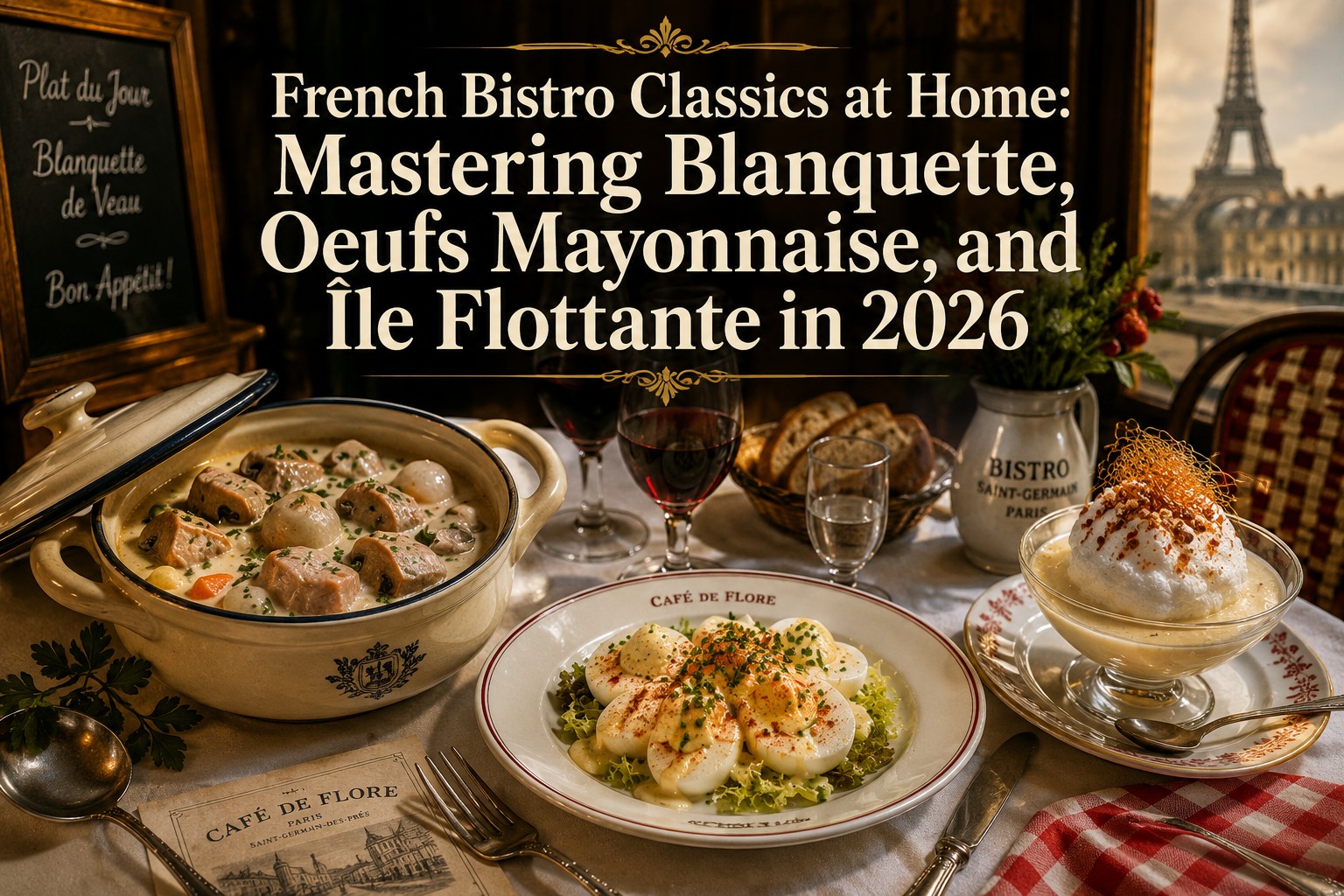
French Bistro Classics at Home: Mastering Blanquette, Oeufs Mayonnaise, and Île Flottante in 2026
Last updated: June 24, 2026
French bistro cooking is experiencing a renaissance in 2026, with home cooks rediscovering the simple elegance of dishes like blanquette de veau, oeufs mayonnaise, and île flottante. These three classics represent the heart of French comfort food: a creamy veal stew, perfectly boiled eggs with homemade mayonnaise, and a delicate floating meringue dessert. Each dish relies on technique rather than exotic ingredients, making them surprisingly accessible for home kitchens.
Key Takeaways
- Blanquette de veau is a gentle veal stew cooked in white stock with a creamy egg-enriched sauce, taking about 2 hours total
- Oeufs mayonnaise requires just perfectly cooked eggs and homemade mayo, but technique matters more than complexity
- Île flottante succeeds when meringues are poached gently and served immediately over cold custard
- Veal can be substituted with chicken or turkey for blanquette without losing the dish’s character
- Fresh eggs at room temperature and slow oil incorporation prevent mayonnaise from breaking
- These bistro classics work beautifully for dinner parties because components can be prepped ahead
- Equipment needs are minimal: heavy pot, whisk, mixing bowls, and a thermometer help but aren’t essential
- Wine pairings lean toward white Burgundy for blanquette, light reds or rosé for oeufs mayo, and sweet wines for île flottante
What Is Blanquette de Veau and How Do You Make It at Home?
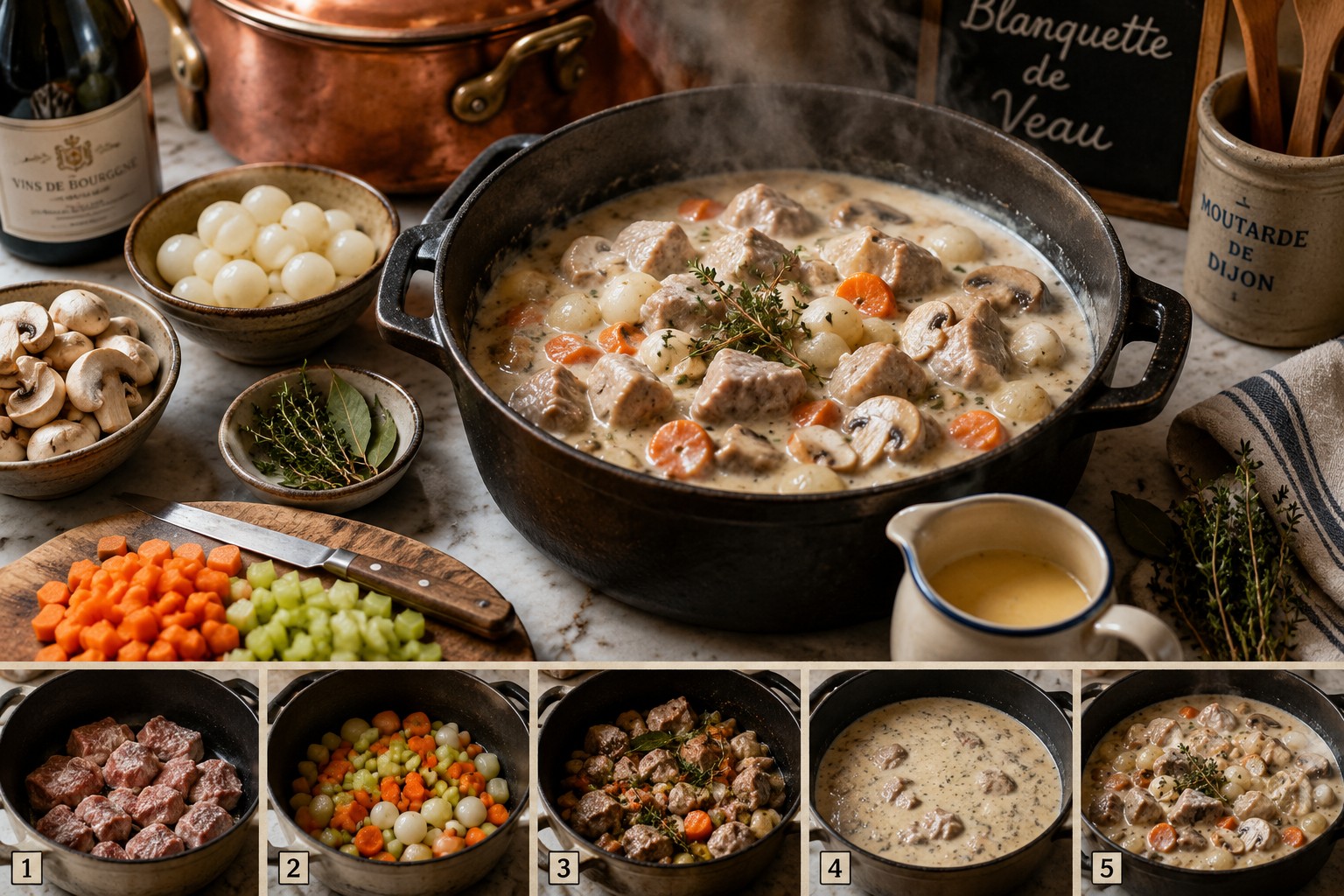
Blanquette de veau is a classic French white veal stew where meat is gently simmered in stock, then finished with a velvety sauce made from egg yolks and cream. Unlike brown stews, the veal isn’t seared first, keeping the sauce pale and delicate. The dish takes about 2 hours from start to finish, with most of that time being hands-off simmering.
Basic steps for blanquette:
- Blanch the veal: Cut 2 pounds veal shoulder into 2-inch cubes, place in cold water, bring to a boil, then drain and rinse (this removes impurities)
- Simmer gently: Return veal to pot with fresh cold water or light stock, add aromatics (onion studded with cloves, carrot, celery, bouquet garni), bring to bare simmer, cook 1.5 hours until tender
- Prepare vegetables: Sauté pearl onions and button mushrooms in butter separately, about 10 minutes each
- Make the sauce: Strain cooking liquid (you need about 2 cups), make a roux with butter and flour, whisk in stock, simmer 10 minutes
- Finish with liaison: Whisk together 2 egg yolks and ½ cup heavy cream, temper with hot sauce, stir back into pot off heat, add lemon juice
- Combine: Add veal and vegetables to sauce, warm gently without boiling (boiling will curdle the eggs)
Common mistake: Letting the sauce boil after adding the egg-cream liaison. Keep heat low and stir constantly. If it does curdle slightly, an immersion blender can sometimes save it.
Choose blanquette when you want impressive results with minimal active cooking time. The gentle simmer requires little attention, making it ideal for Sunday cooking or when you’re working from home.
Oeufs Mayonnaise Recipe: Traditional French Bistro Style
Oeufs mayonnaise is deceptively simple: perfectly cooked hard-boiled eggs served cold with homemade mayonnaise. French bistros serve this as a starter, and the quality depends entirely on egg cooking technique and mayo texture. The dish takes 20 minutes if you make mayo from scratch, or 10 minutes with store-bought.
Perfect hard-boiled eggs:
- Place eggs in cold water, bring to boil, immediately remove from heat, cover, let sit 9 minutes
- Transfer to ice bath for 5 minutes (this prevents green rings and makes peeling easier)
- Peel under running water, starting from the wider end where the air pocket sits
Traditional French mayonnaise from scratch:
- 1 egg yolk (room temperature), 1 teaspoon Dijon mustard, pinch of salt
- Whisk together, then add ¾ cup neutral oil (grapeseed or light olive) drop by drop at first
- Once emulsion forms (mixture thickens), add oil in thin steady stream while whisking constantly
- Finish with lemon juice or white wine vinegar, adjust seasoning
Presentation: Halve eggs lengthwise, arrange cut-side down on plate, spoon mayo generously over top, garnish with capers, cornichons, fresh herbs, and a sprinkle of flaky salt.
How to Make Île Flottante Without It Deflating
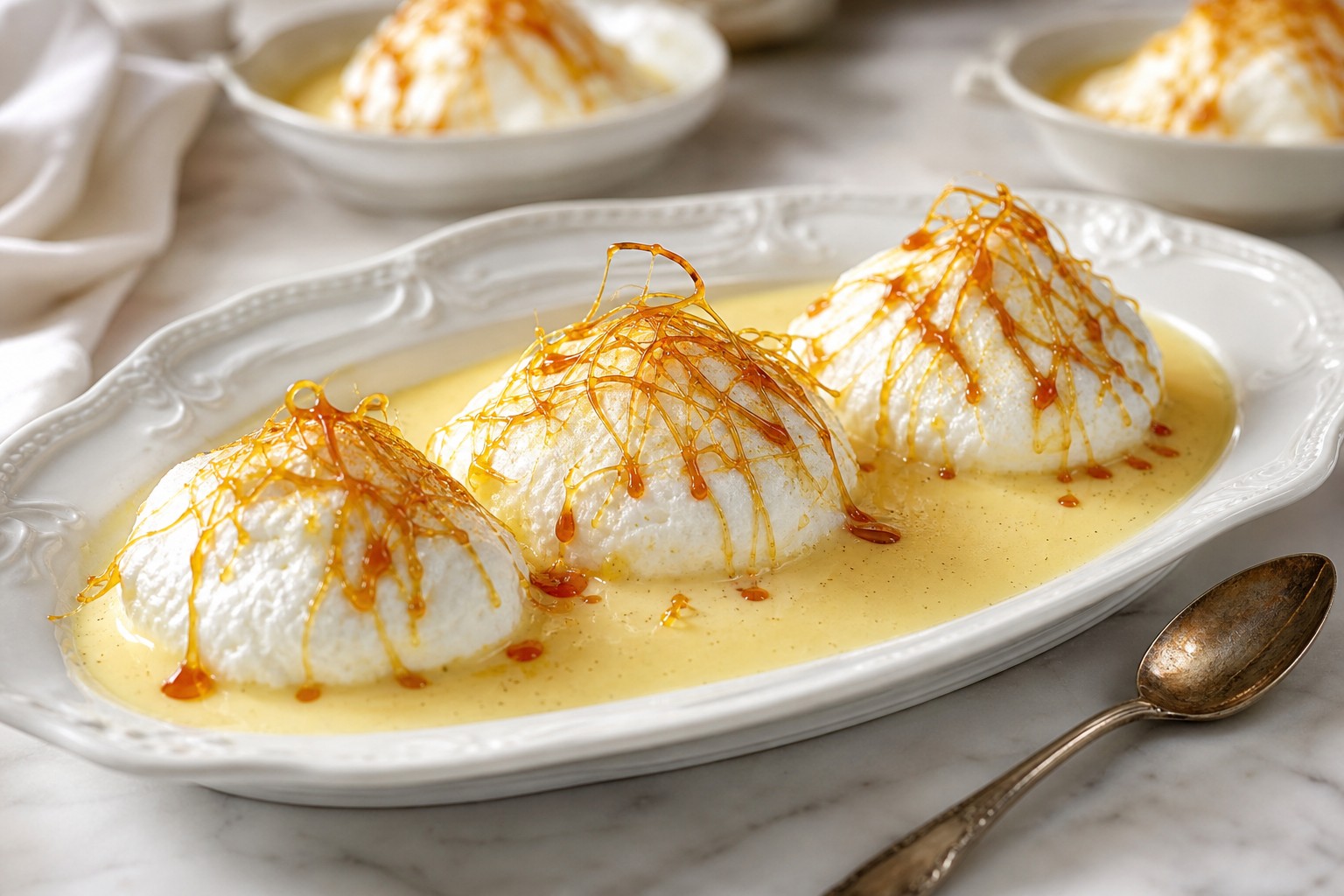
Île flottante (floating island) features poached meringue islands floating in crème anglaise custard, topped with caramel threads. The meringues deflate when overcooked, underwhipped, or served too warm. Success comes from proper meringue technique and gentle poaching in barely simmering liquid.
Foolproof meringue method:
- Use 4 egg whites at room temperature, beat until soft peaks form
- Gradually add ½ cup sugar while beating, continue until stiff glossy peaks form (about 5 minutes total)
- Test: turn bowl upside down—meringue shouldn’t budge
Poaching technique:
- Heat milk or water in wide shallow pan to 180°F (just below simmer—no bubbles breaking surface)
- Shape meringue into ovals using two large spoons, gently slide into liquid
- Poach 2 minutes per side, turning once with slotted spoon
- Drain on clean kitchen towel immediately
Why meringues sink or get watery:
- Underbeaten whites lack structure (beat until truly stiff)
- Liquid too hot causes rapid expansion then collapse (keep at 180°F)
- Storing too long before serving—meringues weep after 2 hours
- Placing hot meringue on warm custard creates condensation
Timing tip: Make crème anglaise first and chill it completely. Poach meringues just before serving and place them on cold custard. The temperature contrast keeps them fluffy.
Blanquette vs Fricassée: What’s the Difference?
Blanquette and fricassée are both white stews, but fricassée involves lightly sautéing the meat in butter first (without browning), while blanquette starts with raw meat in cold liquid. Blanquette produces a paler, more delicate sauce because the meat never touches hot fat. Fricassée has slightly more depth from the brief sauté step, though both finish with the same egg-cream liaison.
Choose blanquette for: Traditional presentation, lighter flavor, when you want the purest expression of veal Choose fricassée for: Slightly richer taste, chicken dishes (chicken fricassée is more common than chicken blanquette)
Both techniques work with veal, chicken, turkey, or rabbit. The cooking times and sauce methods remain identical after the initial treatment.
Where to Buy Veal for Blanquette de Veau
Veal for blanquette typically comes from shoulder or breast cuts, which have enough connective tissue to stay moist during long simmering. Most supermarkets don’t stock veal regularly in 2026, but specialty butchers, whole animal butcher shops, and some higher-end grocery chains carry it. Order ahead to ensure availability.
Best sources:
- Local butcher shops (call ahead, often need 2-3 days notice)
- Whole Foods, Wegmans, or regional premium grocers
- Online meat purveyors (Snake River Farms, Porter Road, crowd cow platforms)
- Farmers markets with vendors selling pasture-raised veal
- Ethnic markets, particularly those serving French, Italian, or Middle Eastern communities
What to ask for: Veal shoulder or breast, cut into 2-inch cubes, bone-in or boneless (bone-in adds flavor). Expect to pay $12-18 per pound in 2026.
Storage: Use within 2 days of purchase, or freeze immediately for up to 3 months. Thaw in refrigerator 24 hours before cooking.
Can I Make Blanquette With Chicken Instead of Veal?
Yes, chicken works beautifully in blanquette and is the most common substitution. Use bone-in, skin-on chicken thighs for best results—they stay moist during simmering and add flavor to the sauce. Boneless thighs work too but cook faster (about 45 minutes instead of 1.5 hours). Chicken breast tends to dry out and isn’t recommended.
Adjustments for chicken blanquette:
- Reduce simmering time to 45-60 minutes for bone-in thighs, 30-35 minutes for boneless
- Remove skin after cooking if desired (it becomes flabby when poached)
- Use chicken stock instead of water for deeper flavor
- Everything else stays the same: aromatics, vegetables, liaison, technique
Other protein options:
- Turkey thighs: Cook like chicken, excellent flavor
- Pork shoulder: Needs full 1.5 hours, richer taste
- Rabbit: Traditional alternative, cook 1 hour
For more guidance on cooking chicken breast to keep it moist and tender, check our detailed methods guide. If you’re looking for where to buy chicken breast in bulk for meal prep, we have sourcing tips.
Common Mistakes When Making French Mayonnaise From Scratch
Homemade mayonnaise breaks (separates into oil and liquid) when oil is added too quickly, ingredients are too cold, or proportions are off. The fix is simple: start a new emulsion with another yolk and slowly whisk in the broken mayo. Prevention is easier than fixing.
Top mistakes and solutions:
Adding oil too fast: Start with literal drops for the first 2 tablespoons. Once emulsion forms and mixture thickens noticeably, you can add oil in a thin stream. Rushing this step is the number one cause of broken mayo.
Cold ingredients: Egg yolks emulsify better at room temperature (65-70°F). Take eggs out of fridge 30 minutes before making mayo. Cold oil is fine, but cold yolks struggle to form stable emulsion.
Wrong oil ratio: Standard ratio is 1 egg yolk to ¾-1 cup oil. More than 1 cup per yolk risks breaking. Less than ½ cup makes thin, runny mayo.
Not enough whisking: Continuous vigorous whisking is essential, especially at the start. Use a bowl on a damp towel to keep it stable, or have someone else add oil while you whisk.
Skipping acid: A small amount of mustard or lemon juice at the start helps emulsification. The lecithin in mustard is particularly effective.
To fix broken mayo: Place 1 fresh yolk in clean bowl, whisk in 1 teaspoon mustard, then slowly whisk in the broken mayo as if it were oil. Works 90% of the time.
Is Blanquette de Veau Hard to Make for Beginners?
Blanquette de veau is actually beginner-friendly despite its fancy reputation. The technique is straightforward—simmer meat in liquid, make a basic sauce, add cream and eggs—and there are few ways to seriously mess it up. The long cooking time is mostly unattended, and the dish is forgiving of small timing variations.
Why it’s easier than it looks:
- No precise timing required (veal is done when fork-tender, anywhere from 1.5-2 hours)
- Gentle simmer means you won’t burn anything
- Sauce is a simple roux-based velouté, one of the first sauces taught in culinary school
- Even if liaison curdles slightly, the dish still tastes good
- Hard to overcook veal shoulder (it just gets more tender)
Skills you’ll practice:
- Making roux (butter and flour cooked together)
- Tempering eggs (gradually warming them so they don’t scramble)
- Adjusting seasoning (blanquette needs assertive salt and lemon to balance richness)
Time commitment: 2 hours total, but only 30 minutes of that is active work. Perfect for a relaxed weekend afternoon.
Start here if: You’re comfortable boiling water and whisking. If you’ve made gravy from pan drippings, you can make blanquette.
Best Wine Pairing for Blanquette de Veau Dinner
White Burgundy (Chardonnay from Burgundy, France) is the classic pairing for blanquette de veau. The wine’s richness and subtle oak match the creamy sauce, while its acidity cuts through the fat. Specifically, look for Côte de Beaune villages like Meursault, Puligny-Montrachet, or more affordable Mâcon-Villages.
Top pairing options:
White Burgundy (Chardonnay): Creamy texture mirrors the sauce, minerality complements veal’s delicate flavor. Choose wines with some oak but not heavily buttered styles. $25-60 range.
Alsace Riesling (dry): High acidity refreshes the palate between bites, stone fruit notes complement mushrooms and onions. Look for “Riesling” without “Vendange Tardive” (which indicates sweet). $20-35.
Loire Valley Chenin Blanc: Vouvray or Savennières offer honeyed richness with bright acidity. Slightly off-dry Vouvray works beautifully. $18-40.
Champagne or Crémant: Bubbles cut richness effectively, celebration-worthy for dinner parties. Extra Brut or Brut styles. $30-80.
Budget option: California Chardonnay with balanced oak (not overly buttery), or unoaked Chablis. $15-25.
Avoid: Heavy oaky California Chardonnay (overpowers delicate veal), high-tannin reds (clash with cream sauce), very sweet wines (make dish taste flat).
Serving temperature: Chill whites to 50-55°F, slightly warmer than refrigerator temperature. This allows flavors to open up.
How Long Does Oeufs Mayonnaise Last in the Fridge?
Assembled oeufs mayonnaise (eggs with mayo) should be eaten within 24 hours for best quality and food safety. Homemade mayonnaise contains raw egg yolk, which limits shelf life to 3-4 days maximum when stored alone. Hard-boiled eggs keep 5-7 days, but once combined with mayo, treat the dish as perishable.
Storage guidelines:
Homemade mayo alone: 3-4 days in airtight container in coldest part of fridge (back of bottom shelf). Discard if it smells off, changes color, or separates.
Hard-boiled eggs alone: 5-7 days in shells, 3-4 days peeled, stored in covered container.
Assembled dish: Serve immediately or within 4 hours. If you must store assembled oeufs mayo, keep refrigerated and eat within 24 hours. The eggs release moisture that thins the mayo and creates food safety concerns.
Best practice for dinner parties: Boil eggs up to 3 days ahead, make mayo up to 2 days ahead, store separately. Assemble plates 30 minutes before serving and keep refrigerated until plating.
Store-bought mayo: If using commercial mayonnaise (which is pasteurized), assembled dish keeps 2-3 days, though texture degrades as eggs release moisture.
Food safety note: Pregnant women, young children, elderly, and immunocompromised individuals should avoid homemade mayo made with raw eggs. Use pasteurized eggs or store-bought mayo instead.
Why Did My Île Flottante Meringue Sink or Get Watery?
Meringues sink when they’re underbeaten, overcooked, or stored too long before serving. They get watery from weeping (sugar syrup separating out) caused by humidity, overbeating, or temperature fluctuations. The most common culprit is poaching liquid that’s too hot, which causes rapid expansion followed by collapse.
Specific causes and fixes:
Underbeaten whites: Meringue needs stiff, glossy peaks that hold their shape completely. Beat on high speed for 4-5 minutes after all sugar is added. Test by turning bowl upside down—nothing should move.
Overbeaten whites: Rare but possible—meringue looks grainy and dry, starts to separate. Stop beating when peaks are stiff and glossy. Can’t be fixed; start over.
Poaching temperature too high: Keep liquid at 180°F (82°C), just below a simmer. Visible bubbles breaking the surface mean it’s too hot. Use a thermometer until you learn to judge by eye.
Poaching too long: 2 minutes per side is enough. Longer cooking dries out the exterior while the interior stays soft, leading to collapse. Meringues should feel barely firm to touch.
Humidity: High humidity days make meringue weep. Not much you can do except serve immediately and accept some weeping. Air conditioning helps.
Storing too long: Meringues start weeping after 2 hours at room temperature, faster if refrigerated. Make them right before serving.
Placing on warm custard: Temperature difference creates condensation. Always use cold crème anglaise straight from fridge.
Do French Bistros Use Store-Bought Mayo for Oeufs Mayo?
Traditional French bistros make mayonnaise from scratch daily, but in 2026, many casual bistros use high-quality commercial mayo or a blend of homemade and store-bought to manage labor costs. High-end establishments and those with Michelin recognition still make everything in-house. The difference is noticeable but not dramatic if the commercial mayo is good quality.
What bistros actually do:
- Traditional/upscale bistros: Fresh mayo daily, often made in large batches using immersion blender
- Casual neighborhood bistros: Mix of homemade (for special dishes) and quality commercial (for high-volume service)
- Brasseries: More likely to use commercial mayo, focusing labor on hot dishes
- Home cooks: Either approach works—homemade impresses, quality store-bought saves time
If using store-bought mayo:
- Choose French brands (Maille, Amora) or high-quality American (Duke’s, Kewpie, or Hellmann’s Real)
- Avoid “light” or “whipped” versions (wrong texture)
- Doctor it: whisk in fresh lemon juice, Dijon mustard, pinch of salt to freshen flavor
- Thin slightly with cream or milk if too thick
The honest truth: At a dinner party, few guests will know whether mayo is homemade unless you tell them. Homemade tastes brighter and more eggy, but quality store-bought with fresh garnishes (capers, herbs, good olive oil drizzle) produces an excellent dish.
Make it from scratch when: You have 10 extra minutes, want to impress, or enjoy the process. Use store-bought when: You’re short on time, making mayo intimidates you, or you’re cooking multiple dishes.
What Equipment Do I Need to Make Classic French Bistro Dishes at Home?
These three bistro classics require minimal specialized equipment. A heavy-bottomed pot, whisk, mixing bowls, and basic kitchen tools handle all three dishes. Optional items like an instant-read thermometer and immersion blender make things easier but aren’t essential.
Essential equipment:
For blanquette de veau:
- Heavy-bottomed pot or Dutch oven (4-6 quart)
- Wooden spoon
- Fine-mesh strainer
- Whisk (for sauce)
- Ladle
For oeufs mayonnaise:
- Medium saucepan (for boiling eggs)
- Mixing bowl
- Whisk (or immersion blender for mayo)
- Slotted spoon
For île flottante:
- Stand mixer or hand mixer (beating egg whites by hand is exhausting)
- Wide shallow pan for poaching (sauté pan or deep skillet)
- Slotted spoon
- Medium saucepan (for crème anglaise)
- Whisk
Helpful but optional:
- Instant-read thermometer: Takes guesswork out of custard (cook to 170°F) and poaching liquid temperature (180°F)
- Immersion blender: Makes mayo in 60 seconds, can save curdled sauce
- Fine-mesh strainer: Produces silkier crème anglaise
- Kitchen timer: Helps with egg cooking precision
You don’t need:
- Copper bowls (nice for meringue but not necessary)
- Specialized molds (shape meringues with spoons)
- Expensive pots (heavy bottom matters more than brand)
Budget approach: If you have a pot, whisk, mixing bowls, and hand mixer, you’re set. Everything else is standard kitchen equipment. Total investment for missing items: under $50.
For related cooking techniques, our guide on how to properly use an oven covers temperature management basics.
Are These French Bistro Recipes Suitable for Dinner Parties?
All three dishes work excellently for dinner parties because they showcase impressive technique while allowing significant advance preparation. Blanquette can be made a day ahead and gently reheated, oeufs mayonnaise components prep in advance and assemble quickly, and île flottante’s custard base makes ahead while meringues poach during dinner.
Dinner party timeline:
Two days before:
- Make mayonnaise, store refrigerated
- Shop for ingredients
One day before:
- Make blanquette completely, cool and refrigerate
- Boil and peel eggs, store covered
- Make crème anglaise, chill
Day of, morning:
- Take blanquette out to check seasoning, adjust if needed
- Prep garnishes (chop herbs, slice cornichons)
Two hours before guests arrive:
- Reheat blanquette gently over low heat (30-40 minutes)
- Assemble oeufs mayonnaise plates, refrigerate
During dinner:
- Serve oeufs mayo as starter (already plated)
- Serve blanquette as main with rice or boiled potatoes
- While guests eat main course, poach meringues (takes 10 minutes)
- Assemble île flottante and serve
Why this menu works:
- Represents classic French progression (cold starter, hot main, elegant dessert)
- Minimal last-minute cooking (only meringues)
- Impressive presentation without stress
- Accommodates 4-8 guests easily (scale recipes proportionally)
- Budget-friendly compared to restaurant prices
Dietary considerations: Blanquette can use chicken for those avoiding veal. All three dishes contain eggs and dairy (not suitable for vegan guests). Gluten-free if you use cornstarch instead of flour for blanquette sauce.
Wine pairing for full menu: Start with Champagne or Crémant for oeufs mayo, white Burgundy with blanquette, finish with Sauternes or late-harvest Riesling for île flottante.
If you’re planning to cook chicken breast for a salad as an alternative starter, we have detailed methods.
Frequently Asked Questions
Can I freeze blanquette de veau? Yes, blanquette freezes well for up to 3 months. Cool completely, transfer to airtight containers, and freeze. Thaw in refrigerator overnight and reheat gently. The sauce may look slightly separated when thawed but will come together when stirred over low heat.
What’s the difference between île flottante and oeufs à la neige? They’re essentially the same dessert with regional name variations. Île flottante typically refers to one large molded meringue, while oeufs à la neige uses individual small meringue quenelles. Both float in crème anglaise with caramel.
Can I make blanquette in a slow cooker? Yes, after blanching the veal, transfer everything to a slow cooker and cook on low for 4-5 hours. Make the sauce separately on the stovetop, then combine. The slow cooker produces very tender meat but you lose some control over the cooking liquid.
How do I know when crème anglaise is thick enough? It should coat the back of a spoon and hold a line when you draw your finger through it. Temperature-wise, cook to 170-175°F. Don’t let it boil or the eggs will scramble. If it does scramble, strain it through fine mesh to remove lumps.
What can I serve with blanquette de veau besides rice? Traditional accompaniments include boiled potatoes, buttered egg noodles, or steamed basmati rice. Some bistros serve it with pilaf. The goal is a neutral starch that soaks up the sauce without competing with the delicate flavors.
Can I use pasteurized eggs for homemade mayonnaise? Yes, pasteurized eggs work perfectly and eliminate food safety concerns for vulnerable populations. The mayo will be identical in taste and texture. Look for brands like Davidson’s Safest Choice in the refrigerated egg section.
Why is my blanquette sauce too thin? Either the roux wasn’t cooked long enough (cook flour and butter for 2-3 minutes before adding liquid), you used too much liquid, or the sauce didn’t simmer long enough to thicken (needs 10 minutes). Fix by making a small amount of additional roux and whisking it in, or by simmering uncovered to reduce.
Can I make île flottante meringues in the oven instead of poaching? Yes, pipe or spoon meringues onto parchment-lined baking sheet and bake at 225°F for 45-60 minutes until dry. They’ll be crunchier than poached meringues (more like traditional meringue cookies) but still work with the custard. Poaching produces the classic soft, marshmallow-like texture.
How do I prevent hard-boiled eggs from getting that green ring? The green ring (ferrous sulfide) forms when eggs are overcooked or cooled too slowly. Use the 9-minute method (boil, remove from heat, cover, sit 9 minutes, ice bath immediately) and the ring won’t form. Older eggs are also less prone to greening than very fresh eggs.
What’s the best way to reheat blanquette without curdling the sauce? Reheat very gently over low heat, stirring frequently. Never let it boil. If you’re nervous, use a double boiler or reheat in a 300°F oven in a covered dish. Microwave works but use 50% power and stir every minute. Add a splash of cream if the sauce seems tight.
Can I make oeufs mayonnaise with quail eggs? Yes, quail eggs make an elegant variation. Use 2-3 quail eggs per person, cook for 2.5 minutes (not 9), and serve with the same mayonnaise. They’re fiddly to peel but impressive for special occasions.
Is blanquette de veau the same as veal stew? Not quite. Blanquette is a specific type of white stew where meat isn’t browned and the sauce is enriched with egg yolks and cream. Regular veal stew typically involves browning the meat and may use tomatoes or wine. Blanquette has a more refined, delicate character.
Conclusion
French bistro classics at home in 2026 offer a refreshing return to technique-driven cooking that prioritizes flavor and tradition over complexity. Blanquette de veau, oeufs mayonnaise, and île flottante represent three pillars of French comfort food: a patient braise, perfect simplicity, and delicate pastry work. Each dish teaches fundamental skills—making roux, emulsifying mayo, whipping meringue—that apply across countless recipes.
Your next steps:
Start with oeufs mayonnaise if you’re new to French cooking. The technique is straightforward, the ingredient list is short, and success comes quickly. Master the mayonnaise, and you’ve learned an essential skill.
Move to blanquette de veau (or chicken blanquette) when you’re ready for a weekend project. The long simmer time is mostly hands-off, and the egg-enriched sauce teaches you about liaisons and temperature control. Make it once, and you’ll realize it’s far easier than its reputation suggests.
Save île flottante for when you want to impress. The components are simple, but the presentation is dramatic. Practice the meringue technique on a quiet afternoon before attempting it for guests.
Remember: French bistro cooking isn’t about perfection or fancy equipment. It’s about respecting ingredients, following technique, and taking your time. These three dishes have survived decades of culinary trends because they deliver comfort, elegance, and satisfaction in equal measure. In 2026, as home cooks increasingly seek authentic, no-frills cooking experiences, these classics offer exactly what modern kitchens need: real food, real technique, and real flavor.
Start this weekend. Choose one dish, gather your ingredients, and discover why French bistro classics never go out of style.
For more cooking guidance, explore our resources on what to do with a bunch of chicken breasts and how to keep chicken breast from drying out.
SEO Meta Title: French Bistro Classics at Home 2026: Blanquette & More


