
How Many Chicken Thighs Is a Pound: Serving and Sizing Guide
You probably just want a quick number to plan dinner or grocery shopping.
For bone-in, skin-on thighs, you’ll usually get about 3 thighs per pound. For boneless, skinless thighs, you’ll usually get about 4–5 per pound.
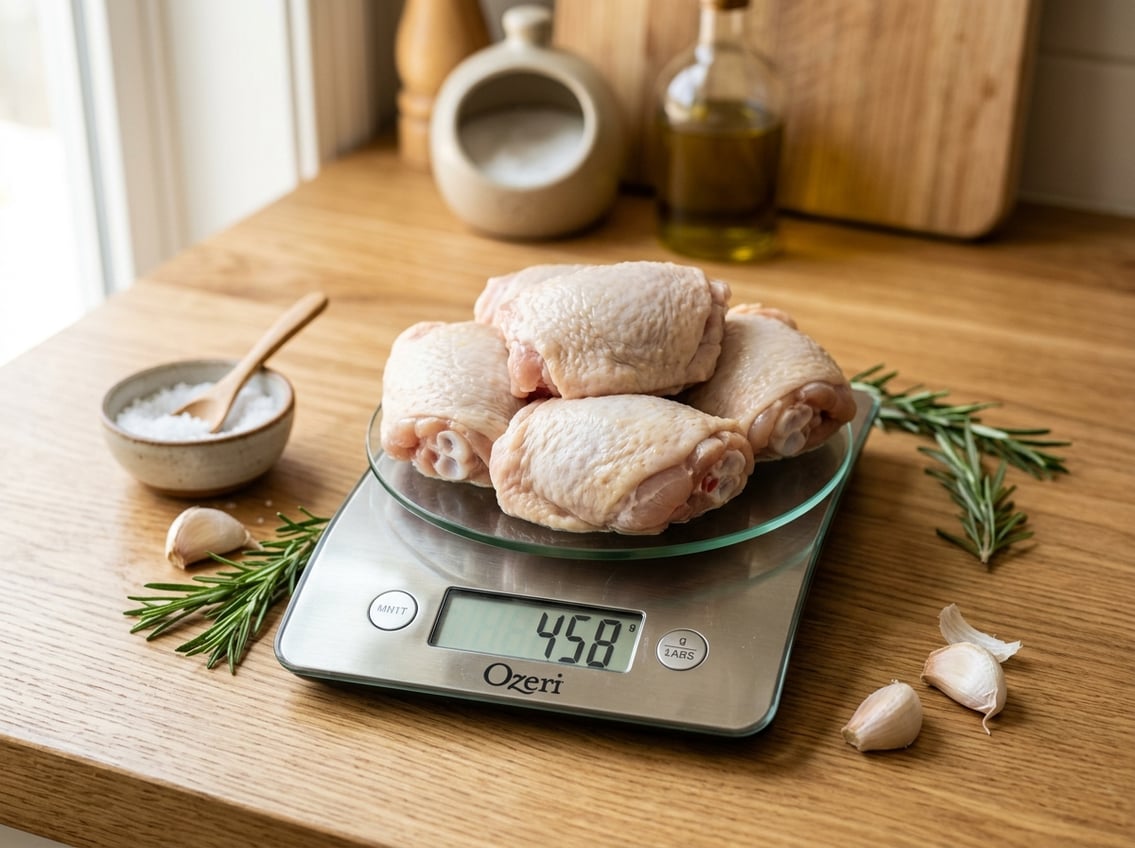
Thigh size, bone and skin presence, and cooking loss can change those counts. Serving sizes and easy conversions for pounds, cups, and package sizes help you buy and cook confidently.
Typical Chicken Thigh Count Per Pound
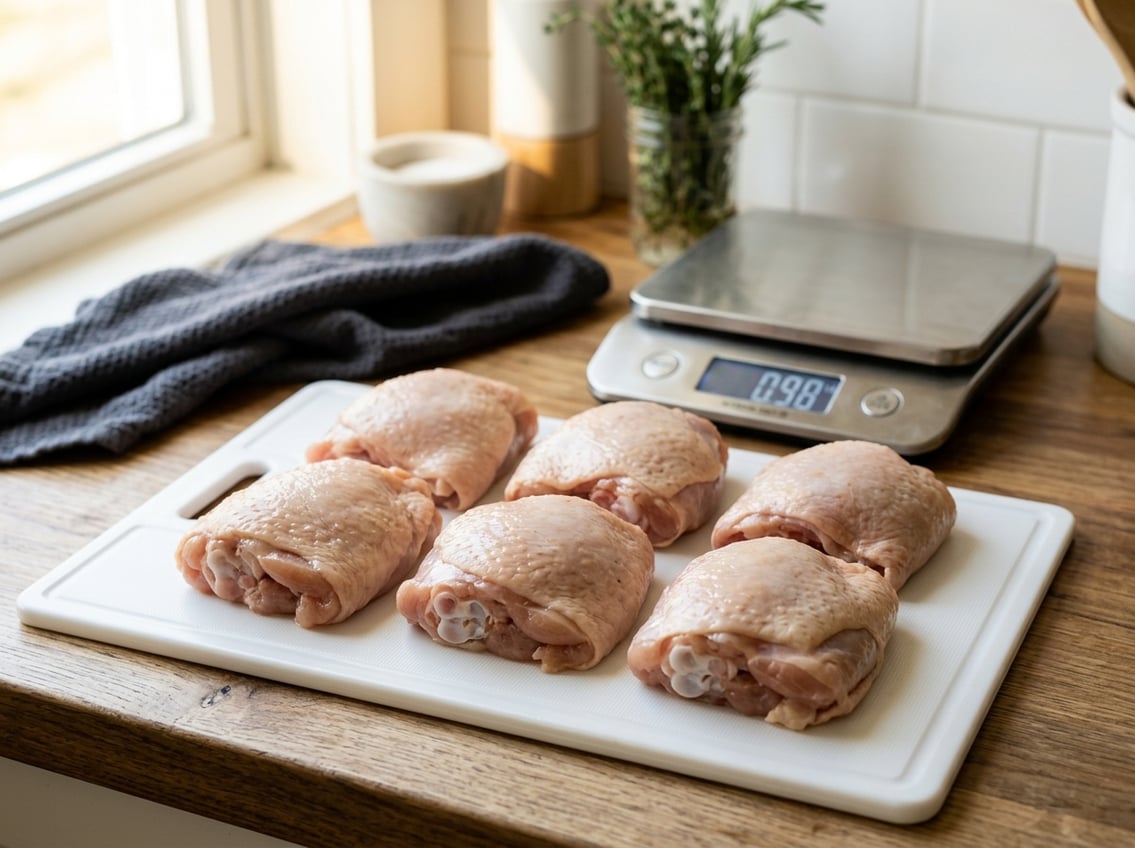
Bone-in, skin-on thighs weigh more, so you get fewer per pound. Boneless, skinless pieces are smaller and more numerous per pound.
Bone-In Versus Boneless Portion Counts
Bone-in chicken thighs typically come 3 per pound, with each raw piece weighing about 4–6 ounces.
Bones and skin add weight, so the edible meat per thigh is roughly 2–3 ounces after cooking.
Plan on 1 bone-in thigh per adult serving when the thigh is the main protein.
Boneless, skinless chicken thighs usually measure 4–6 per pound, averaging 2–3 ounces each raw.
They yield more edible meat per pound, about 12–16 ounces cooked from 1 raw pound.
Use 2 boneless thighs per adult serving for a standard 4–6 ounce cooked portion.
Factors Affecting Thigh Quantity
Size varies: supermarket packs may contain smaller boneless thighs (5–6 per lb) or larger ones (3–4 per lb).
Butcher-cut or family-farm thighs may be larger than grocery-packaged pieces.
Processing changes counts as well. Trimmed, deboned, or skinless thighs weigh less than untrimmed bone-in pieces.
Packaging often rounds to convenient counts, so check ounce labels if you need exact portions.
Recipe role and serving size influence how many thighs you buy.
For casseroles or salads, measure by cups or ounces (1 lb boneless ≈ 2 cups diced).
For main-dish portions, follow the serving guidelines above to match appetite and leftovers.
Average Weight and Sizing of Chicken Thighs
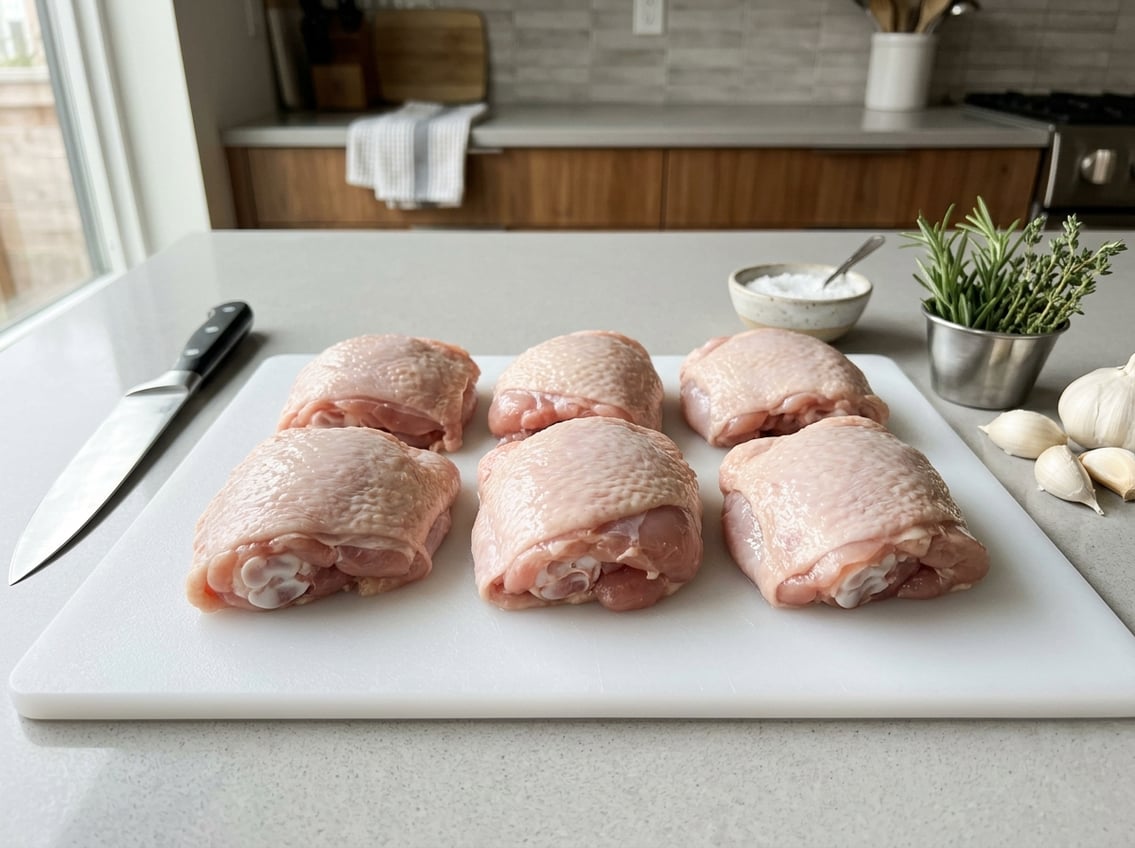
Individual thighs vary by cut and cooking state.
Raw, bone-in thighs weigh more than boneless pieces, and cooked weight drops by roughly a quarter.
Raw and Cooked Weight Comparisons
Raw bone-in, skin-on thighs commonly weigh about 110–140 g (3.9–4.9 oz) each.
Raw boneless, skinless thighs typically fall near 75–95 g (2.6–3.4 oz) each.
These raw figures are what most package nutrition labels use.
When you cook thighs, expect weight loss from moisture and fat rendering.
A reasonable rule is to expect around 20–30% weight loss for bone-in, skin-on thighs and 25–35% for leaner boneless pieces.
A 125 g raw bone-in thigh usually yields about 90–100 g cooked meat, while an 85 g raw boneless thigh yields about 55–65 g after cooking.
Use raw weights for calorie counting unless the packaging specifies cooked-weight nutrition.
Size Variability by Cut
Bone-in thighs include the bone and skin, which add non-edible weight.
That raises package weight but lowers edible meat per thigh compared with boneless cuts.
Expect about 125 g raw per average bone-in thigh and 83 g raw per average boneless thigh.
Different suppliers and chicken breeds can change those numbers.
Smaller utility or young chickens produce thighs under 100 g raw bone-in.
Larger or “large” labeled thighs can exceed 150–200 g raw.
If you need consistent portions, buy boneless, skinless thighs or trim and weigh thighs individually.
Retail packs often list total weight.
Convert to counts using average per-cut weights: roughly 4 bone-in thighs per pound or 4–5 boneless thighs per pound, depending on size.
Weighing Individual Thighs
Weigh thighs on a kitchen scale for precise portions.
Tare the bowl first, then weigh raw if you track calories because most databases use raw values.
Record whether you included skin and bone.
Removing bone reduces weight by roughly 30–40% of the raw bone-in number.
If you lack a scale, estimate counts: use 4 bone-in thighs = 1 lb and 4–5 boneless thighs = 1 lb as practical approximations.
For meal planning, plan one bone-in thigh per adult or two boneless thighs per adult as portion guidelines.
Adjust by appetite and side dishes.
Serving Amounts and Portion Planning
Plan portions by weight and account for bone-in vs. boneless.
Use 4–6 ounces cooked per adult for a main course.
Increase for big eaters, and reduce when sides are heavy.
How Many Chicken Thighs Per Serving
If you use boneless, skinless thighs, plan about 4–6 ounces cooked per adult.
That usually equals 1–2 small boneless thighs or roughly 0.25–0.33 lb (4–5.3 oz) raw per person.
For bone-in thighs, plan 8–12 ounces raw to deliver the same edible meat, which typically equals one medium bone-in thigh per adult.
Bone and skin increase raw weight but not edible meat, so count by ounces rather than pieces when sizes vary.
Quick reference:
- Boneless: 4–6 oz cooked → 1–2 thighs
- Bone-in: 8–12 oz raw → 1 thigh
Adjust to appetite; teens and athletes may need more.
How Many Thighs to Buy for a Group
Decide cooked ounces per person, multiply by guest count, then convert to raw weight.
Example: for 20 adults at 6 oz cooked each, you need 120 oz cooked (7.5 lb).
Convert to raw:
- Boneless: divide cooked weight by 0.75 → buy about 10 lb raw
- Bone-in: divide by 0.55 → buy about 13.6–14 lb raw
If you lack a scale, estimate by piece count:
- Boneless: assume 3–4 thighs per pound
- Bone-in: assume 2–3 thighs per pound
Add a 10–15% buffer for seconds, serving variation, or unexpected guests.
Adjusting Quantities for Leftovers
If you want leftovers, add 15–25% to your total raw purchase.
For 10 adults at 6 oz cooked each, you’d normally buy about 7.5 lb cooked equivalent.
Adding 20% means buy about 9–9.5 lb raw boneless.
Cooked thighs keep 3–4 days refrigerated or 3 months frozen.
Label portions before storing to avoid waste.
If you plan to shred thighs for salads or tacos, one boneless thigh can stretch to two small tacos.
You can reduce per-person raw weight when serving shredded preparations.
Conversions: Pounds, Cups, and Cooking Yield
A pound of raw chicken thighs typically equals about 2 cups of chopped meat when boneless and skinless.
Expect variations by bone presence, cut size, and whether the meat is diced or shredded.
How Many Cups in a Pound of Chicken Thighs
A pound of boneless, skinless chicken thighs usually yields about 2 cups of chopped or diced meat.
If the thighs are bone-in, the edible meat per pound drops roughly in half.
One pound of bone-in thighs yields closer to 1 to 1.25 cups of meat.
Quick reference:
- Boneless, skinless thighs: about 2 cups per pound
- Bone-in thighs (raw): about 1–1.25 cups meat per pound
Weigh packaged thighs when precision matters.
Cup measurements vary with how tightly you pack the pieces, so scale by weight for consistent recipes.
Estimating Cups for Diced or Shredded Meat
Diced chicken occupies more volume than shredded, because cubes trap air and don’t compress as much.
One pound of boneless thighs diced typically measures about 2 to 2.25 cups.
The same pound shredded usually measures 1.75 to 2 cups.
When a recipe calls for a cup amount:
- For diced: plan 2 cups per pound
- For shredded: plan 1.75–2 cups per pound
Pack cups loosely when measuring diced or shredded chicken for recipes like casseroles or salads.
If you need an exact volume, chop or shred and then spoon into the cup measure rather than pressing the meat down.
Chicken Shrinkage During Cooking
Chicken thighs lose mass during cooking from water and fat loss.
Expect roughly 15–25% weight loss for boneless, skinless thighs with standard roasting or sautéing.
Bone-in pieces can lose a similar percentage of edible meat, but the presence of bone makes yield calculations less direct.
Start with about 1.25 pounds raw boneless thighs to end with 1 pound cooked (estimate 20% loss).
For bone-in, buy roughly twice the weight of what you need in meat servings.
Rest cooked chicken for a few minutes before measuring; juices redistribute and volume stabilizes.
Quantity Estimates for Common Purchase Scenarios
You can use these quick counts and storage tips to plan meals and shopping.
Expect differences between bone-in and boneless, skinless thighs and plan portions accordingly.
Chicken Thigh Counts in 1.5 Pounds
For bone-in, skin-on thighs, expect about 3 to 5 pieces in 1.5 pounds.
Bone and skin add roughly 4–6 ounces per thigh, so 1.5 lb typically equals 3 larger or 4–5 medium thighs.
For boneless, skinless thighs, expect about 6 to 9 pieces in 1.5 pounds.
Boneless thighs average 2.5–3.0 ounces each, so 1.5 lb (24 oz) gives you roughly 8 thighs if they’re small-to-medium, or 6–7 if they’re large.
Quick reference:
- Bone-in: 3–5 thighs per 1.5 lb
- Boneless/skinless: 6–9 thighs per 1.5 lb
If you need exact portions, weigh thighs on a kitchen scale after trimming.
That ensures the number matches your recipe or calorie target.
Bulk Buying and Storage Tips
Choose boneless, skinless thighs when buying 5–10 pounds for a family or meal prep.
These provide predictable counts and faster cooking.
A 5 lb pack of boneless thighs usually contains 25–40 pieces depending on individual size.
Freeze unopened packs flat to save space and speed thawing.
Portion into meal-sized packages, such as 1.5 lb or 2 lb, and label with date and weight.
Thaw in the refrigerator for 24 hours per 2–3 pounds to ensure safe handling.
Vacuum-seal thighs to keep quality longer, up to 9 months in the freezer.
If you use regular freezer bags, plan for 4–6 months.
Bring frozen thighs to fridge temperature before seasoning for cooking consistency.
This helps you achieve even cooking and predictable yield per thigh.


