
What Should Chicken Thighs Be Cooked To: Temps, Times, and Best Methods
You want safe, juicy chicken thighs without guessing. Cook thighs to at least 165°F for immediate safety. For tender, fall-apart dark meat, aim for 190–195°F. 175°F sits in the middle for reliably juicy results.
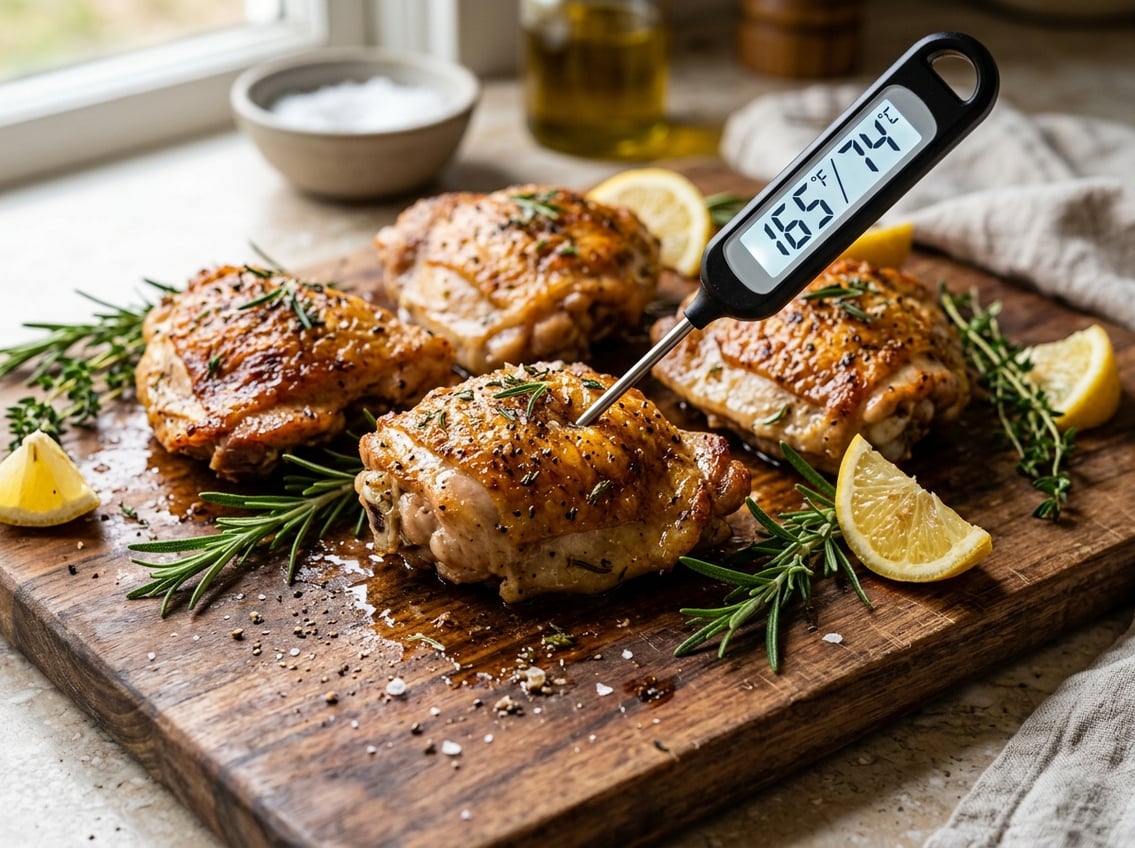
Different methods like roasting, braising, grilling, or pan-searing change the temperature-to-texture tradeoff. Use an instant-read thermometer for accuracy, but you can also use visual cues.
Bone-in or boneless and skin-on or skinless thighs affect timing and flavor. Adjust your method based on these factors to reach your target temperature.
Essential Internal Temperatures for Chicken Thighs
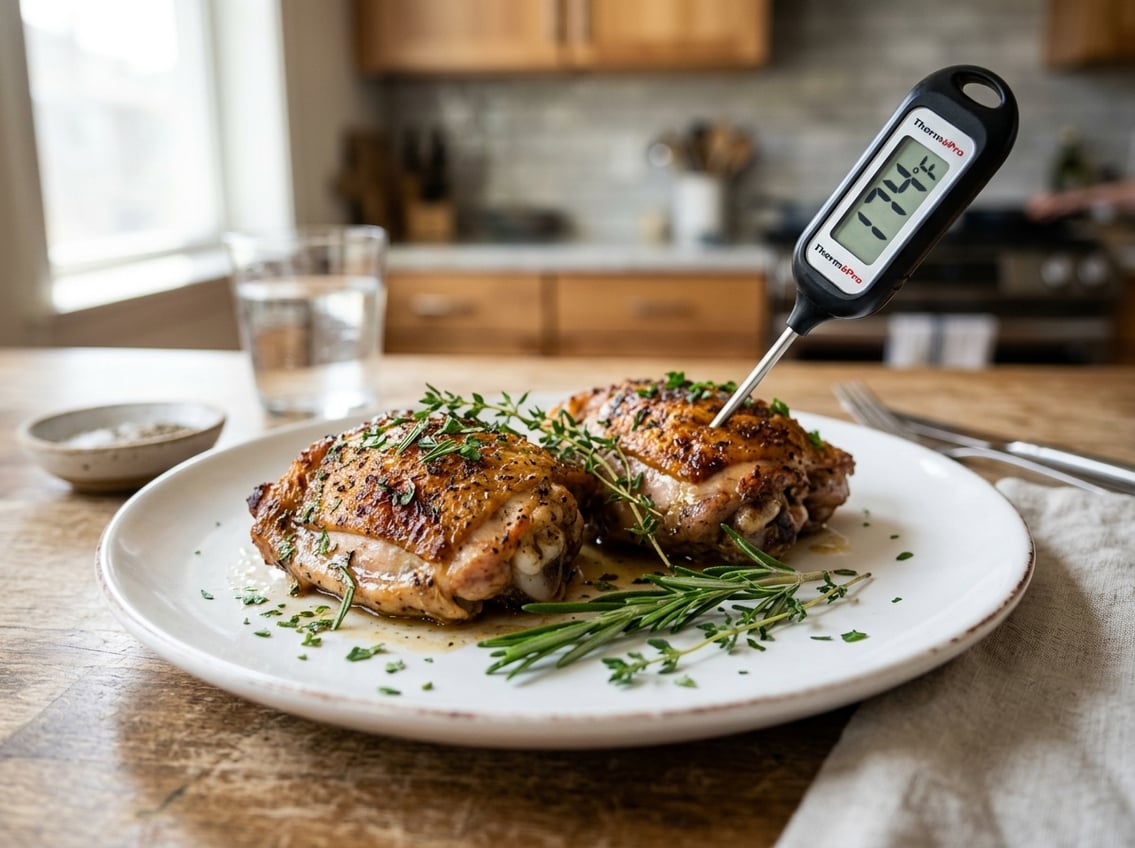
You need to know the minimum safe temperature and the range that yields the best tenderness. Dark meat cooks differently from white meat, affecting both safety and texture.
Minimum Safe Temperature Guidelines
Cook chicken thighs to at least 165°F (74°C) measured in the thickest part, away from bone. Use an instant-read thermometer and allow the probe to stabilize for a reliable reading.
If you prefer a lower finish temperature, you must hold the meat at that temperature long enough to pasteurize it. For most home cooks, aiming for 165°F removes guesswork and ensures safety.
Rest the thighs for 3–5 minutes after removing from heat. Carryover heat can raise the internal temp slightly and redistribute juices.
Optimal Range for Tender and Juicy Results
For juicier, more tender thighs, many cooks target 175–195°F (79–91°C). Collagen in dark meat breaks down into gelatin in this range, making meat softer and more succulent.
Oven-roast at 400°F to reach 175°F in 25–35 minutes for bone-in thighs. Braising or slow-roasting at 300–325°F may take 45–90 minutes to hit 190°F. Use a thermometer to track progress rather than relying on time alone.
If you want crisp skin and tender meat, finish skin-side up under high heat or a quick broil after reaching your target internal temp.
Differences Between White Meat and Dark Meat
White meat (breast) and dark meat (thighs/drumsticks) react differently to heat because of muscle composition. Breasts dry out quickly when pushed past 165°F, while thighs gain tenderness as connective tissue dissolves between about 140°F and 195°F.
Treat thighs and breasts differently when cooking a whole bird or mixed cuts. Cook thighs to 175–195°F for tenderness, and remove breasts earlier or use lower-temperature techniques and rest to keep them juicy.
Time-to-temperature varies with bone-in vs. boneless thighs and piece thickness. Always check the thickest part of each piece and adjust cook time rather than guessing by weight alone.
Verifying Doneness: Tools and Techniques
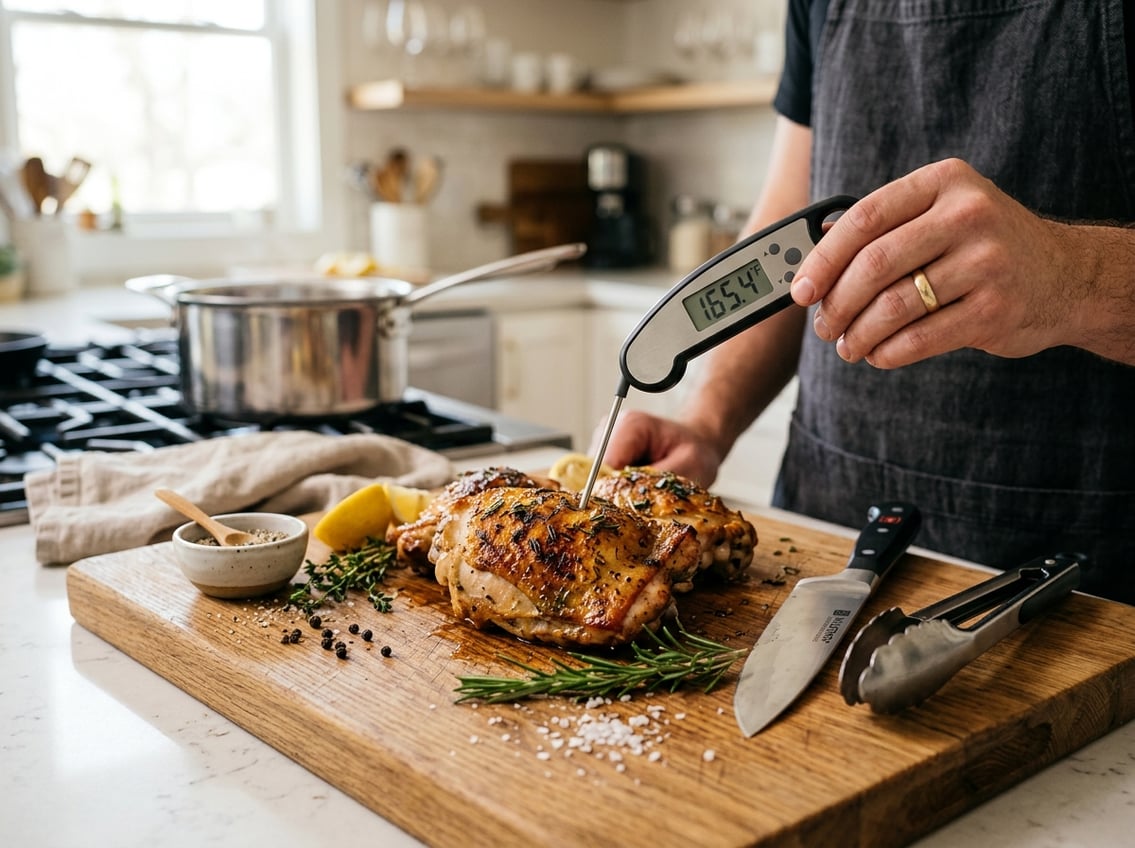
Use the right thermometer and insert it in the thickest part away from bone. If you lack a probe, check visual and texture cues.
Using a Meat Thermometer Correctly
Pick a calibrated meat thermometer and place the probe into the thickest part of the thigh, avoiding contact with bone or fat. For bone-in thighs, insert the probe from the side into the center of the muscle. For boneless, push straight into the middle.
Hold the probe steady until the reading stabilizes. Follow the USDA minimum of 165°F (74°C) as the baseline, but many cooks remove thighs at 170–185°F depending on desired tenderness.
Clean the probe before and after use. Verify accuracy periodically by testing in ice water or boiling water.
Instant-Read Thermometer Tips
Use an instant-read thermometer for quick checks during searing, grilling, or roasting. Insert it at least 1/2 inch into the thickest part and wait the device’s specified stabilization time.
If you plan to finish in the oven, test toward the end of cooking and remove when the probe shows your target temperature. Carryover cooking will raise internal temp 2–5°F during resting.
Store and handle the unit gently. Do not leave instant-read probes in direct oven heat unless the model is rated as a leave-in probe.
Visual and Textural Cues
When you can’t use a thermometer, rely on specific visual and tactile signs. Cut a small slit at the thickest point. Cooked thigh meat looks opaque and light-brown to white, not translucent.
Press the meat with tongs or your finger. Properly cooked thighs feel firm but still springy. Undercooked meat feels soft and jelly-like, while overcooked meat is stiff and dry.
Look for clear juices, not pink or bloody runoff. On bone-in thighs, check for slight pullback of meat from the bone and a little looseness at the joint.
Cooking Methods and Their Impact on Temperature
Different cooking methods change how heat moves through the meat and how long connective tissue needs to break down. Pay attention to oven or grill settings, target internal temperature, and resting time.
Oven Roasting Chicken Thighs
Roasting uses dry, even heat. Set the oven to 400–425°F (205–220°C) for skin that browns without overcooking the interior. For bone-in thighs, expect 30–45 minutes to reach 175–185°F. For boneless, plan 20–30 minutes.
Use an instant-read thermometer inserted into the thickest part, avoiding bone. Pull the thighs a few degrees before target to allow carryover. Rest the meat 5–10 minutes to let juices redistribute and finish rising 2–5°F.
Arrange thighs skin-side up on a rack for even air circulation. To get very tender meat, pull to 190–195°F and roast longer at 350°F.
Baking Chicken Thighs
Baking uses lower temps and covered pans, which preserves moisture. Bake at 350–400°F (175–205°C) depending on whether you want crisp skin or a juicier, saucier result. Covered baking reduces surface browning; uncover for the last 10 minutes to crisp skin.
Target internal temps remain the same: 165°F is the USDA minimum, 175–185°F for a balance of tenderness, and 190–195°F for very soft, pull-apart texture. Use a thermometer through the thickest part. Baking times vary with pan depth and whether thighs start cold.
If baking with vegetables, start vegetables first or raise oven to 400°F to ensure even doneness. Briny or oily marinades speed surface browning. Adjust bake time if the surface chars.
Grilling Chicken Thighs Outdoors
Grilling exposes thighs to direct and indirect heat. Control temperature zones on the grill for even cooking. Sear over medium-high direct heat (425–500°F) for 2–4 minutes per side to crisp skin and create char. Move to indirect heat at 325–350°F to finish.
Bone-in thighs typically reach 175–185°F after 20–30 minutes total. Boneless finishes faster.
Always measure temperature in the thickest part, avoiding bone contact. Keep the lid closed during indirect cooking to stabilize grill temp and use a probe thermometer for continuous readings.
For skin-on thighs, start skin-side down to render fat. Watch flare-ups from marinades with sugar and reduce direct time if charring occurs.
Pan-Searing and Braising Techniques
Start by pan-searing to brown skin or surface and develop flavor. Use medium-high heat and a heavy skillet. Sear 3–5 minutes per side until golden, then finish in the oven at 350–375°F or transfer to a braising liquid and simmer gently.
Braising combines liquid and low, steady heat to convert collagen in dark meat to gelatin. Maintain an internal temperature range of 175–195°F for best tenderness. Longer, lower cooking (around 300°F oven or low simmer) increases succulence.
Deglaze the pan after searing to build the braising sauce. If you need crisp skin after braising, briefly broil or finish in a hot skillet to re-crisp at 425–500°F.
Bone-In vs. Boneless and Skin-On vs. Skinless Cuts
You’ll choose between bones, no bones, and whether the skin stays on based on cooking time, flavor, and how you plan to use the thighs. Temperature targets and techniques change with those choices.
Bone-In Chicken Thighs
Bone-in chicken thighs take longer to reach safe internal temperature because bone slows heat transfer. Aim for 165°F (74°C) measured in the thickest part of the meat, away from the bone, then rest 5–10 minutes.
Bones add flavor and help thighs stay moist during roasting or braising. Use lower oven temperatures (325–375°F) for even cooking in whole pieces, or sear then finish in the oven to get a brown exterior without overcooking the interior.
If you grill, watch flare-ups and use indirect heat for thicker thighs.
Boneless Chicken Thighs
Boneless thighs heat through faster and more evenly, so they reach 165°F sooner. They tolerate higher-heat, quick methods like pan-searing, stir-frying, or broiling. Check temperature in the center; thinner pieces may need only a few minutes per side.
Because boneless thighs often have more surface contact, they crisp and caramelize quickly. They’re convenient for skewers, cuts for salads, and recipes that call for uniform pieces.
If you’re stuffing or rolling thighs, remove them from heat at 160–162°F and rest. Carryover heat will finish them to 165°F without drying.
Skin-On vs. Skinless: Impact on Cooking
Skin-on thighs give you a protective fat layer that promotes browning and keeps meat moist. Roast or pan-sear skin-side down to render fat and crisp the skin. Finish meat-side up to avoid soggy skin.
Target 165°F in the meat and allow a resting period to redistribute juices. Skinless thighs cook faster and have less surface fat to crisp, so they suit quick sautés, curries, or braises where a browned crust isn’t required.
Because they lack the insulating skin, monitor temperature closely to prevent drying. Pull at 160–162°F and rest to reach safe 165°F while preserving tenderness.
Preparing Chicken Thighs for Optimal Cooking
Proper prep sets you up for even cooking, juicy meat, and crisp skin when appropriate. Focus on salt, acid, and timing so the thighs hit the right internal temperature.
Marinating Chicken Thighs
Marinades add flavor and can tenderize. Use oil plus an acid and salt. Combine 2–3 tbsp oil with 1 tbsp acid (vinegar, lemon juice, or yogurt) per pound of thighs, plus 1 tsp kosher salt and your choice of herbs or spices.
Marinate in a nonreactive container or zip-top bag. For bone-in, skin-on thighs marinate 1–4 hours. For boneless, skinless, limit to 30–90 minutes to avoid overly soft texture from acids.
Pat thighs dry before cooking to promote browning. Reserve any marinade used with raw meat only if you boil it for at least 1–2 minutes before using as a sauce.
Brining Chicken Thighs
Brining firms the meat and improves juiciness by increasing the meat’s water-holding capacity. Use a simple wet brine: 4 cups water + 3 tbsp kosher salt + 2 tbsp sugar per 1–2 pounds of thighs.
Submerge thighs and refrigerate 30 minutes to 2 hours for boneless pieces. For bone-in, brine 2–8 hours. Rinse lightly and pat dry after brining to prevent overly salty crust.
For a quick alternative, a dry brine of ½–1 tsp kosher salt per pound applied and refrigerated for 1–24 hours works well and helps skin crisp when roasting or pan-frying.
Cooking Chicken Thighs From Frozen
You can cook thighs from frozen safely if you adjust time and method. The best options are oven roasting at 375°F (190°C) or simmering in a covered pan with a little liquid.
Both methods allow heat to penetrate evenly. Expect about 50% longer cooking time than thawed thighs.
Use a meat thermometer and cook until the thickest part reaches 165°F (74°C). For bone-in frozen thighs, check temperature near the bone.
Do not start frozen skin-on thighs in a high-heat pan, as this prevents proper browning. Thaw in cold water for quicker prep if you want crisp skin or a faster sear.
Timing and Temperature Charts for Popular Techniques
Here are clear time and temperature targets for boneless and bone-in thighs across common methods. These include the internal temperatures to aim for and how resting affects final doneness.
Typical Timing by Method and Cut
Bake boneless, skinless thighs at 425°F for about 20–30 minutes. Check with an instant-read thermometer in the thickest part and target 165°F.
Smaller pieces finish toward the low end of that range. Roast bone-in, skin-on thighs at 425–450°F for 30–40 minutes.
If you roast at 350°F, cook for 40–50 minutes. For sear-then-roast, sear 4–5 minutes per side over high heat, then roast 12–20 minutes depending on size.
For pan-frying or sautéing, cook bone-in halves for 6–8 minutes per side over medium-high heat. Boneless pieces need 4–6 minutes per side.
Sous-vide uses 140–165°F for 1–4 hours depending on texture preference, then sear quickly.
Temperature Chart Reference
Use this quick reference. Insert the thermometer into the thickest, meatiest part, avoiding bone.
- Boneless, baked (425°F): 20–30 min → 165°F internal
- Bone-in, roasted (425–450°F): 30–40 min → 165°F internal
- Low-temp roast (350°F): 40–50 min (4–8 oz thighs) → 165°F internal
- Pan-fry/sauté (med-high): 4–8 min per side → 165°F internal
- Sous-vide: 140°F (tender) for 1–2 hrs; 150–165°F (firmer) for 1–4 hrs → finish by searing to brown
You must cook to an internal temperature of 165°F for safety. Visual checks, such as clear juices and opaque meat, support the reading but do not replace it.
Resting and Carryover Cooking
Let the thighs rest for 5–10 minutes if they are boneless and 10–15 minutes if they are bone-in. The internal temperature usually rises by 2–8°F during this time, depending on the size and residual heat.
Juices redistribute during rest. If you slice too soon, the meat loses moisture.
If you remove the chicken when the thermometer reads 160–162°F, resting will likely bring it to 165°F. For large roasts or crowded pans, expect higher carryover and lower your target removal temperature by about 2–5°F for small pieces and 5–8°F for large bone-in portions.


