
Who Invented Chicken a la King? Uncovering Its Origins and History
Historians debate the inventor of chicken à la King. Multiple chefs and hotels in the United States and Britain claimed the dish in the late 19th and early 20th centuries, so no single creator stands out.
Most evidence suggests U.S. hotel and restaurant chefs popularized the recipe. Chefs named King or those working at places like the Bellevue and Delmonico’s played a key role in spreading the dish.

Let’s look at what the dish is, why its origin stories persist, its early recipes, and how cooks have adapted it over time. The story moves from elegant hotel dining rooms to home kitchens, showing how a creamy sauce became a culinary legend.
What Is Chicken à la King?

This dish combines diced poultry with a creamy sauce and vegetables. You’ll often find it served over bread, rice, or pasta.
Mushrooms, pimientos, and sometimes sherry are common. Some recipes substitute turkey or tuna.
Chicken à la King features diced or shredded chicken in a savory cream sauce. A roux or cream base gives the dish its signature richness.
The recipe calls for fully cooked, bite-sized chicken pieces. Each forkful blends meat, sauce, and vegetables.
The dish became popular in the early 20th century as both home and restaurant fare. It became a comfort-food staple midcentury.
You can think of it as a flexible comfort food. Cooks adapt the sauce, add vegetables, or swap proteins, but chicken in a creamy, seasoned sauce remains the core.
Common Ingredients and Garnishes
Core ingredients include cooked chicken, butter, flour, milk or cream, and mushrooms. Diced pimiento or bell pepper adds color and sweetness, and peas show up in some versions.
Seasoning is simple: salt, black pepper, and sometimes a splash of sherry or dry white wine. Mushrooms add earthiness and texture.
Garnishes are minimal but add color. Chopped parsley or pimiento strips are common. Some cooks sprinkle paprika or add toasted bread crumbs when baking the dish in pastry.
Typical Serving Styles
People usually serve Chicken à la King over toasted bread, white rice, or egg noodles. Toast gives crispness, rice absorbs flavors, and noodles offer a neutral base.
The dish also appears in pastry cases for a more formal look. Puff pastry contains the sauce and provides a flaky contrast.
Variations use turkey or tuna, and vegetables can be adjusted—peas, carrots, or peppers are frequent additions.
Keep the sauce warm but not boiling to maintain smoothness. Choose a starch that fits the meal’s style and texture.
Contested Origins
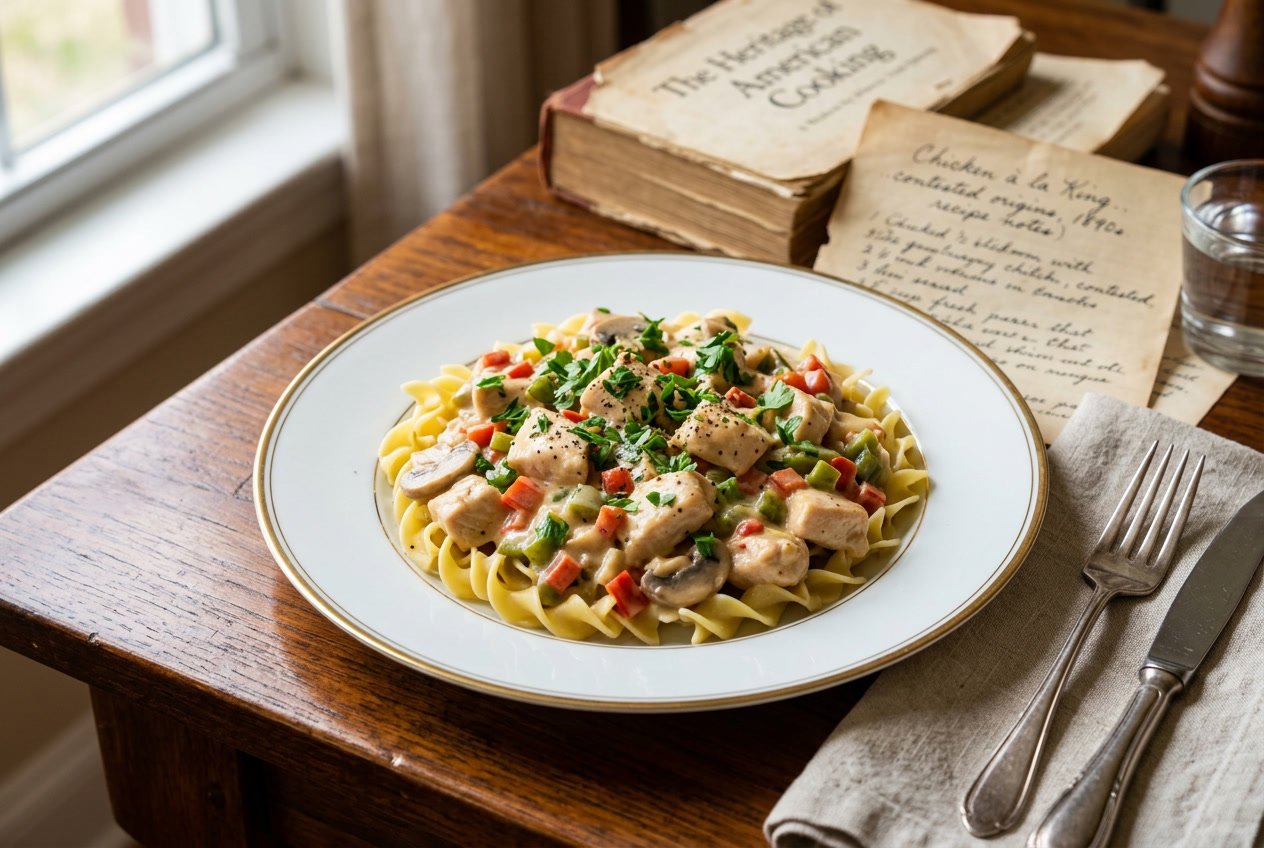
Several origin stories tie the dish to late 19th-century American hotels, chefs, and cookbooks. Accounts disagree on who named or first served the dish, but most agree it began in the U.S. and appeared in print by the 1890s.
Competing Stories in the United States
Some accounts credit Chef George Greenwald at the Brighton Beach Hotel in New York in the 1890s. The dish was associated with hotel owner E. Clark King II.
Another claim points to William King of the Bellevue Hotel in Philadelphia, also in the 1890s, and reported in a 1915 New York Times obituary.
Delmonico’s in New York features in another version. Some stories say Foxhall P. Keene suggested the dish to a Delmonico’s chef, or that it was linked to James R. Keene’s circle.
Fannie Merritt Farmer’s 1896 Boston Cooking School Cook Book includes recipes labeled similarly, offering the earliest firm printed evidence.
British and International Claims
Some histories connect the dish to British hotels. Claridge’s Hotel in London appears in stories suggesting the dish, or versions called “à la Keene” or “à la reine,” traveled across the Atlantic.
One story ties the creation to a celebration after Foxhall (the horse) won a race in 1881, with a London hotel preparing a special dish.
These British claims often overlap with American names and reflect parallel naming rather than a single inventor. Internationally, cooks adapted the recipe, making it hard to assign a single birthplace.
Timeline of Early Mentions
- 1881: Anecdotal link to a London hotel celebration after Foxhall’s racing victory.
- 1890s: Multiple hotel-based claims in New York and Philadelphia.
- 1896: Fannie Merritt Farmer publishes recipes in the Boston Cooking School Cook Book, the earliest clear printed recipe.
- 1915: New York Times obituary cites William King (Bellevue) as a creator.
These points show how oral tradition, hotel publicity, and cookbook publication shaped the dish’s early history.
Who Really Invented Chicken à la King?
Several competing stories connect the dish to late 19th–early 20th century New York and Philadelphia figures. Each claim points to a chef or patron and to slightly different early recipes.
The George Greenwald and E. Clark King II Story
One version credits chef George Greenwald at the Brighton Beach Hotel in New York in the 1890s. The dish was named for hotel owner E. Clark King II, who wanted a rich, elegant entrée for guests.
This story appears in period hotel brochures and later references, which gives it some documentary support. The name “King” refers to a proprietor, not royalty.
The French-styled name “à la King” made the dish sound refined and marketable. If you follow this story, the dish began as a hotel specialty for upscale clientele.
The William “Bill” King Claim
Another claim attributes Chicken à la King to William “Bill” King of the Bellevue Hotel in Philadelphia, also in the 1890s. A 1915 New York Times obituary credits William King with the recipe.
Obituaries can reflect local memory more than documentation, so this version relies on personal attribution rather than menus or printed recipes. This connection emphasizes the dish’s spread through prominent hotels.
The Keene Family and Delmonico’s Tale
Other stories link the dish to the Keene family and Delmonico’s in Manhattan. Some name James R. Keene or his son Foxhall P. Keene as the inspirers, while others credit Delmonico’s chef Charles Ranhofer.
Fannie Merritt Farmer included recipes called Chicken à la King in her 1896 Boston Cooking-School cookbook, providing firm printed evidence of the name. The Keene/Delmonico narrative shows a possible evolution from “Chicken à la Keene” to “à la King.”
Delmonico’s culinary prestige and Ranhofer’s influence helped spread the dish nationally.
Early Recipes and Reception
Early printed recipes and menus show how the dish moved from professional kitchens to home cookbooks and everyday dining. Publications and chefs played a role in spreading it, and its comfort-food status grew through restaurant service and home cooking.
First Cookbook Appearances
Fannie Merritt Farmer’s Boston Cooking-School Cook Book (1915) offered a widely cited printed recipe. That book gave home cooks a clear version: diced chicken in cream sauce with mushrooms and often sherry, served over toast, rice, or noodles.
Newspaper mentions and hotel menus appeared before and alongside Farmer’s recipe. The New York Times reported on claims linking the dish to Bellevue and other hotels.
These records show how a restaurant specialty became accessible to home cooks through cookbooks.
Popularity in the 20th Century
By the 1920s–1960s, Chicken à la King appeared on club and banquet menus and in American households as a staple chicken dish. Mid-century cookbooks and magazines featured it as a Saturday-night dinner or buffet item, often over toast points or in pastry shells.
Writers and food editors in mainstream outlets documented its popularity. The recipe adapted to convenience trends, with canned soups and pre-cooked meats making preparation easier and helping the dish remain a classic comfort food.
Ingredients and Preparation
The dish uses a roux-thickened cream sauce, tender protein, and flexible serving options like rice, noodles, bread, or pastry. Precise proportions, gentle cooking, and a splash of sherry or pimiento enhance the flavors.
The Sauce
Start with equal parts butter and flour to make a light roux. Cook until the raw flour smell disappears.
Whisk in warmed chicken stock, then cream or half-and-half to control thickness and prevent curdling. Season with salt, white pepper, and a bit of dry sherry.
Add sautéed mushrooms and finely diced onion, cooking the onion until translucent. Add diced pimiento or roasted red pepper at the end for color.
Adjust the stock-to-cream ratio for your preferred texture. Finish with a small pat of butter off heat for sheen.
Proteins and Vegetables
Cubed cooked chicken is the classic choice. Use poached breast or roasted leftovers for moist meat.
Turkey and canned or flaked tuna are common substitutions. Add them at the end to warm through.
Vegetable additions include mushrooms and peas. Sauté mushrooms separately before adding to the sauce.
Peas, diced carrots, or bell pepper can be stirred in near the end. Keep vegetable pieces small and uniform.
If using canned protein or vegetables, drain well to avoid thinning the sauce. Taste and adjust salt before serving.
Serving Options
Choose your base to match the meal. Serve the sauce over steamed rice or egg noodles for a hearty meal.
For a classic look, spoon the mixture into puff pastry shells. Toast points or buttered bread work well for buffet service.
Make sure the sauce is thick enough to coat without pooling. Garnish with chopped parsley or pimiento strips for color.
Modern Variations and Legacy
Chicken à la King remains a creamy chicken dish familiar from midcentury cookbooks. Today, cooks prepare it with fresh ingredients, bolder seasoning, and varied service options.
Expect adaptations that add or swap vegetables, adjust the sauce, or change how the dish is plated.
Contemporary Twists and Global Adaptations
You can find modern twists that replace canned ingredients with fresh produce and homemade sauce. Chefs often use sautéed shiitake or cremini mushrooms, roasted bell peppers, and peas.
They finish the sauce with sherry or dry white wine for depth. Many home cooks prefer a roux-thickened béchamel made with stock and cream instead of egg-thickening.
This method makes the sauce more stable for reheating or baking. Global adaptations change the protein or liquid to suit local palates.
In Australia, cooks sometimes substitute coconut milk or seafood for cream and chicken. In the U.K., cooks use double cream and mustard for richness.
You can also find versions served over rice, pasta, or toasted bread points. Each choice alters texture and presentation.
Chicken à la King in Today’s Cuisine
You will see Chicken à la King on restaurant menus as both nostalgic comfort food and as an ingredient for contemporary plates.
Upscale kitchens transform it into plated entrees with microgreens and reduced pan sauces. Chefs also use the components as a filling for vol-au-vents and puff pastry tartlets.
Casual spots and frozen-food brands keep a more traditional profile. They offer accessible versions that echo the midcentury chicken à la king recipe.
If you cook it at home, focus on technique. Brown diced chicken for Maillard flavor and sweat aromatics.
Make a smooth roux, then finish with cream and seasonings. This approach preserves the dish’s comforting creaminess and lets you adapt it to modern tastes.


