
Where to Temp Chicken Thighs: Precise Spots & Safe Cooking Tips
You want juicy, safe chicken thighs. The quickest way to achieve this is to check the temperature in the thickest part of the meat near, but not touching, the bone.
Aim for about 175°F for reliably tender thighs. For falling-apart soft meat, push toward 190–195°F. The USDA minimum is 165°F, but this won’t maximize tenderness.
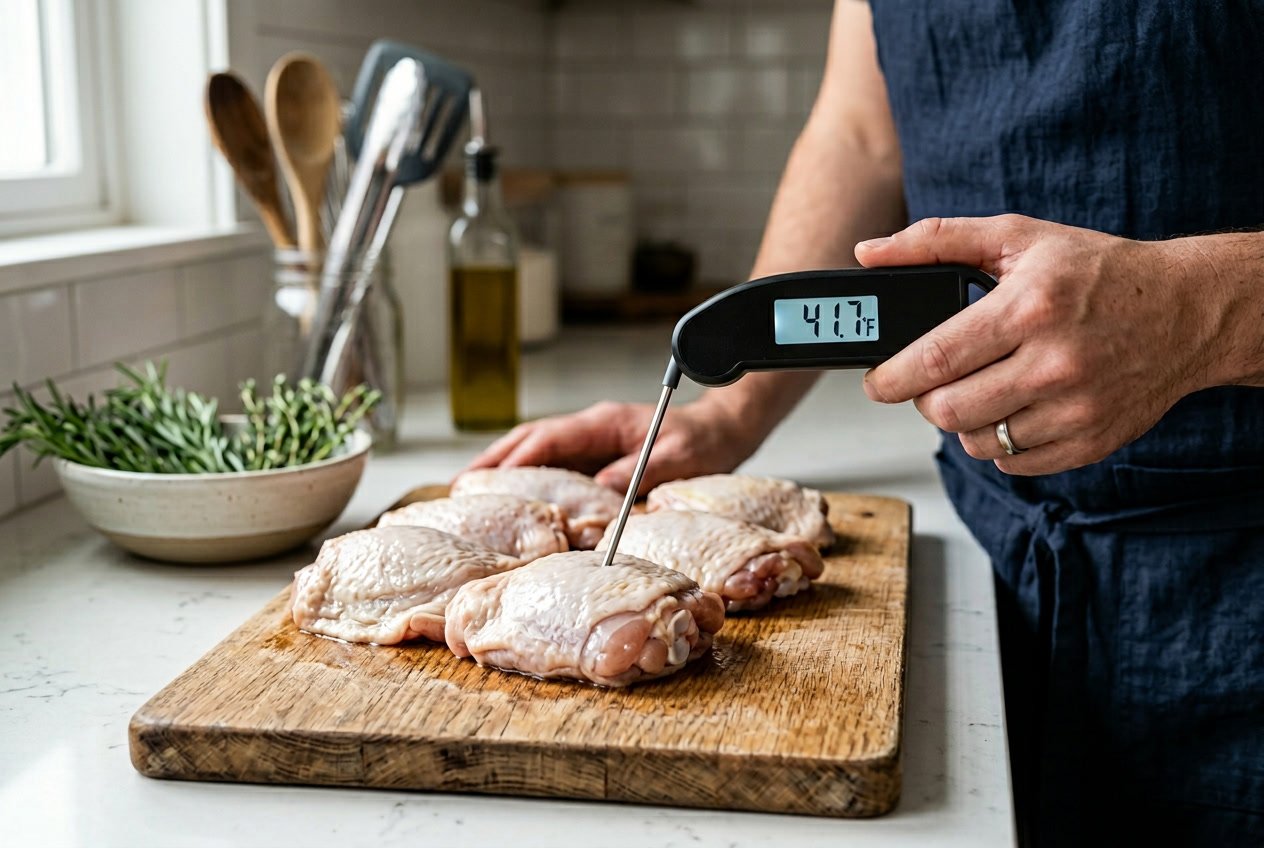
This guide shows exactly where to place your thermometer and how to avoid false readings. You’ll also learn which temperatures suit different cooking methods and textures.
Follow these placement and timing tips to stop guessing and start serving consistently great thighs.
Best Place to Temp Chicken Thighs
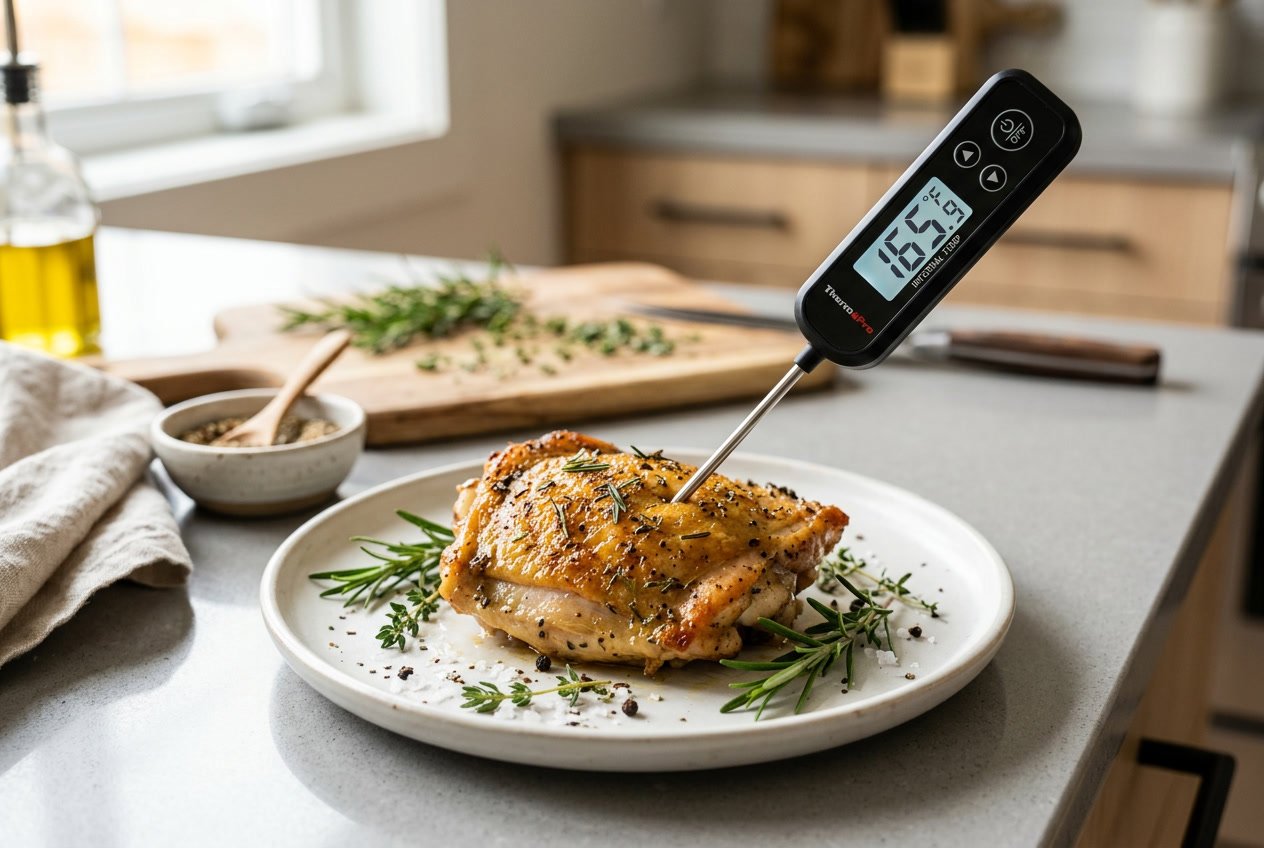
Place the probe in the thickest part of the meat without touching bone. Avoid cartilage or fat pockets that can give a false high reading.
Use an instant-read meat thermometer and insert it so the tip sits in the center of the thickest section.
Where to Insert the Thermometer
Insert the probe into the thickest part of the thigh muscle. For bone-in thighs, probe from the side toward the center of the meat.
For boneless thighs, probe straight down into the center. Push the tip at least 1/2–1 inch into the flesh so the sensing area is fully surrounded by meat.
Hold the thermometer steady for the time recommended for your device, usually 5–10 seconds for instant-read models, to get a stable reading.
Avoiding Bones and Cartilage
Keep the probe away from bone, cartilage, or the joint. Bone conducts heat and will show a higher temperature than the surrounding meat.
If you hit bone, reposition the probe farther from the bone and recheck in the thickest portion. When testing multiple thighs, check the largest piece, not a small one.
If you use a wireless probe, place it at least ¼ inch away from bone.
Visual Signs of Proper Placement
When placed correctly, the probe will sit fully embedded in the center of the thigh. The tip should not be visible through the skin.
The thermometer reading should rise steadily. If it fluctuates or drops when you move the probe, you may be skimming surface heat or touching bone.
Gently wiggle the probe after insertion. If it feels like it’s hitting a hard surface, withdraw and reinsert slightly.
Aim for a final reading between 175–185°F for juicy, tender thighs, or at minimum 165°F for safety.
Understanding Chicken Thigh Internal Temperature
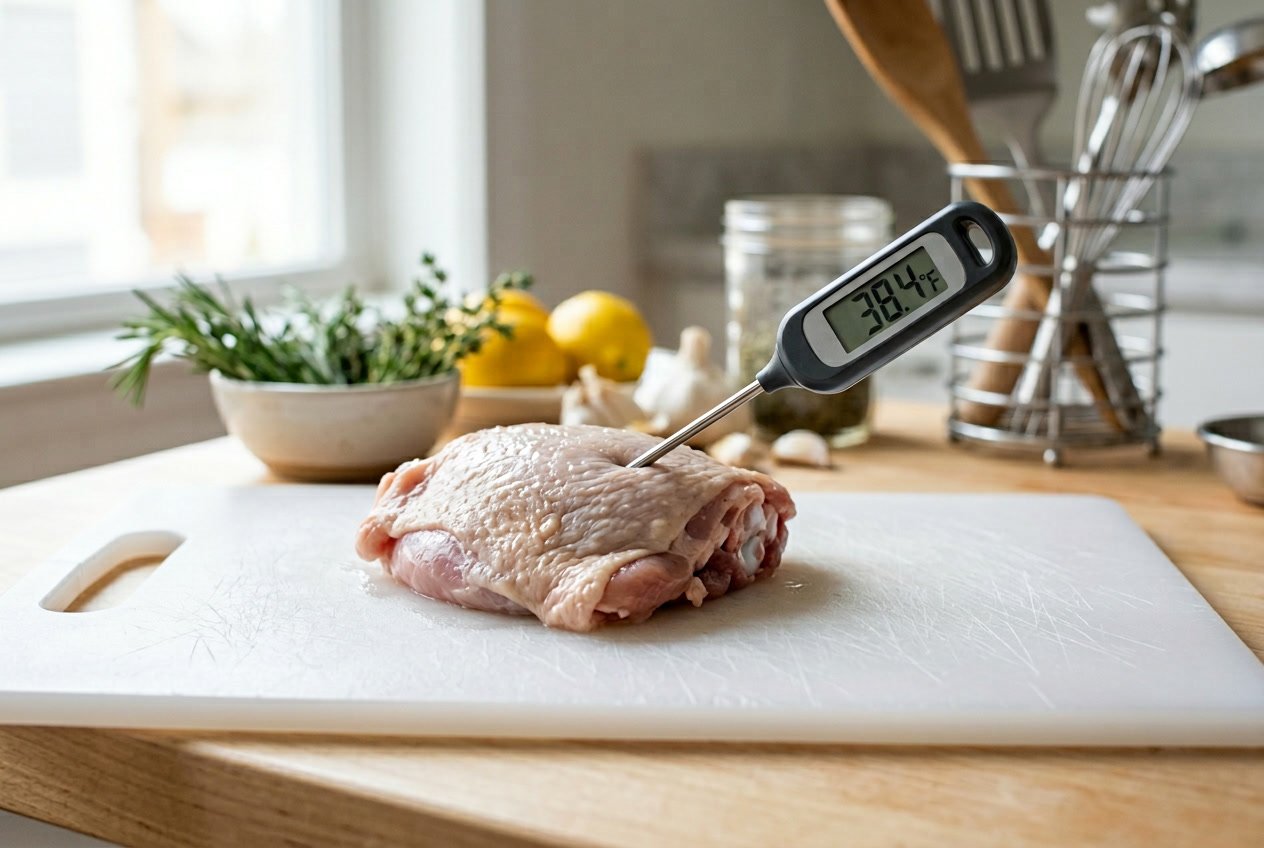
You need to know the safe minimum temperature and why dark meat often benefits from higher temps. Follow precise temp targets and place your thermometer correctly to avoid guesswork.
USDA Safety Guidelines for Chicken
The USDA requires poultry reach a minimum internal temperature of 165°F (74°C) to inactivate Salmonella and other pathogens.
Measure with an instant-read thermometer inserted into the thickest part of the thigh, avoiding bone contact.
Take the temperature at least ¼ inch away from the bone and allow the probe to settle for a few seconds. Use the thermometer as your primary doneness indicator.
Calibrate your thermometer periodically to ensure accurate readings.
Why Dark Meat Prefers a Higher Temp
Chicken thighs contain more connective tissue and intramuscular fat than breast meat. Collagen begins converting to gelatin between roughly 140°F and 195°F.
Cooking thighs to 175–195°F often yields the best texture. 175°F gives tender, slightly firm meat, while 190–195°F produces melting, pull-apart thighs.
Avoid exceeding about 210°F; muscle fibers can tighten and create a stringy texture. For moist, falling-off-the-bone thighs, aim for the higher end and use low, slow methods like braising or indirect grilling.
How to Use a Meat Thermometer for Chicken Thighs
Use an instant-read thermometer or an oven-safe probe to check the thickest part of the thigh, avoiding bone and fat. Insert the probe to the center of the meat, wait for a stable reading, and confirm the internal temperature reaches 165°F.
Types of Meat Thermometers
Instant-read digital thermometers give fast, accurate readings in 2–10 seconds. Look for a probe length of at least 1.5 inches so you can reach the center of thicker pieces without touching bone.
Oven-safe probe thermometers stay in the meat while it cooks and connect to a display outside the oven or to a wireless receiver. Use these when you need continuous monitoring.
Dial thermometers exist but tend to be slower and less precise than digital instant-read models. Calibrate any thermometer every few months by using an ice-water test (32°F).
Step-by-Step Temperature Testing
Insert the probe into the thickest part of the thigh, pushing it toward the center but not through to the bone.
If the thigh is bone-in, angle the probe alongside the bone to avoid contact. For boneless thighs, insert straight into the middle at least 1 to 1.5 inches deep.
Wait until the digital display stabilizes, then record the highest steady value. If the reading is near 160–165°F, check a second spot in the same thigh or in another thigh to confirm consistency.
Clean the probe with hot, soapy water between checks to avoid cross-contamination.
Common Mistakes to Avoid
Avoid touching bone with the probe. Bone conducts heat and can show a higher temperature than the meat.
Also avoid inserting into fat pockets or the skin, which can mask the true internal temperature. Don’t rely solely on cook time or color.
Wait for a steady number on the thermometer. Perform an ice-water or boiling-water check periodically, and replace or recalibrate any device that drifts more than a few degrees.
Cooking Methods and Timing for Chicken Thighs
Target internal temperature and cooking time change with method and whether thighs are bone-in or boneless. Use a probe thermometer in the thickest part (not touching bone) and aim for at least 165°F (74°C); many prefer 175–185°F (79–85°C) for more tender dark meat.
Baking Chicken Thighs
Baking gives consistent heat and reliable timing. For bone-in, skin-on thighs, roast at 375°F (190°C) for about 35–45 minutes.
Check temperature at the thickest point; 165°F is safe, 175–180°F yields juicier, more tender meat. For boneless thighs, raise oven to 425°F (218°C) and bake 20–30 minutes.
Place skin-side up on a rack or baking sheet and pat skin dry to promote browning.
Quick checklist:
- Bone-in, 375°F: 35–45 min.
- Boneless, 425°F: 20–30 min.
- Thermometer in thickest part; rest 5–10 minutes before serving.
Grilling and Broiling Techniques
Grilling gives char and fast cooking. Preheat grill to medium-high (375–450°F/190–230°C).
Boneless thighs need about 6–8 minutes per side. Bone-in require 10–15 minutes per side and may need indirect heat after searing to finish through.
Use two-zone grilling: sear over direct heat, then move to indirect heat until the internal temp reads 165–175°F. For broiling in the oven, place thighs 6–8 inches from the broiler element and broil 6–10 minutes per side.
Tips:
- Oil grates and pat thighs dry.
- Use instant-read thermometer frequently.
- Let thighs rest to redistribute juices.
Slow Cooking and Braising
Slow methods emphasize tenderness over crispness. In a slow cooker, set LOW for 6–7 hours or HIGH for 3–4 hours.
Braise on the stovetop or in the oven at 300–325°F (150–165°C) for 1.5–3 hours for fall-apart texture. Use bone-in thighs for best flavor and moisture retention.
Brown the thighs briefly first to develop color, then add liquid (stock, wine, or sauce) to cover about one-third of the thighs. Cook until internal temp reaches at least 165°F and connective tissue has softened.
Notes:
- Browning improves flavor.
- Keep liquid low to avoid boiling; gentle simmer is ideal.
- Shred easily after longer braise times.
Air Frying and Other Methods
Air frying produces crisp skin with shorter cook times. Preheat the air fryer to 400°F (204°C).
Boneless thighs take about 10–14 minutes; bone-in require 18–22 minutes. Flip halfway and check internal temperature in the thickest spot.
Sautéing or pan-roasting works for quick meals: sear skin-side down in a hot skillet 6–8 minutes, then finish in a 375°F oven 10–15 minutes for bone-in.
Pressure cooking cooks thighs on high pressure for 10–15 minutes; allow natural release for best texture.
Practical reminders:
- Adjust times for size and starting temperature.
- Always verify doneness with a thermometer.
- Rest briefly to lock in juices.
Tips for Juicy, Tender, and Flavorful Chicken Thighs
Control three things: flavor penetration, internal temperature management, and skin texture.
Use an acid or enzymatic component in a marinade for at least 30 minutes, pull thighs from heat at the right temp, and use high, dry heat to crisp skin.
Marinating for Maximum Flavor
Marinate bone-in or boneless thighs to add flavor and help tenderize. For a basic marinade, combine 2 tbsp olive oil, 1 tbsp acid (lemon juice, vinegar, or yogurt), 1 tsp salt per pound, and aromatics (minced garlic, smoked paprika, chopped herbs).
Yogurt or buttermilk works especially well because their enzymes and mild acidity tenderize meat without turning it mushy.
Marinate in a sealed bag or covered container in the fridge. Short marinate: 30–60 minutes for thin pieces. Longer: 4–12 hours for thicker or bone-in thighs.
Avoid exceeding 24 hours with strong acids to prevent mealy texture. Pat thighs dry before cooking to improve browning and skin crispiness.
Resting and Slicing After Cooking
Resting lets juices redistribute and finalizes the internal temp. Remove thighs from the oven or pan when their probe reads 160–175°F, depending on your texture preference.
Tent loosely with foil and rest 5–10 minutes for individual thighs, 10–15 minutes for a whole tray. Use an instant-read thermometer to confirm final temp after resting.
Carryover heat often raises it 3–8°F. Slice against the grain for the most tender bites and serve immediately once sliced.
Crispy Skin Tricks
Dry skin before cooking to get a snap. Pat skin thoroughly with paper towels and, if time allows, refrigerate uncovered for 1–4 hours to dehydrate the surface.
Start skin-side down in a hot, dry skillet to render fat, about 6–8 minutes until deep golden. Finish in a 400–425°F oven for 10–20 minutes, depending on size, until internal temp reaches your target.
Alternatively, roast at 425°F from the start on a wire rack to promote even air circulation. For extra crisp, sprinkle 1/4–1/2 tsp baking powder per pound into a dry spice rub.
Safe Storage and Handling After Cooking
Cool cooked thighs quickly to limit time in the 40–140°F danger zone. Store them chilled in small portions, using shallow airtight containers, and label with date and time.
How to Store Cooked Chicken Thighs
Place thighs in shallow containers no more than 2 inches deep to speed cooling. Refrigerate them within 2 hours of cooking. If the ambient temperature is above 90°F, refrigerate within 1 hour.
Set your fridge to 40°F (4°C) or below. Keep thighs on a bottom shelf to avoid dripping on other foods.
Use airtight containers or heavy-duty wrap to prevent moisture loss and cross-contamination. Label containers with the cooking date.
Plan to use refrigerated thighs within 3 to 4 days. For longer storage, freeze in meal-sized portions.
Freeze at 0°F (-18°C) and expect best quality for up to 4 months. Use vacuum sealing or freezer bags to reduce freezer burn.
Handling Leftover Chicken Thighs
Reheat leftovers until they reach an internal temperature of 165°F (74°C) before eating.
Insert a probe or instant-read thermometer into the thickest part, avoiding the bone, to get an accurate reading.
When you reheat chicken in an oven or on the stovetop, cover it so it heats evenly.
If you use a microwave, stir or rotate the pieces and check the temperature in several spots.
Throw away any thighs that smell bad, have a slimy texture, or feel sticky.
Do not taste to test safety.
If you do not know how long the chicken has been left out, throw it away to avoid foodborne illness.
Only reheat the portion you plan to eat to maintain quality and safety.


