
When Was The First Chicken Discovered? Origins, Evolution & Domestication
Archaeologists traced the earliest definite domestic chicken bones to central Thailand, dated roughly between 1650 and 1250 BC. This evidence gives the clearest archaeological answer to when chickens first appeared in human contexts.
The familiar domestic chicken emerged around 3,000–3,500 years ago. This development links to the rise of dry rice farming in Southeast Asia, with chickens spreading westward through ancient trade routes.
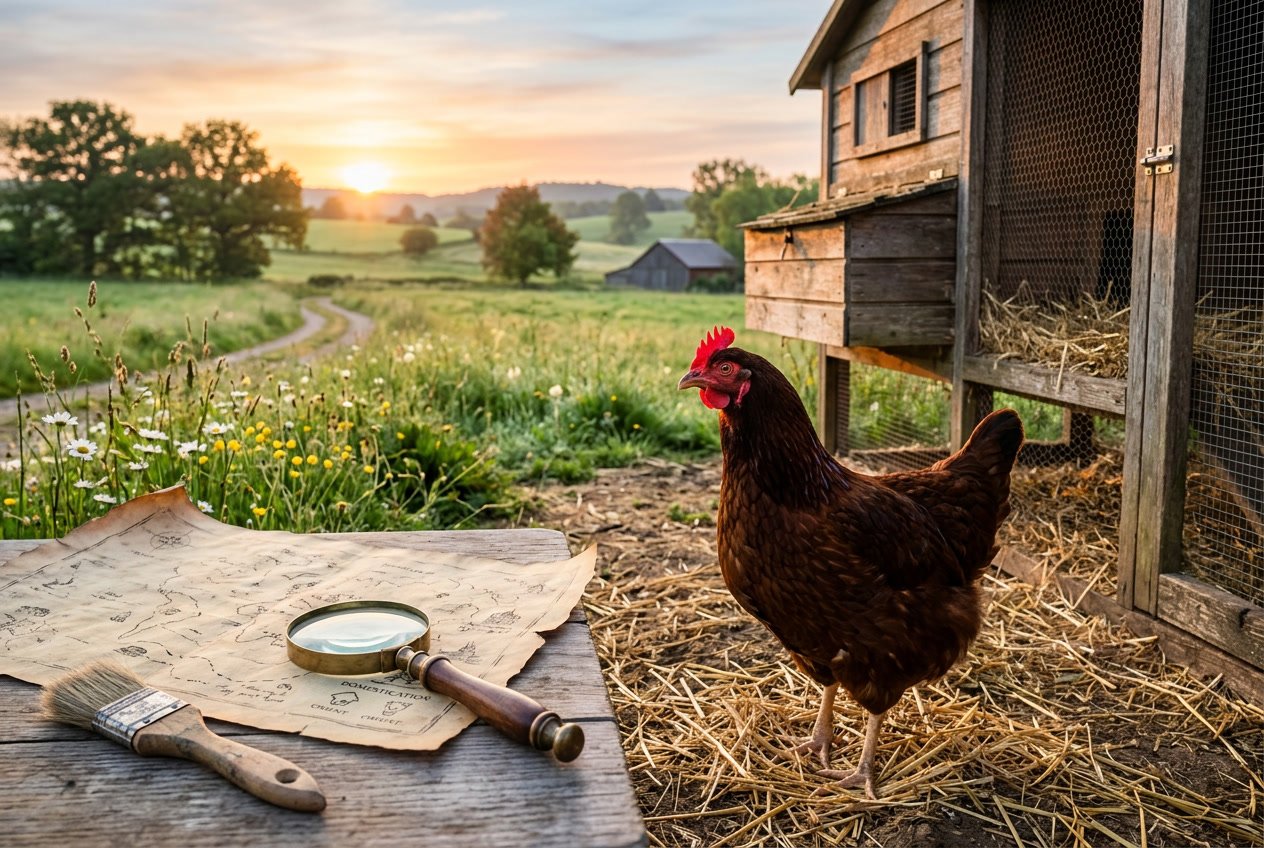
The timeline covers the role of wild junglefowl, the shift from casual encounters to breeding, and the spread of chickens across continents. The story moves from bones and dates to cultural uses, trade-driven dispersal, and the biological changes that produced modern chickens.
Discovery Of The First Chicken
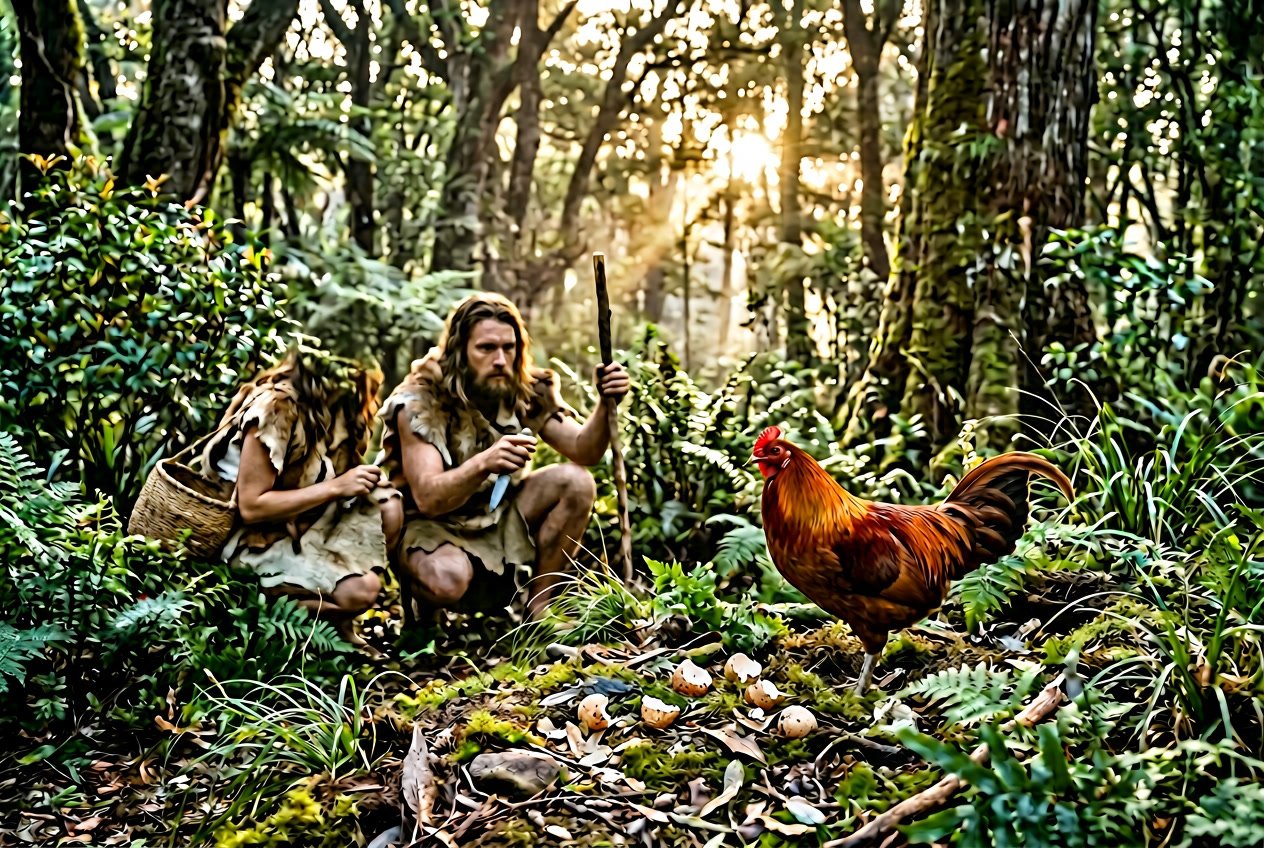
You will learn where the earliest chicken bones were found and how Ban Non Wat fits into the Neolithic picture. Archaeologists use specific methods to identify ancient chickens and date them precisely.
Earliest Chicken Remains And Dating
Excavations in northern China and Southeast Asia uncovered some of the oldest bones attributed to domestic chickens. Radiocarbon dates on chicken-like bones from sites such as Dadiwan and nearby Neolithic settlements give ages in the range of roughly 5,400–7,400 years before present.
Researchers distinguish wild red junglefowl from domestic chickens by examining bone size, robustness, and articulation patterns. Genetic sampling, when available, confirms affiliation to Gallus gallus and helps place remains on a timeline relative to modern breeds.
Radiocarbon ranges provide age brackets rather than exact years. Morphology and DNA together strengthen claims about the first domestic chickens.
Ban Non Wat And The Neolithic Context
Ban Non Wat, in central Thailand, sits within a well-documented Neolithic to Bronze Age sequence. Faunal assemblages there indicate deliberate animal management and rising dependence on domesticates.
At Ban Non Wat, chicken bones appear alongside other domestic species and agricultural indicators. Stratigraphic layering and associated pottery styles let archaeologists place those bones within regional Neolithic phases dated by radiocarbon to several thousand years BCE.
This context suggests humans in the area kept or managed birds rather than merely hunted wild junglefowl. The association of chicken remains with habitation layers and human artifacts supports this view.
Archaeological Techniques In Identifying Chickens
Archaeologists use several techniques to identify ancient chickens and distinguish them from wild fowl. Osteological analysis, radiocarbon dating, ancient DNA, and contextual assessment work together in this process.
Osteology examines size, shape, and muscle-attachment sites on bones—especially the tibiotarsus and humerus—to detect domestication-related changes. Radiocarbon dating of bone collagen or associated charcoal provides calendar ages, and calibration curves convert radiocarbon years into calendar years.
Ancient DNA, when preserved, links specimens to Gallus gallus and reveals maternal lineages. Stable isotope analysis can indicate diet changes consistent with human provisioning.
Field context matters as well. Archaeologists check whether bones come from domestic refuse, burial deposits, or traded goods, since context affects interpretation about when and how chickens became part of human economies.
Evolutionary Origins Of Chickens
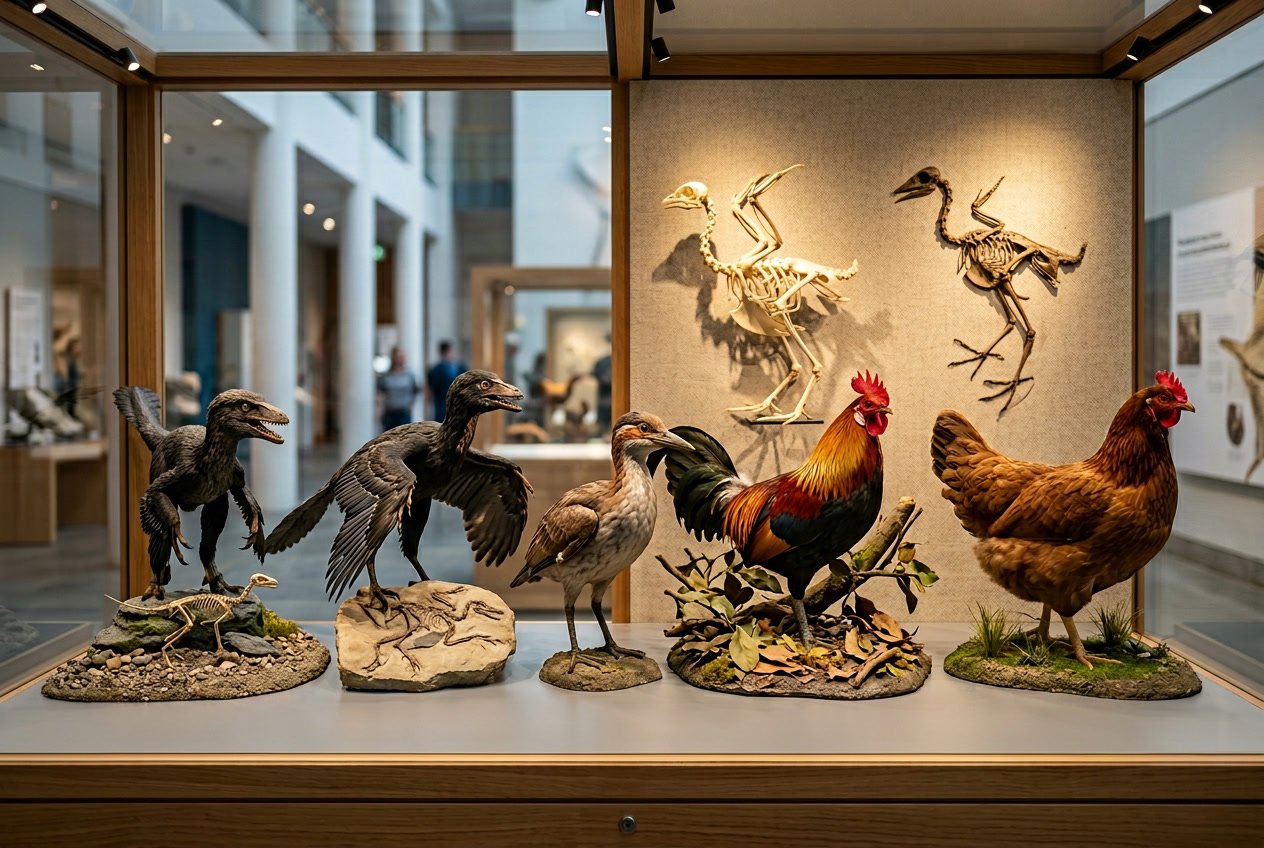
You will learn how birds evolved from theropod dinosaurs and why Archaeopteryx matters to that story. The lineage that produced Gallus gallus fits into the pheasant family and the genus Gallus.
Link Between Birds And Dinosaurs
Fossil evidence and comparative anatomy show birds evolved from small, bipedal theropod dinosaurs. Key theropod features—hollow bones, a furcula (wishbone), and three-toed feet—also appear in modern birds.
Feather evolution can be traced through many non-avian theropods that preserved filamentous or pennaceous feathers, indicating feathers predate true flight. Molecular and developmental studies support that avian lungs, growth rates, and certain reproductive traits descend from theropod ancestors.
The bird skeleton and some behaviors reflect dinosaurian heritage. The dinosaur-to-bird transition provides the framework for later avian diversification, including the line leading to chickens.
The Role Of Archaeopteryx In Avian Evolution
Archaeopteryx occupies a pivotal place as an early Late Jurassic fossil that mixes reptilian and avian traits. It displays teeth, a long bony tail, and clawed fingers alongside asymmetrical flight feathers and a feathered body.
Those mixed features made Archaeopteryx the first clear fossil evidence linking birds to theropod dinosaurs. Researchers use Archaeopteryx to test hypotheses about the origin of flight and feather function.
Its flight capability remains debated, but its morphology confirms feathers were established by about 150 million years ago. Archaeopteryx shows that the essential avian blueprint existed long before the Galliformes line evolved.
Family Phasianidae And The Genus Gallus
Phasianidae includes pheasants, partridges, turkeys, and relatives—ground-adapted, often heavy-bodied birds that diversified during the Cenozoic. Characteristic traits include strong legs for scratching and robust bodies.
Within Phasianidae, the genus Gallus contains species such as Gallus gallus (the red junglefowl), widely accepted as the principal wild ancestor of domestic chickens. Gallus gallus displays behaviors—social hierarchies, omnivorous diet, and nesting—that predisposed it to commensal relationships with humans.
Genetic studies and archaeological data place the divergence and eventual domestication of Gallus gallus within Southeast Asia. The genus links directly to the question about the first chickens.
The Domestication Process
You will learn which wild species gave rise to domestic chickens and what genetic data reveal about timing and location. Archaeological and genomic markers anchor current scientific views.
Red Junglefowl As Primary Ancestor
Gallus gallus, commonly called the red junglefowl, serves as the primary wild ancestor of Gallus gallus domesticus. Archaeological and genomic studies converge on populations of the subspecies G. gallus spadiceus in Southeast Asia as the main source for domestication.
This subspecies occupied lowland forests and agricultural edges where early rice and millet storage created new food opportunities. Osteological remains from sites in central Thailand dated to the late second millennium BCE provide clear early domestic chicken evidence.
Long-term proximity between humans and red junglefowl supports a commensal pathway: birds scavenged cereal stores and gradually adapted to human environments. Behavioral traits of red junglefowl—tameness variation, social structure, and reproductive plasticity—made them predisposed to this transition.
Influence Of Other Junglefowl Species
Gene flow from other junglefowl species, especially Gallus sonneratii (gray junglefowl), also influenced domestic chicken diversity. Hybridization events between red junglefowl and local junglefowl populations introduced alleles affecting plumage, morphology, and possibly behavior into early domestic stocks.
These traits appear regionally in South Asia and may explain some morphological variation in archaeological assemblages. Modern chicken genomes show signatures of past admixture unevenly across breeds, implying multiple local encounters between human-associated birds and wild relatives after initial domestication.
Archaeological contexts with overlapping ranges of different junglefowl species require careful species-level identification. Misattribution can skew interpretations of when and where true poultry husbandry began.
Genetic Evidence For Domestication
Genomic analyses estimate divergence times and track ancestry. Large-scale sequencing of modern Gallus genomes identifies red junglefowl as the dominant progenitor and places the divergence between domestic lineages and wild G. gallus spadiceus populations within a broad interval of roughly 12,800 to 6,200 years ago.
Genetic markers reveal selective sweeps related to reproduction, growth, and plumage that distinguish Gallus gallus domesticus from wild counterparts. These sweeps, combined with archaeological radiocarbon dates and osteometric confirmation, help narrow the timeline.
Archaeological evidence of unequivocal domestic bones appears in Southeast Asia by the late second millennium BCE. Genome-wide studies detect localized introgression from gray junglefowl and other Gallus species, clarifying how hybridization shaped modern chicken diversity.
Early Human-Chicken Interactions
Early contacts between people and wild red junglefowl set the stage for deliberate breeding, ritual use, and integration into farming systems. Chickens moved from foragers’ edges into human settlements and became part of social practices like cockfighting.
Origins Of Chickens In Human Societies
The earliest clear evidence of domestic chickens appears in Southeast Asia, especially at Neolithic sites such as Ban Non Wat in central Thailand, dated to roughly 1650–1250 BCE. Those bones show traits of domestication—smaller size and association with human food refuse—rather than isolated wild remains.
Genetic studies tie modern domestic chickens to the red junglefowl (Gallus gallus) and indicate multiple local domestication events and gene flow from wild populations. Pottery and iconography depicting fowl across South and East Asia signal early symbolic and economic roles.
As people kept chickens for eggs, meat, and easy-to-manage protein, chickens became embedded in household economies and daily diets.
Cockfighting And Cultural Significance
Cockfighting appears in texts, art, and burial contexts across Asia and the Mediterranean, showing its deep social reach. In many societies, cockfighting served as a public spectacle, a ritual with divinatory aspects, and a marker of status or masculinity.
Chickens also carried symbolic value in funerary offerings, as clan totems, and in seasonal ceremonies. Managing fighting stock encouraged selective breeding for aggression, stamina, and plumage—traits that influenced the broader domestication process.
Rice Farming And Chicken Domestication
The rise of wet-rice and millet cultivation led to more permanent settlements and reliable grain stores that attracted wild fowl. Stored grain and human food waste created predictable food patches, turning commensal red junglefowl into regular human associates.
Archaeological correlations show that initial chicken bones often appear alongside early rice and millet contexts, suggesting agriculture acted as a magnet for commensal animals. Rice farming created ecological and economic conditions—consistent food, shelter, and proximity—that made intentional breeding and management practical.
Over generations, this relationship produced the fully domesticated chickens found in historical records and modern flocks.
Spread And Dispersal Of Chickens
Chickens originated in Southeast Asia and spread outward over millennia via human movement, trade, and changing agricultural systems. Their arrival in new regions often followed the spread of cereal farming and established trade networks.
Arrival In Europe And Africa
Chickens reached Mediterranean Europe by roughly the first millennium BCE. Secure evidence appears around 800 BCE in some locations.
Radiocarbon dating and iconography place domestic chickens in Greece and Italy by the early Iron Age, linked to established agricultural villages and animal-keeping practices. In Africa, chickens appear later in the archaeological record, reaching the Nile Valley and Ethiopian highlands by the first millennium BCE.
Their arrival often coincides with contact with Near Eastern and Indian Ocean traders rather than local domestication. Genetic studies support multiple introductions into Africa rather than a single origin on the continent.
Chickens did not flood into Europe and Africa at one moment. Instead, discrete waves of introduction followed established trade corridors and agricultural expansions.
Trade Routes And Cultural Exchange
People moved chickens as commodities along both maritime and overland routes. Indian Ocean trade carried chickens between Southeast Asia, South Asia, and East Africa, with island-hopping and coastal exchange helping their movement into eastern Africa and Madagascar.
Overland corridors, including Anatolia and the Levant, brought birds into the Mediterranean and Europe. Military campaigns and colonial-era expansions later sped up dispersal, but earlier spread relied on crop storage and settled farming that attracted junglefowl ancestors to human settlements.
Cultural exchange influenced how people used and depicted chickens. Artistic and textual records from Mesopotamia, the Aegean, and Rome show chickens integrated into ritual, food economy, and status displays, which encouraged their movement across social networks.
Chicken Remains In Ancient Burial Sites
People placed chicken remains in burials to signal domestic status and symbolic roles. In mainland Southeast Asia, Bronze Age graves at Ban Non Wat contain many juvenile chicken bones and grave offerings dated to about 1000 BCE, suggesting managed flocks and ritual use.
In Europe and Africa, burial deposits and grave goods with chicken bones or cockerel imagery appear in Iron Age contexts. These finds often accompany other domesticates and show that chickens served as food, symbols of fertility or protection, or prestige items.
Careful stratigraphic control and direct dating remain crucial. Radiocarbon reanalysis or taxonomic reassessment has overturned some early claims for ancient chickens.
When properly dated and identified, burial contexts provide strong evidence for established poultry keeping and cultural significance.
Development Of Domestic Chickens And Breeds
People turned wild junglefowl into Gallus domesticus, formed distinct breeds, and used organizations and hatcheries to standardize traits for meat, eggs, and show.
From Wild Fowl To Domestic Chickens
People trace domestic chickens back to the red junglefowl (Gallus gallus) in Southeast Asia, where they began keeping birds roughly 6,000–8,000 years ago. Early relationships included capture, selective rearing for behavior and egg production, and breeding for traits like tameness and clutch size.
Genetic studies reveal contributions from multiple junglefowl species in some domestic lines, explaining variation in pigmentation and other traits. Archaeological finds and ancient DNA link initial domestication sites to agricultural villages, not large urban centers, showing gradual integration into human households.
Traders and migrants moved chickens rapidly across Asia, into Europe by the Iron Age, and worldwide later. This dispersal created regional populations that became the basis for formalized breeds.
Formation Of Chicken Breeds
People define breeds as populations selected for consistent traits such as egg color and rate, growth speed, body conformation, or ornamental features. Selection happened both informally, with farmers saving the best layers or broilers, and deliberately, as breeders isolated lines for specific outcomes.
By the 19th century, visible breed differences like comb type, feather color, and size became consolidated through record-keeping and controlled mating. Commercial pressures led to specialized lines: long-lived layers, fast-growing meat birds, and dual-purpose strains. Hatcheries produced uniform pullets at scale for farms.
Breed formation involved both phenotype selection and, more recently, genetic tools to fix desirable alleles such as those for yellow skin or high feed conversion. This drove modern intensive production but also created narrow genetic pools in some commercial stocks.
Role Of Breed Organizations
You rely on breed standards to compare and preserve traits. Organizations began codifying those standards in the 19th century.
The American Poultry Association (APA) founded in 1873 and set one of the earliest comprehensive standards in the U.S. The APA lists accepted breeds and detailed characteristics.
Standards govern show classes, color patterns, weight ranges, and type. This helps hobbyists and breeders maintain uniform lines.
Breed clubs and national bodies maintain studbooks. They promote conservation of rare breeds and provide judging rules for exhibitions.
Hatcheries work with these organizations by producing standardized stock for commercial and backyard markets. They scale genetics defined by breed standards into thousands of chicks and supply both production farms and enthusiasts who follow APA or similar standards.


