
What Is Chicken Thighs Temp? Safe Internal Temps & Cooking Tips
You want chicken thighs that are both safe and delicious. Aim for an internal temperature of at least 165°F for safety, but many cooks prefer 175–195°F to break down connective tissue and get exceptionally tender, juicy dark meat.
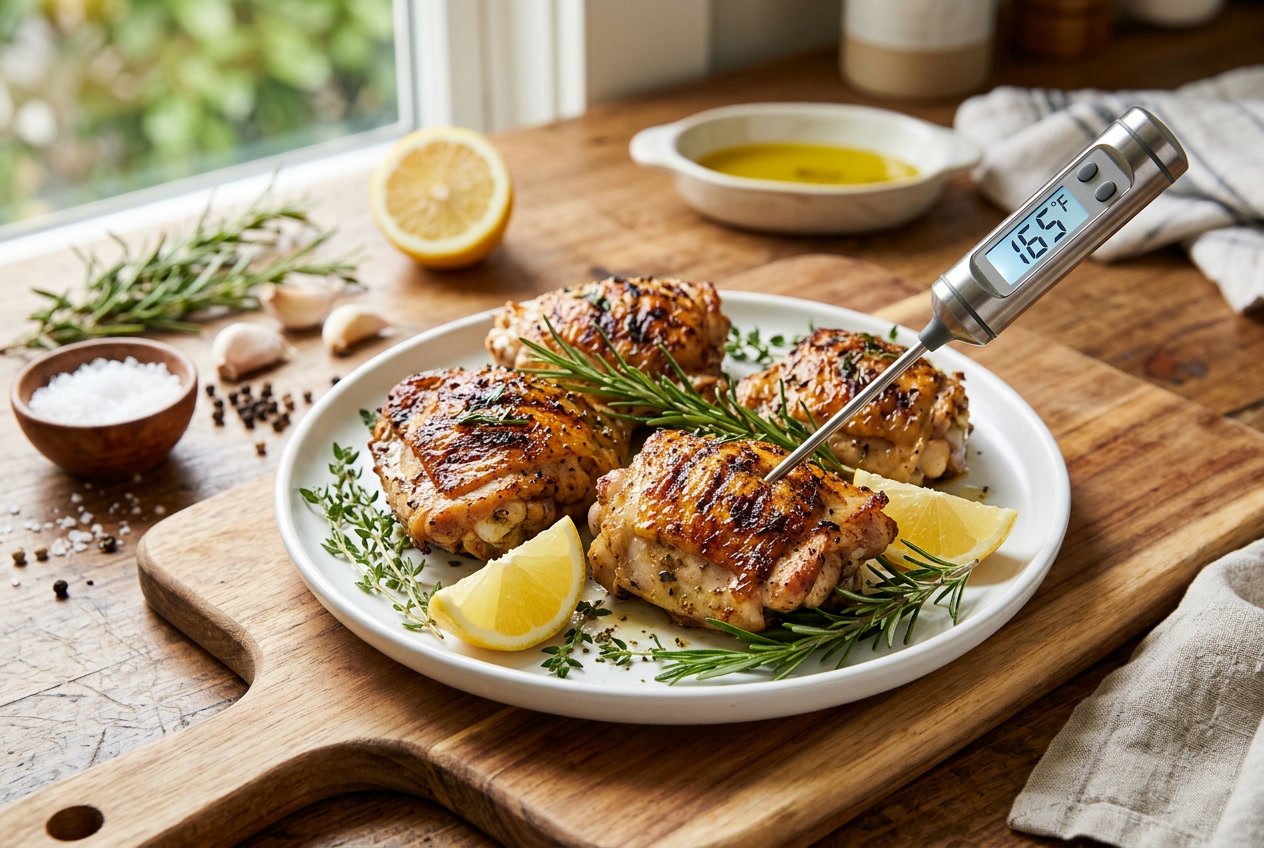
This post explains the safe minimum, the temperatures that improve texture and flavor, how to measure accurately, differences between bone-in and boneless thighs, method-specific guidelines, and best practices for handling and reheating leftovers.
What Is the Safe Internal Temperature for Chicken Thighs?
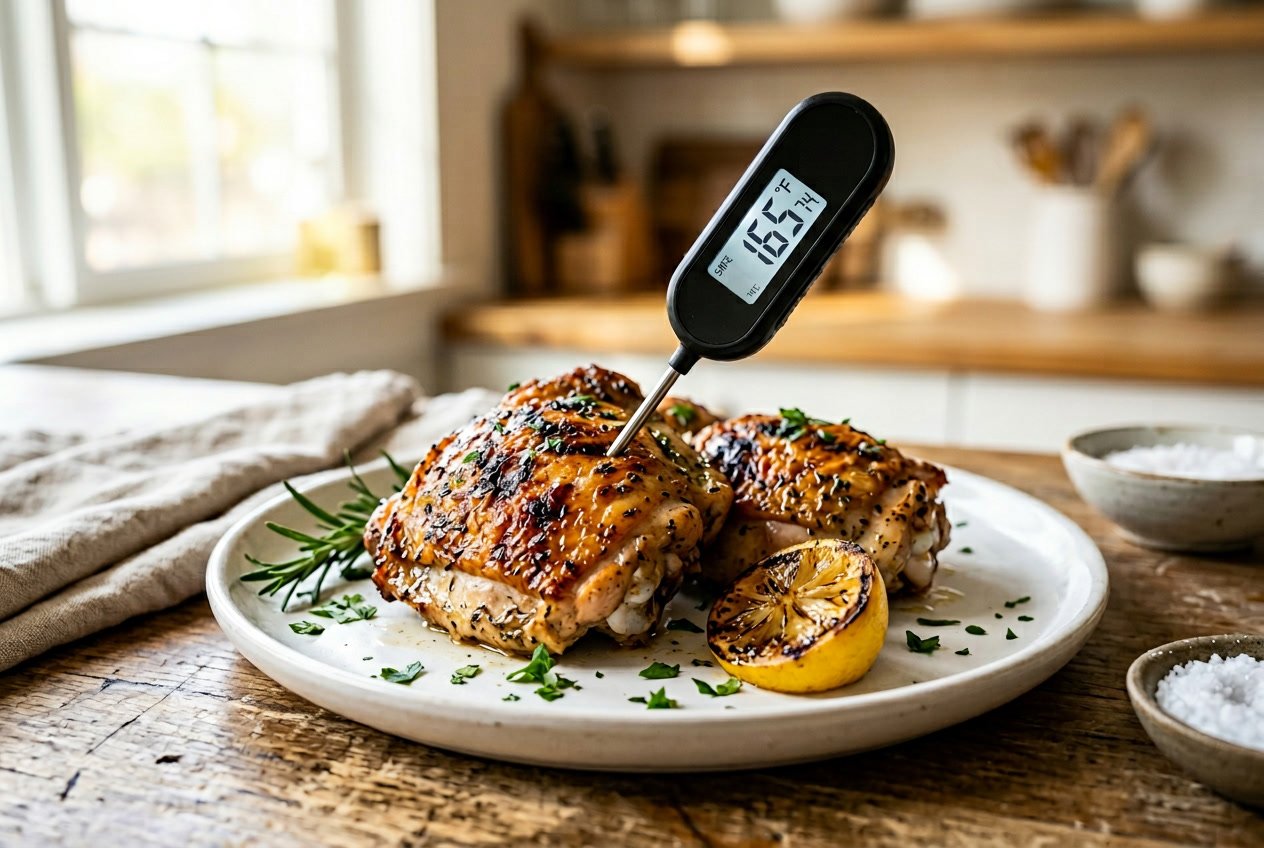
Cook chicken thighs to a temperature that kills common pathogens while keeping the meat juicy. The guidance below explains the specific temperature target and why temperature matters for safety.
USDA Guidelines for Chicken Thighs
The USDA sets the safe minimum internal temperature for all poultry at 165°F (74°C) measured with an instant-read thermometer in the thickest part of the thigh, away from bone.
Insert the probe at least ¼ inch from the bone to avoid a falsely high reading caused by the bone conducting heat.
Follow these steps for reliable readings:
- Turn off the heat source or let the meat rest; open the oven or grill briefly.
- Probe the thickest area of the thigh, avoiding bone contact.
- Wait for the thermometer to stabilize, then record the temperature.
The USDA target is a single-point standard to ensure immediate pathogen reduction. You can use higher holding temperatures or longer time-at-temperature profiles for additional tenderness, but 165°F is the official minimum for safety.
Why Temperature Ensures Food Safety
Temperature kills bacteria such as Salmonella and Campylobacter by denaturing proteins.
Reaching an internal temperature of 165°F rapidly reduces these organisms to safe levels in the meat.
Time also matters: lower temperatures can be safe if held long enough, but that requires precise control and knowledge.
For home cooking, aim for 165°F in chicken thighs to eliminate guesswork and avoid the risk of undercooking.
Use a calibrated instant-read thermometer for repeatable results, and check multiple thighs when cooking a batch to ensure uniform safety.
Understanding 165°F (74°C) and Its Importance
165°F (74°C) is the temperature at which harmful poultry pathogens are reliably killed within seconds.
That threshold is practical for home cooks because it balances safety and simplicity.
Chicken thighs contain connective tissue and benefit from higher temperatures for texture, but safety does not require you to cook to 190–195°F for pathogen control.
If you prefer lower final temperatures for moisture, follow time-temperature tables (such as sous-vide or controlled slow-cooking) that specify how long to hold at a lower temp to achieve equivalent pathogen reduction.
Let thighs rest briefly after cooking; resting evens internal temperature and can raise it slightly.
Verify with your thermometer: the correct chicken thighs internal temp ensures safety without overcooking.
Optimal Chicken Thigh Temperature for Taste and Texture
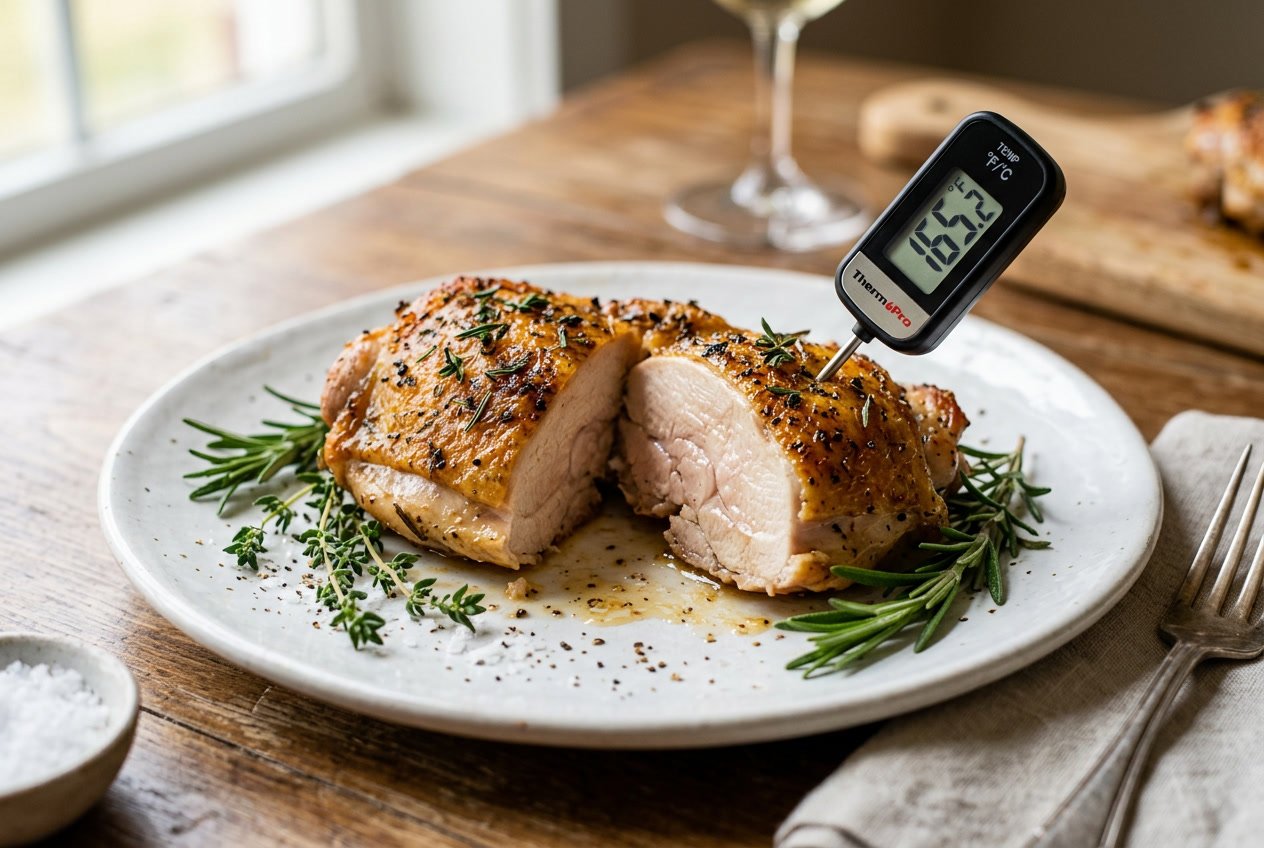
Choose a temperature target that keeps the meat safe while converting connective tissue into gelatin for tenderness.
Small shifts of 5–20°F change texture more than flavor, so measure at the thickest part away from bone.
Recommended Temperature Ranges
- 165°F (74°C) — USDA safe minimum; reliable for boneless skinless thighs and fast weeknight cooking.
- 175°F (79°C) — Sweet spot for bone-in, skin-on thighs; more collagen has broken down and the meat feels juicier.
- 185°F–195°F (85°C–91°C) — Best for braises, slow cooking, or when you want fall-off-the-bone texture.
Insert an instant-read thermometer into the thickest part of the thigh, avoiding the bone.
For bone-in thighs, pull at 175°F and rest 5–10 minutes; carryover heat raises internal temp slightly.
For boneless thighs, stop around 165°F–170°F to avoid drying.
How Higher Temperatures Affect Tenderness
Chicken thighs contain more collagen than breasts. As you heat thighs above 165°F, collagen gradually converts to gelatin and moistens surrounding fibers.
Between 170°F and 185°F, the meat softens and feels silkier rather than simply firmer.
At 185°F–195°F, collagen breakdown is nearly complete, producing a pull-apart, tender texture ideal for shredding.
Higher temps also render fat, which adds mouthfeel and flavor.
Monitor texture by probing with a fork and checking juiciness; a thermometer alone won’t tell you how the collagen has behaved.
Signs of Overcooked Chicken Thighs
Overcooked thighs lose juiciness and develop stringy or dry fibers, especially in boneless pieces.
If the meat flakes apart into dry threads instead of separating into moist shreds, it has passed its optimal range.
Other signs include excessively tight skin that shrinks away from the bone and a chalky, pasty mouthfeel.
On the grill or in a pan, prolonged direct high heat can render all fat and leave a dry interior even if the thermometer reads a high temperature.
To prevent this, remove bone-in thighs at about 175°F and boneless at about 165°F–170°F, then rest to let juices redistribute.
How to Accurately Measure Chicken Thighs Temp
Measure at the thickest part of the thigh, avoid the bone, and allow a short resting time for carryover cooking.
Use a calibrated meat thermometer and take readings from multiple spots on bone-in pieces to confirm even doneness.
Using a Meat Thermometer Correctly
Insert an instant-read or probe meat thermometer into the thickest part of the thigh, perpendicular to the bone.
Aim for the center of the muscle, not touching bone or fat, which give falsely high readings.
For bone-in thighs, take readings in two places: one near the bone (without contacting it) and one in the center of the meat.
Wait until the digital reading stabilizes—instant-read units usually take 2–5 seconds; analog types need longer.
If you use a leave-in probe during roasting or smoking, position the tip away from bone and racks.
Calibrate your thermometer occasionally by testing in ice water (32°F / 0°C) and boiling water (212°F / 100°C, adjusted for altitude).
Clean the probe after each use.
Avoiding Common Thermometer Mistakes
Do not insert the probe at an angle that reaches bone or only the surface; that underestimates undercooked center temperature.
Avoid measuring through skin pockets or large fat deposits, which insulate and skew results.
Don’t rely on a single spot for bone-in thighs—hot and cool zones form around the bone.
Avoid checking immediately after removing from heat; tent the thighs and wait 3–7 minutes so carryover cooking raises the internal temp a few degrees.
Never use a dirty probe or cross-contaminate.
Wipe the probe with hot, soapy water and sanitize between raw and cooked checks.
If your thermometer has a protective case, keep it clean to prevent inaccurate readings.
Bone-In vs. Boneless Chicken Thighs: Temperature Considerations
Bone-in thighs take longer to heat through but develop richer texture when cooked to higher temps.
Boneless thighs cook faster and reach safe temperatures sooner.
Track internal temperature with an instant-read thermometer and aim for tenderness as well as safety.
Bone-In Chicken Thighs Cooking Temps
Bone slows heat transfer, so bone-in chicken thighs need more time.
Insert your thermometer into the thickest part of the meat, avoiding contact with the bone, and check for at least 165°F (74°C) for immediate safety.
For more tender, collagen-broken-down results, let the internal temperature rise to 175–195°F (79–91°C); at those levels the connective tissue melts and the meat becomes juicier and more falling-off-the-bone.
Use lower, slower methods such as roasting at 325–375°F or braising to hold the meat in the 140–195°F collagen-breakdown window for longer.
If roasting at high heat for crisp skin, pull when the thickest part reads 175°F and rest 5–10 minutes; carryover can add a few degrees.
Boneless Chicken Thighs Cooking Temps
Boneless thighs heat faster and are thinner, so avoid overcooking.
Aim for a minimum internal temperature of 165°F (74°C) measured in the center to ensure safety.
For juicier results without long cook times, remove boneless thighs at 165–175°F; they don’t need the extended time bone-in cuts benefit from to break down collagen.
Cook boneless thighs quickly at 400–450°F on a grill or in a hot oven, or pan-sear then finish in the oven.
Rest boneless pieces 3–5 minutes after cooking; the brief rest evens temperature and retains juices.
Cooking Methods and Temperature Guidelines
Aim for safe internal temperatures while matching cooking method to the texture you want.
Use an instant-read thermometer in the thickest part, avoiding bone contact.
Grilling Chicken Thighs Safely
Grill bone-in, skin-on thighs over a two-zone fire.
Sear skin-side down over direct high heat for 4–6 minutes to build color, then move to indirect heat and cook until the thickest part reaches 175°F (79°C).
That higher endpoint lets collagen convert to gelatin for tender, juicy dark meat.
For boneless thighs, cook over medium-high direct heat for about 5–7 minutes per side and target 165–170°F (74–77°C).
Watch for flare-ups from dripping fat; keep a cooler zone to move pieces if flames spike.
Let grilled thighs rest 5–10 minutes to equalize juices before serving.
Baking Chicken Thighs for Best Results
Preheat the oven to 400–425°F (204–218°C) for crispy skin and even cooking.
Arrange skin-side up on a wire rack set over a rimmed sheet pan so fat drains and air circulates; this prevents steaming and speeds crisping.
Bake bone-in, skin-on thighs 35–45 minutes, pulling at 175°F for tender results.
Bake boneless thighs 20–25 minutes and remove at 165–170°F to avoid drying.
If you want extra-crispy skin after braising or slow cooking, finish under a broiler for 2–4 minutes while watching closely.
Other Cooking Techniques
Pan-searing: Start in a cold skillet skin-side down to render fat, then increase to medium-high and cook 8–12 minutes for bone-in pieces, finishing in a 400°F oven if needed.
Use an oil with a high smoke point and avoid overcrowding the pan.
Air fryer: Preheat to 400°F and cook bone-in thighs 22–28 minutes, boneless 16–20 minutes, skin-side up.
Do not stack pieces; arrange in a single layer for even crisping.
Slow cooker or pressure cooker: For shreddable thighs, use high for 3–4 hours or low for 6–7 hours in a slow cooker.
For an Instant Pot, 10–12 minutes high pressure with natural release yields fall-apart texture.
If you want crisp skin afterward, transfer to a hot pan or broiler for a few minutes.
Handling and Reheating Leftover Chicken Thighs
Keep leftovers cold, reheat to a safe temperature, and avoid reheating more than once.
Use a thermometer and add a little moisture to prevent dry meat.
Safe Reheating Internal Temps
Reheat each chicken thigh until the thickest part reaches 165°F (74°C).
Insert a probe thermometer into the meat, not touching bone, and check temperature in several spots if pieces vary in size.
Heat evenly: cover thighs with foil in the oven at 325–350°F (160–175°C) for 10–20 minutes depending on size, or simmer covered in a skillet with 1–2 tablespoons of broth until 165°F.
If using a microwave, rotate and pause to check temperature; finish in the oven or on the stove for more even heat.
Do not rely on steam or surface heat alone.
If reheating from frozen, thaw in the refrigerator first or extend cooking time and verify 165°F throughout.
Storing Leftover Chicken Thighs
Cool cooked thighs to room temperature within 2 hours. Place them in shallow, airtight containers.
Label each container with the date so you use the oldest first. Store in the refrigerator at 40°F (4°C) or below and use within 3–4 days.
For longer storage, freeze thighs in freezer-safe bags or containers for up to 4 months. Remove excess air to reduce freezer burn.
Only reheat the portion you plan to eat. Split large batches into meal-sized portions before storing to keep texture and safety consistent.


