
What Does Chicken Thighs FP Mean? Label Decoding & Buying Tips
If you’ve ever stared at a package of chicken thighs and wondered what “FP” means, you’re not alone. FP usually stands for “Fresh Packed” or “Fully Processed,” but in most grocery labeling, it indicates a packing or processing method rather than a quality grade.
That small code tells you how the product was handled before it reached the shelf. Knowing it helps you choose the cut you want with confidence.
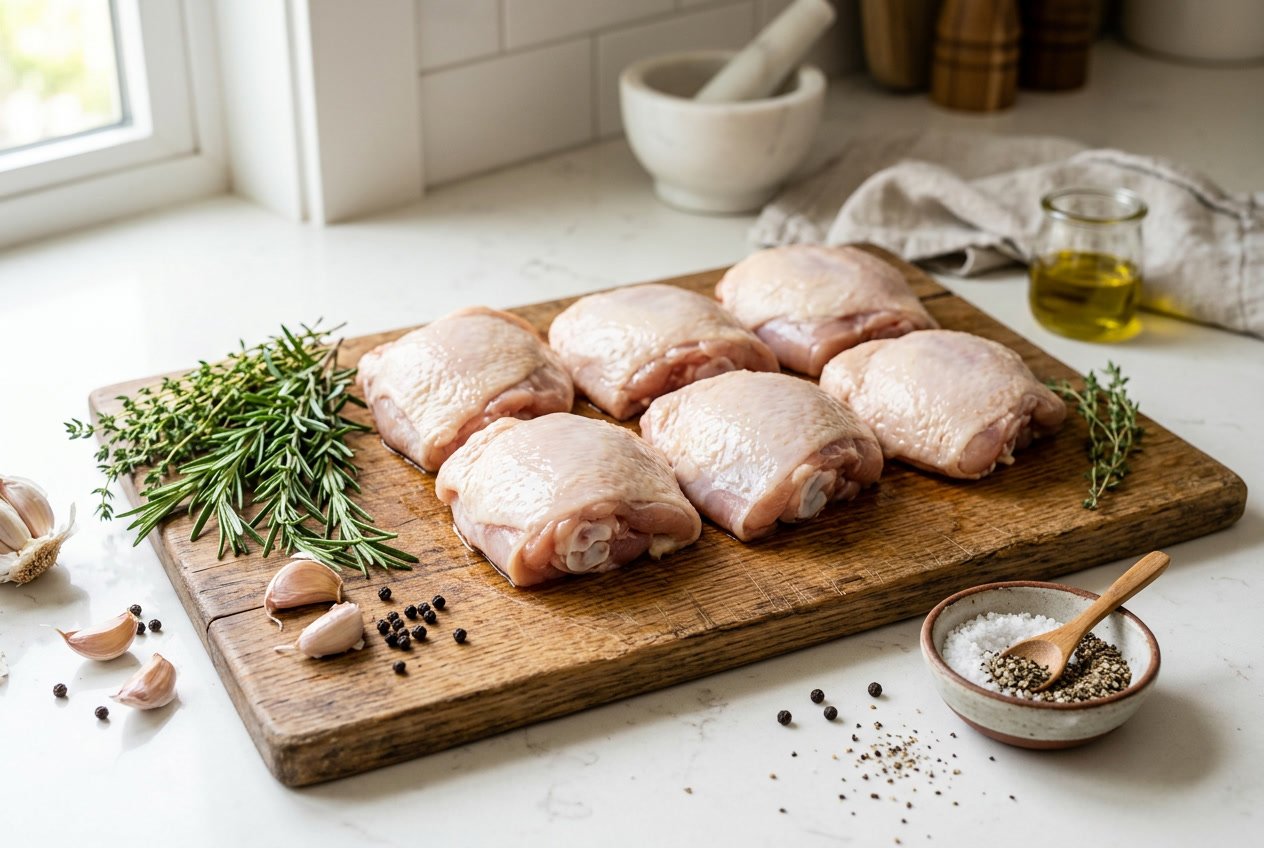
Manufacturers use short codes like FP to communicate processing details. These codes differ from labels about raising practices such as organic, free-range, or cage-free.
You should also look for certification or inspection marks to verify safety and claims. Recognizing these labels on chicken cuts helps you understand what they tell you about processing, handling, and safety.
Understanding ‘FP’ on Chicken Thighs Labels
FP serves as a meal-category shorthand used in Trim Healthy Mama-style planning and on some recipe or packaging notes. It tells you how the food fits into a low-carbohydrate, fat-focused meal approach and how to combine it with other ingredients.
FP Meaning in Chicken Thighs
FP stands for “Fuel Pull.”
When you see FP on chicken thighs, it usually means the piece is trimmed and prepared to be lower in visible fat so it works in meals meant to be lower in both heavy fats and carbs.
Manufacturers or recipe authors may label skinless, trimmed boneless thighs as FP because they keep protein prominent without adding extra oil or fatty sauces.
You should treat FP chicken thighs as leaner options compared with skin-on or untrimmed thighs.
That affects cooking choices. Use dry-heat methods like grilling or baking, or apply light marinades.
FP labeling does not change food safety or basic nutrition facts. It simply signals suitability for lower-fat meal patterns.
FP in Trim Healthy Mama Diets
In Trim Healthy Mama (THM) terminology, FP meals combine moderate protein with very low fat and carbs to support steady energy.
FP chicken thighs fit this pattern when you remove skin and visible fat, then cook without butter, heavy oils, or creamy sauces.
You can pair FP thighs with non-starchy vegetables and minimal oil dressings.
That keeps the meal in the FP zone and helps you avoid crossing into an S (satisfying/fat-focused) or E (energy/carbohydrate-focused) meal.
Track portions and cooking fat precisely. A single tablespoon of oil can shift the meal category.
FP Versus S and E in Meal Planning
FP differs from S (Satisfying) and E (Energizing) primarily by macronutrient emphasis.
S meals pair protein with higher healthy fat, like butter, avocado, or full-fat dairy.
E meals pair protein with carbs, such as grains, starchy vegetables, or fruit.
FP aims for minimal added fat and carbs.
If you start with chicken thighs, decide by preparation. Skin-on roasted thighs with butter are S.
Boneless skinless thighs grilled with salsa and a side of rice are E.
Label the thigh according to your cooking method and sides, not just the cut itself.
That helps you keep consistent macronutrient targets.
Common Chicken Packaging Terms
These labels tell you how the bird was raised, what went into its feed, and what processing rules applied. Pay attention to the exact words on the package and any certifying agency named.
Raised Without Antibiotics
When a package says “Raised Without Antibiotics,” it means the chickens did not receive antibiotics at any point in production. Look for a USDA Process Verified or similar statement for third-party confirmation.
This label does not mean the meat is sterile or safer to eat. You still must handle and cook it properly.
It also doesn’t prevent cross-contamination during processing. Check whether the packer notes separate processing lines.
If antibiotics were used for treatment, the bird cannot carry this label. Some packages add “no antibiotics ever” or “raised without medically important antibiotics”; those specify the antibiotic classes avoided.
Always read the fine print and any certifier (e.g., AMS Process Verified) for enforcement details.
Raised Without Hormones
“Raised Without Hormones” appears frequently, but federal rules prohibit hormones in U.S. poultry production. When you see this claim, it reiterates an already regulated fact rather than indicating a special practice.
The label can still be useful abroad or on imported products where rules differ. Check origin.
Some companies include a statement like “The USDA prohibits hormone use in poultry” to clarify why the claim is redundant.
For meaningful differences in production systems, combine this label with others, such as organic, free-range, or third-party certifications.
USDA Organic Overview
USDA Organic covers feed, medication, and outdoor access. To be certified organic, birds must eat organic feed with no synthetic pesticides or fertilizers, receive no antibiotics, and have access to the outdoors under defined standards.
The USDA’s National Organic Program enforces organic rules and certifies farms. Look for the USDA Organic seal or the certifier’s name on packaging for verification.
Organic does not automatically mean pasture-raised or higher welfare.
It does require some outdoor access but not a specific pasture-time minimum.
Combine the organic label with other statements, such as “pasture-raised” or an AMS Process Verified claim, if particular animal-welfare or processing practices matter to you.
Chicken Cuts and Labeling
You will find specific differences in texture, cooking use, and label language between chicken thighs and breasts. Packaging terms reflect cut, bone-in or boneless status, and any added solutions or processing.
Chicken Thighs Versus Chicken Breast
Chicken thighs are dark meat from the bird’s leg. They contain more fat and connective tissue than breasts.
You’ll get richer flavor and better moisture retention during longer cooking methods like braising or roasting.
Breasts are white meat from the chest and are leaner with a milder flavor.
They cook faster and dry out more easily. Look for labels that indicate “no added solution” or “marinated” to know if moisture was retained.
On packaging, thighs may appear as “bone-in,” “boneless,” “skin-on,” or “skinless.”
Pay attention to those exact terms because they change cook time and yield.
Breasts will be labeled similarly, often with portion sizes like “split breasts” or “cutlets.”
How Cuts Affect Label Terms
Labels must state if a product has added weight from injections, marinades, or brines. You should see phrases such as “injected with approximately X% of a solution” or “self-basted” when fat or broth has been added.
These statements affect net weight and price-per-pound.
Regulatory terms also matter.
“Fresh” means the product was never frozen below the regulated temperature, while “frozen” indicates 0 °F or lower.
If a package lists “mechanically separated” in the ingredients, that describes a specific processing method and will be declared as such.
Read packaging for processing notes like “fully cooked,” “ready to cook,” or “no antibiotics added.”
These notes tell you how to handle, cook, and what to expect in texture and flavor.
Important Certifications and Organizations
These organizations set standards you can rely on when choosing chicken thighs labeled FP or other market terms. They cover production practices, animal welfare, and industry-wide guidelines that affect labeling, safety, and consumer expectations.
National Chicken Council Guidelines
The National Chicken Council (NCC) represents major U.S. poultry producers and issues guidance on processing, food safety, and marketing claims you see on packaging. The NCC does not certify products; instead, it publishes best-practice documents and industry statistics that influence how terms like “fresh,” “minimally processed,” or shorthand marketing like FP are used across brands.
NCC guidance focuses on salmonella control, sanitary processing, and supply-chain traceability. If you compare brands, check whether a company cites NCC-aligned protocols or third-party audits for pathogen testing and cold-chain controls.
That detail tells you whether a producer follows widely accepted safety practices rather than a proprietary or unclear process.
Animal Welfare Approved
Animal Welfare Approved (AWA) is a third-party certifier that evaluates on-farm animal care for pasture-based livestock, including poultry. When a producer displays AWA, you can expect independent verification that birds had outdoor access, natural behaviors were supported, and no routine antibiotics were used.
AWA certification requires on-site audits and documented husbandry practices. For you, that means higher confidence in welfare claims and more transparency about life-stage handling, breed choices, and stocking densities.
Humane Farm Animal Care Programs
Humane Farm Animal Care (HFAC) runs the Certified Humane program, focused on measurable welfare standards for housing, feed, veterinary care, and transport. Look for the Certified Humane label if you want assurance that producers met specific maximum stocking densities, provided enrichments, and avoided unnecessary fast growth practices.
HFAC uses periodic audits and published standards you can read to understand what “humane” means in practice. This certification affects both welfare and some food-safety outcomes, since stress and overcrowding can increase disease risk.
Organic, Cage-Free, and Free-Range Explained
These labels affect how the bird was raised, what it ate, and the oversight behind the claim. You’ll see differences in mandatory standards, third-party audits, and what “outdoor access” or “organic feed” actually require.
National Organic Program Certifications
The USDA’s National Organic Program (NOP) enforces the “USDA Organic” label. To use it, producers must follow organic practices from chick to slaughter, including certified organic feed, no synthetic pesticides or GMOs in feed, and no antibiotics or growth promotants.
You should expect documentation. Farms must be certified by a USDA-accredited agent and pass annual inspections.
The NOP also limits allowable inputs for housing and bedding and requires recordkeeping that traces feed and treatments.
Organic certification does not automatically guarantee continuous outdoor time.
NOP requires conditions that allow birds to move and access bedding, but specific hours or pasture access can vary.
Look for both the USDA Organic seal and the certifier name when you want verifiable organic standards.
Free-Range Chicken Standards
“Free-range” under USDA AMS rules requires producers to provide birds with continuous access to the outdoors during their laying cycle. The rule defines access, not the quality or size of the outdoor space.
When you buy free-range chicken, expect variability. Some operations give meaningful pasture access; others meet the rule with minimal outdoor area.
If you want measurable outdoor space, seek third-party certifications or label claims that specify square footage or pasture-management practices.
Otherwise, “free-range” indicates at least some outdoor access but not a fixed amount or type of habitat.
Cage-Free Chicken Claims
“Cage-free” means hens are not kept in conventional battery cages and can walk, spread wings, and lay eggs in nests. It applies mainly to layers rather than meat birds.
For chicken thighs labeled cage-free, the claim typically references how the hens lived before processing.
Cage-free does not ensure outdoor access or low stocking density.
Facilities can be indoor barns with high bird density, enrichment, and varying welfare outcomes.
If animal welfare is your priority, check for additional certifications (Certified Humane, Animal Welfare Approved) that set space, enrichment, and management standards.
Those seals provide audit-backed assurances beyond the basic cage-free designation.
Regulation, Inspection, and Food Safety
This section explains who inspects chicken thighs labeled “FP,” what regulatory standards apply, and how labeling and safety checks protect you at retail and in commerce.
Role of Food Safety and Inspection Service
The Food Safety and Inspection Service (FSIS) enforces federal standards for meat and poultry that affect chicken thighs labeled “FP.” FSIS inspects slaughter and processing establishments, reviews labels for accuracy, and conducts microbiological testing to verify products meet safety limits for pathogens like Salmonella and Campylobacter.
FSIS requires that inspected poultry packages carry an official mark and truthful labeling. FSIS verifies product temperature control, sanitary processing, and that any claims, such as “fresh” or “no antibiotics,” meet regulatory definitions or include required qualifying statements.
FSIS also enforces recall authority. If testing or inspection finds contamination or misbranding, FSIS can order removal from commerce, inform the public, and mandate corrective actions from the manufacturer.
Agricultural Marketing Service Responsibilities
The Agricultural Marketing Service (AMS) administers voluntary quality and grading programs that relate to labeling terms you see on chicken thighs.
AMS evaluates and certifies claims like “Certified” or certain grade designations when producers opt in.
AMS program reviewers check that marketing claims have auditable documentation.
For example, when a packer uses an AMS-certified label program tied to production practices, AMS staff verify records and may perform on-site audits to confirm consistency with the certification criteria.


